

Table of Contents
- Best Modular Sofas for Small Apartments: Quick Comparison
- How We Evaluated These Modular Sofas
- Understanding Modular Sofa Dimensions and Measurements
- Small-Space Sofa Configurations That Work
- How to Arrange Furniture in a Small Living Room
- Durability, Cleaning and Renter-Friendly Features
- Which Modular Sofa Should You Choose?
- Conclusion
- Frequently Asked Questions
Last Updated: October 6, 2026
Best Modular Sofas for Small Apartments: Quick Comparison
Finding the right modular sofas small apartments means balancing comfort, style, and practicality. A modular sofa for small apartments transforms how you use limited square metres by offering flexibility that fixed furniture simply can't match. At The Family Nest, we understand that renters and first-time apartment dwellers need pieces that work hard without dominating the room.
The challenge isn't finding a sofa, it's finding one that actually fits your space, moves when you move, and doesn't cost a fortune. Most guides focus on style without addressing the real concerns: delivery access through narrow hallways, assembly without specialist tools, and whether it'll still look good after three years of daily use.
Below, we've evaluated modular sofas across dimensions, configuration options, durability, and renter-friendly features. Our comparison focuses on options that genuinely suit small-space living.
Quick Picks:
- Best Overall: Cozey Ciello Sofa, compact footprint with flexible modules
- Best Corner Option: Cozey Ciello Corner Sectional, maximises corner space efficiently
- Best Value Pick: HONBAY U-Shaped Modular Sectional, affordable entry point for modular living
- Best for Deep Seating: Sundays Get Together Modular Sofa, comfort-focused design
How We Evaluated These Modular Sofas
We assessed each option across five key criteria that matter in compact living: physical dimensions and floor-space impact, module flexibility and reconfiguration options, durability and material quality, ease of assembly and disassembly, and suitability for renters moving between homes.
Dimensions matter most in small apartments. A sofa that looks compact online might still consume 80% of your usable floor space once delivered. We prioritised options where individual modules stay under 1 metre wide, allowing easier navigation through doorways and around tight corners.
Configuration flexibility determines whether you're locked into one layout or can adapt as your space changes. The best modular sofas for small apartments let you add or remove sections without buying a whole new piece. We favoured designs where modules connect simply, no special tools, no permanent fixtures.
Durability separates pieces that last five years from those that fall apart after two. Materials matter: high-density foam, reinforced frames, and removable covers that survive washing make the difference between a bargain and a burden. We looked for sofas with components replaceable if wear happens.
Assembly and disassembly are non-negotiable for renters. If moving to a new apartment means hiring specialists or losing parts, the sofa isn't truly modular. We prioritised designs with straightforward connection systems and provided assembly guides.
Understanding Modular Sofa Dimensions and Measurements
Modular sofa dimensions determine whether a piece actually works in your space or becomes an expensive obstacle. Most small apartments have living rooms between 3 by 4 metres and 4 by 5 metres, tight quarters where every centimetre counts.
Individual modules in well-designed modular sofas typically measure 80-100 centimetres wide, 90 centimetres deep, and 75-85 centimetres high. These dimensions let modules fit through standard doorways (usually 80 centimetres) when tilted, though tight stairwells and narrow hallways can still pose problems. Always measure your entry points before ordering.
L-shaped configurations often use less total floor area than a traditional three-seater plus armchair setup.
Depth matters more than width in small spaces. Sofas deeper than 95 centimetres eat into walkable floor space noticeably. Shallower options (85-90 centimetres) leave more room to move, though you sacrifice some lounging comfort.
Check the height too. Lower-profile sofas (75-80 centimetres) make rooms feel larger. Higher backs (85+ centimetres) provide more support but can make compact spaces feel cramped. Measure your apartment's proportions before choosing.
Small-Space Sofa Configurations That Work
L-shaped and corner configurations dominate small-apartment living because they use walls efficiently. Rather than floating a sofa in the centre of the room, corner layouts anchor furniture to the perimeter, freeing up the middle space for movement and additional pieces.
A two-module L-shape (one two-seater plus one corner module) typically occupies about 2.5 by 2.5 metres when positioned in a corner. This leaves a living room's remaining space for a small coffee table, side table, and clear floor for movement. Compare that to a traditional three-seater sofa (roughly 2.2 by 0.95 metres) plus a separate armchair, you often use the same footprint but with less seating and flexibility.
U-shaped configurations work only if you have 4+ metres of continuous wall space. They offer excellent seating capacity but demand a larger footprint. They are better suited to small homes with open-plan living than to studio apartments.
Single-wall arrangements, stacking modules along one wall, suit galley-style apartments or studios where floor space is the priority. Two or three modules in a row give you seating without dominating the room. This works best with modular pieces where each section stands alone; interconnected sections lose flexibility.
How to Arrange Furniture in a Small Living Room
Smart furniture arrangement in compact spaces follows one principle: anchor your largest piece to a wall, then build around it. Never float a sofa in the middle of a small room, it fragments the space and wastes floor area.
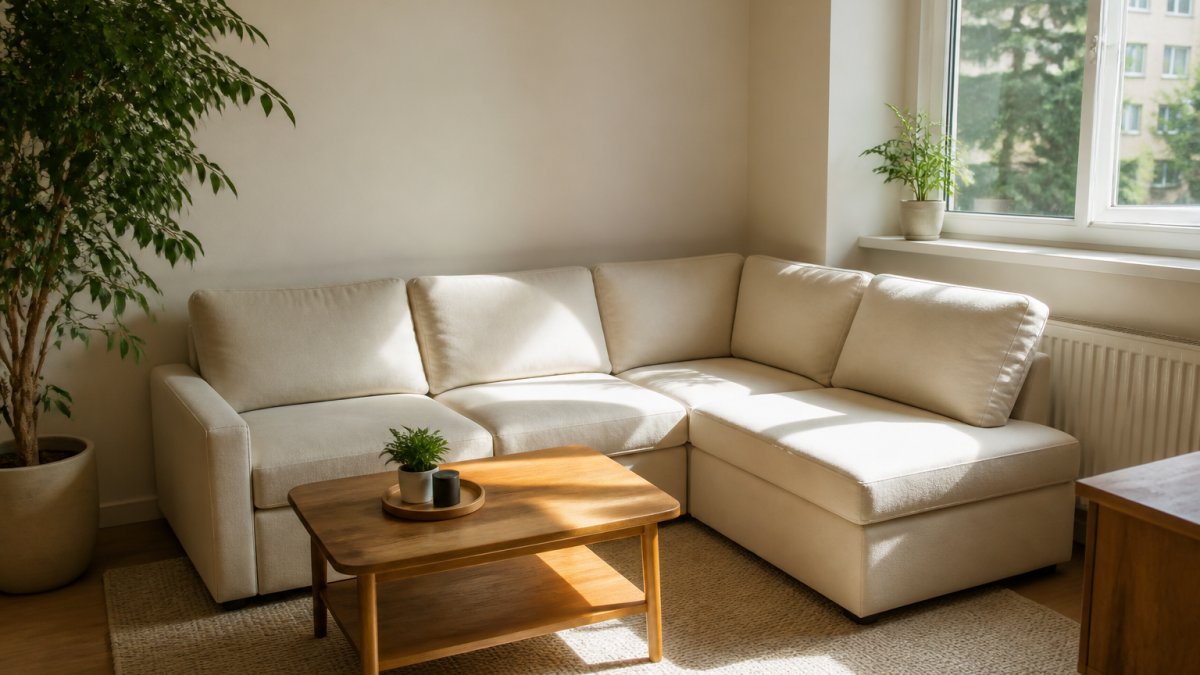
Start by measuring your living area and identifying natural anchor points: corners, walls opposite windows, or walls flanking a doorway. Position your modular sofa along the longest wall or in a corner, with modules connected but not permanently fixed.
Place your coffee table within arm's reach of the sofa, roughly 40-50 centimetres away, but keep it small. A side table (60 by 60 centimetres or smaller) works better than a sprawling coffee table in tight spaces.
Use vertical space to compensate for limited floor area. Wall-mounted shelves, floating storage, and tall narrow bookcases draw the eye upward and create the illusion of more space.
Lighting placement affects how spacious a room feels. Position floor lamps beside the sofa rather than in corners, and use table lamps on side tables to create pockets of light.
If your apartment has a separate bedroom, resist the urge to fill your living room with extra seating. One modular sofa, a small chair or two, and a side table are enough.
Durability, Cleaning and Renter-Friendly Features
Modular sofas take more wear than fixed furniture because modules shift, connect, and disconnect repeatedly. Durability depends on frame construction, foam density, and fabric choice.
Removable covers are essential for renters and families. You'll spill things, coffee, wine, pet accidents happen. Covers that unzip and wash in a machine (or hand-wash without damage) keep your sofa looking fresh for years.
Check whether covers are available separately. If you damage a cover after the warranty expires, can you buy a replacement? Some manufacturers sell covers cheaply; others charge nearly as much as a new sofa. This detail matters for long-term value.
Fabric choice affects durability and cleaning. Microfibre resists staining and cleans easily but shows dust and wear visibly. Linen and cotton are breathable and look elegant but stain more readily.
Legs and connectors wear first in modular sofas. Plastic feet scratch floors and crack under weight. Metal legs last longer and look better. Connection systems should use metal brackets or sturdy plastic clips, not flimsy velcro or magnetic systems that fail after repeated use.
For renters, avoid sofas that require wall anchoring or permanent assembly. The best modular sofas for small apartments connect with simple clips or brackets that leave no marks and disassemble in minutes.
Which Modular Sofa Should You Choose?
| Sofa | Best For | Key Advantage | Trade-Off |
|---|---|---|---|
| Cozey Ciello Sofa | Compact apartments, flexible layouts | Removable covers, compact modules | Limited deep-seating comfort |
| Cozey Ciello Corner Sectional | Corner-based layouts | Efficient corner use, modular design | Requires corner space |
| HONBAY U-Shaped Modular Sectional | Budget-conscious buyers, larger spaces | Affordable entry price, good seating | U-shape demands more floor area |
| Joybird Holt | Tight rooms needing quality | Specifically designed for tight spaces | Limited information on Australian availability |
| Lovesac Sactional | Customisation priority, premium budgets | Highly reconfigurable, durable | Higher price point |
| Koala Torquay Sectional | Small-space buyers wanting two-section setup | Recommended for small spaces | Price varies by configuration |
| Koala Bangalow Sectional | Households wanting layout flexibility | Multiple layout options available | Limited specific dimension data |
| Albany Park Kova Sofa | Editorial picks, modular preference | Recognised quality, modular design | Limited Australian pricing confirmation |
| Sundays Get Together Modular Sofa | Comfort-first buyers, deeper seating | Extra-deep seating, sturdy design | Deeper profile uses more floor space |
Cozey Ciello Sofa wins for most small-apartment dwellers. Its compact modules fit through standard doorways, removable covers wash easily, and the connection system needs no tools. You're paying for practicality that survives moves and years of use. The trade-off is that it prioritises function over luxury, it's comfortable for sitting and lounging, not napping.
HONBAY U-Shaped Modular Sectional suits budget-conscious buyers who have the floor space for a U-shape. It offers excellent seating capacity at a lower price point than most alternatives. The downside: U-shapes don't work in every apartment layout, and they consume more floor area than L-shaped configurations.
Sundays Get Together Modular Sofa appeals to comfort-focused buyers willing to sacrifice some floor space for deeper seating. If your apartment is 4+ metres in one direction and you prioritise lounging over floor space, the extra depth pays off. For studios or very tight one-bedroom apartments, it's overkill.
Joybird Holt and Albany Park Kova Sofa are strong editorial picks but lack detailed Australian pricing and delivery information. Both are worth investigating if you prefer designer aesthetics and are willing to contact suppliers directly for local availability.
At The Family Nest, we prioritise sofas that move easily, assemble without specialists, and survive years of renter life.
Conclusion
The best modular sofas small apartments for your space depends on your layout, comfort priorities, and whether you're renting or own. Modular sofas for small apartments solve a real problem: they adapt to spaces that fixed furniture can't, and they move when you do.
Start by measuring your entry points and available floor space. Identify whether an L-shape or straight-line configuration suits your layout. Then prioritise removable covers and simple assembly, these features matter more than premium fabrics or trendy designs in compact living.
The Family Nest makes moving and settling into new spaces painless. Our curated selection includes sofas designed for real apartments, with free shipping, easy installation guides, and a 30-day return policy. When you find the right modular sofa, we handle the logistics so you can focus on making your space feel like home.
Frequently Asked Questions
What measurements should I take before buying a modular sofa for a small apartment?
Measure your doorways, hallways and stairwells first, modular sofas arrive in sections, but each piece must fit through your access points. Measure your room's length, width and ceiling height. Note the distance from walls to windows and radiators. Account for at least 60 centimetres of clearance in front of the sofa for comfortable seating. Check if you need the sofa to float in the room or sit against a wall, as this affects your available floor space and traffic flow through the apartment.
Are modular sofas easy to move when renting?
Yes, modularity is one of their key advantages for renters. Each section disassembles and moves independently, fitting through narrow doorways and tight staircases more easily than a traditional sofa. The Family Nest offers easy installation guides and free returns within 30 days if the sofa doesn't work in your space. Disassembly takes 30 to 60 minutes depending on the design. Many renters choose modular sofas specifically because they can reconfigure or relocate them without specialist help when moving apartments.
How many seats should a small apartment sofa have?
A two-seater or three-seater works best for most small apartments. Two-seaters typically measure 150-180 centimetres wide and provide enough seating without dominating the room. If you regularly host guests, a three-seater (180-210 centimetres) or an L-shaped configuration with a chaise adds flexibility without requiring a full sectional. Consider your household size and how often you entertain. A modular sofa lets you start small and add modules later as your needs change.
What is the difference between a modular sofa and a sectional?
A modular sofa consists of independent pieces that clip or connect together, allowing you to rearrange or reconfigure the layout. A sectional is typically one fixed unit with a permanent L-shape or U-shape. Modular sofas offer more flexibility for small spaces because you can adjust the configuration, move individual sections, and even use pieces separately. Sectionals are often bulkier and harder to move through doorways, making them less ideal for compact apartments or renters who may need to relocate.
Can I return a modular sofa if it doesn't fit my space?
The Family Nest offers a 30-day return policy and free returns, so you can order with confidence. If the sofa doesn't work with your layout or dimensions, you can send it back without losing money. Take accurate measurements before ordering and check the product dimensions carefully, most modular sofas list the width and depth of each module so you can plan your arrangement. If you're unsure whether a configuration will work, The Family Nest's team can help you verify fit before purchase.