

Table of Contents
- Start With a Budget Plan and Priority List
- Small Apartment Decorating Ideas on a Budget
- Small Living Room Ideas on a Budget
- Cheap Storage Ideas for Small Apartments
- Rental Apartment Decorating Ideas on a Budget
- Where to Save and Where to Spend
- Common Mistakes to Avoid When Decorating on a Budget
- Frequently Asked Questions
Last Updated: October 4, 2026
Start With a Budget Plan and Priority List
Decorating small apartments on a budget starts with one simple step: decide what matters most.
Most people fail at decorating on a budget because they try to fix everything simultaneously. They buy new furniture, paint walls, add lighting, and organize storage all in one month.
The smarter approach is to prioritise. Ask yourself: What do I see first when I walk in? What bothers me most right now? What will make the biggest visual impact?
Once you've identified your top three priorities, set a realistic total budget. Be honest about what you can spend. Then allocate roughly 40% to your first priority, 35% to your second, and 25% to your third.
Document your plan in writing. Take photos of your space from different angles. Measure your rooms carefully. Note the dimensions of doorways, windows, and walls.
Small Apartment Decorating Ideas on a Budget
Decorating small apartments on a budget requires strategy, not just spending less. The goal is maximum impact with minimum expense. Start by choosing multifunctional furniture, using vertical space, and letting light do the heavy lifting.
Choose Multifunctional Furniture First
Multifunctional furniture is the foundation of decorating small apartments on a budget. A storage ottoman serves as seating, a footrest, and hidden storage. A wall-mounted desk folds up when you're not using it. A bed with drawers underneath eliminates the need for a separate dresser.
When shopping, ask one question: Does this piece do more than one job? If it only sits there and looks pretty, it's taking up space you can't afford to waste.
The Family Nest offers a curated selection of stylish and practical home essentials, including space-saving furniture designed to elevate your living space. Easy installation with provided guides means you can set things up yourself.
Look for:
- Ottomans with hidden storage
- Nesting tables that stack when not needed
- Beds with built-in drawers
- Wall-mounted shelves that double as display space
- Sofa beds for guest rooms or studio apartments
Use Vertical Space and Wall Storage
Small apartments have limited floor space but plenty of wall space. Use it. Install floating shelves above your sofa, desk, or bed. Hang a pegboard for kitchen storage. Mount a narrow bookcase on the wall instead of taking up floor space with a tall unit.
Vertical storage does three things at once: it stores your belongings, it adds visual interest to bare walls, and it makes the room feel taller. A room that feels taller feels bigger.
Install shelves at eye level and above. Keep everyday items on middle shelves where you can reach them easily. Store seasonal or rarely-used items higher up. Heavy items go lower to prevent accidents.
Wall storage also lets you decorate as you go. Add plants, small art pieces, or decorative boxes to shelves. This costs very little but transforms how a room feels.
Small Living Room Ideas on a Budget
Your living room is the heart of your home. Make it count. The key is arranging furniture to create flow, using mirrors and light to expand the space visually, and choosing pieces that earn their place.
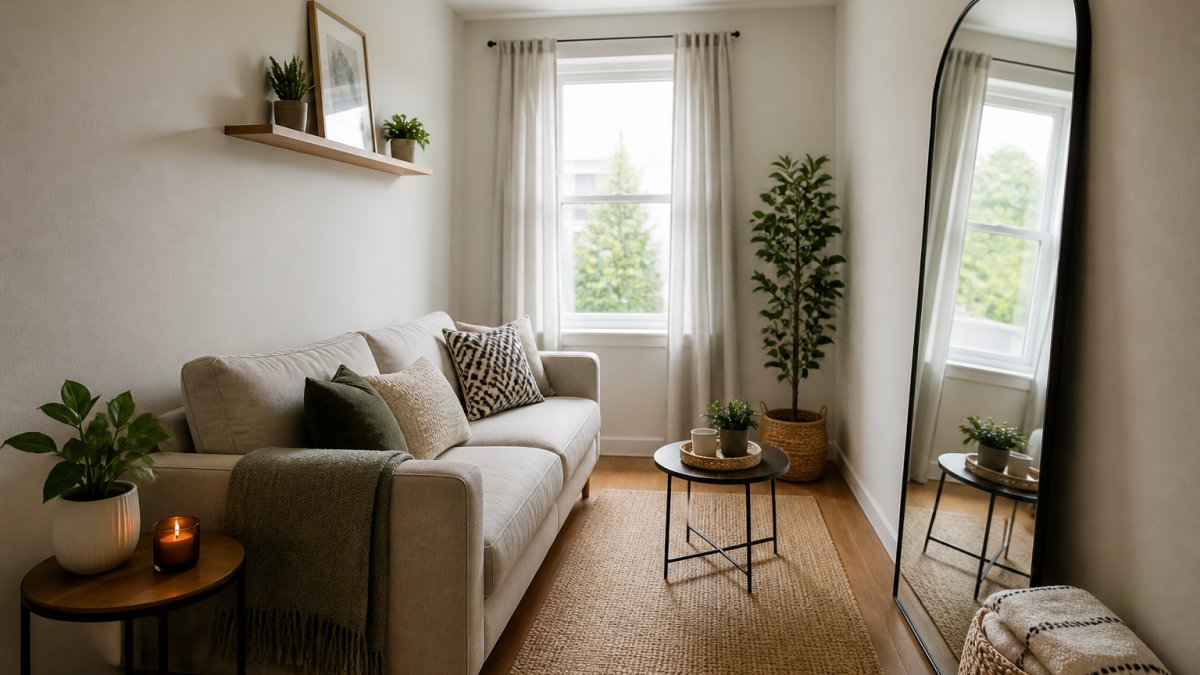
Arrange Furniture to Maximise Flow
Furniture placement determines how a small living room feels. Push furniture against walls to create an open centre. This makes the room feel bigger and easier to move through.
Create one focal point. This might be a window, a piece of art, or your television. Arrange seating to face this focal point. Everything else supports this main focus.
Leave a walking path from the door to the main seating area. This path should be at least 60 centimetres wide. If you have to squeeze past furniture to sit down, the room feels cramped even if it isn't.
Measure before you buy. Know the exact dimensions of your sofa, chair, and tables. Use painter's tape to mark out furniture placement on your floor before purchasing. This prevents expensive mistakes.
Add Light and Visual Space With Mirrors
Mirrors are the secret weapon of small-space decorating. A mirror reflects light and makes a room feel twice as big. Place a large mirror opposite a window to bounce natural light around the room.
You don't need an expensive mirror. A basic framed mirror from a homewares store works just as well as a designer version. What matters is size and placement.
Hang mirrors on walls that face windows or light sources. Lean a large mirror against a wall in a corner. Group smaller mirrors together on one wall to create visual interest.
Mirrors also reflect your furniture and decor, which makes the room feel fuller without adding clutter. This is especially useful in studio apartments where every square centimetre counts.
Lighting works alongside mirrors. Warm lighting (2700K colour temperature) feels cosy. Layered lighting, a mix of overhead lights, lamps, and accent lighting, makes a small room feel intentional rather than bare.
Cheap Storage Ideas for Small Apartments
Storage is the difference between a tidy small apartment and a chaotic one. You need smart storage solutions that don't eat up floor space.
Vertical storage dominates in small spaces. Wall-mounted shelves, pegboards, and hanging organisers cost less than furniture and take up no floor space.
Under-bed storage is invisible but essential. Flat storage boxes slide under beds and hold seasonal clothing, extra bedding, or items you use rarely.
Cube storage units stack vertically and hold more than they look like they should. Add fabric baskets to hide clutter while keeping items accessible. The baskets make the storage look intentional instead of messy.
Corner spaces are often wasted in small apartments. A corner shelf unit or a tall narrow cabinet fits perfectly and provides surprising storage capacity.
The Family Nest offers smart organization solutions designed to optimize your home storage. Easy installation with provided guides means you're not paying someone else to install your storage.
Key storage principles:
- Use vertical space before horizontal
- Keep frequently used items at arm's reach
- Store seasonal items out of sight
- Label everything so you find what you need
- Use clear containers so you see what's inside without opening them
Rental Apartment Decorating Ideas on a Budget
Renting means you can't paint walls or drill holes for permanent fixtures. This limits your options but doesn't stop you from creating a beautiful space.
Use Removable and Reversible Decor
Removable wallpaper sticks to walls and peels off cleanly without damaging paint. It costs less than paint and takes a few hours instead of days. When you move, you take it with you.
Temporary adhesive strips hold lightweight art, shelves, and mirrors without damaging walls. Test them on an inconspicuous spot first to make sure your walls can handle them. Most rental apartments have paint that works fine with adhesive strips.
Rugs define spaces without permanent changes. A large rug under your seating area anchors the room and makes it feel intentional. When you move, the rug comes with you.
Curtains and curtain rods can hang from tension rods that don't require drilling. They adjust to fit different window sizes and leave no marks when removed.
Furniture arrangement is your most powerful tool as a renter. You can't change the walls, but you can change how furniture sits in the room. This alone transforms how a space feels.
Avoid Permanent Changes
Never drill holes in walls unless you're prepared to repair them when you leave. Never paint without landlord permission. Never remove fixtures like light fixtures or cabinet doors.
Instead, work within the space you have. Use what's already there. Make the existing features work harder for you.
If your apartment has poor lighting, add lamps. If walls are bare, hang art with removable strips. If storage is limited, add vertical shelving with adhesive strips or tension rods.
The advantage of rental-friendly decorating is flexibility. When you move, you're not leaving behind expensive changes. Everything you've bought comes with you.
Where to Save and Where to Spend
Not every decorating decision costs the same. Some items are worth spending more on. Others are fine as budget versions.
- Furniture you'll keep for years (a good sofa, a quality bed frame, durable storage)
- Items you use daily (a comfortable chair, good lighting, a functional desk)
- Pieces that anchor the room (a large mirror, a statement rug, a focal-point piece of art)
Save money on:
- Decor that changes with trends (throw pillows, wall art, small accessories)
- Items you'll replace seasonally (plants, seasonal storage boxes, temporary organisers)
- Pieces that serve a single purpose (decorative objects, picture frames, small accent pieces)
The Family Nest offers a curated selection of stylish and practical home essentials. Free shipping and free returns mean you're not paying extra for convenience.
Budget for installation help only if you genuinely can't do it yourself. Most modern furniture comes with clear instructions and basic tools. If you can follow a recipe, you can assemble furniture.
Thrifted and secondhand furniture costs a fraction of new pieces. Check local marketplaces for quality items. A vintage side table costs a fraction of new pieces. Paint it if the colour doesn't match your space.
Common Mistakes to Avoid When Decorating on a Budget
Most budget decorating fails happen for the same reasons. Avoid these traps.
Buying before measuring. You measure once. You buy twice if you don't. Measure your space, your doorways, and your furniture. Write it down.
Choosing style over function. A beautiful chair that doesn't fit your lifestyle is just clutter.
Ignoring lighting. A room with poor lighting feels small and depressing no matter how nice the furniture is. Lighting is cheap.
Overcrowding the space. More furniture doesn't make a small apartment feel bigger. It makes it feel cramped. Leave empty space. Let the room breathe.
Buying everything at once. Decorating in stages lets you see what works before spending more. Buy your anchor pieces first.
Forgetting about vertical space. Small apartments have walls. Use them. Vertical storage and wall decor free up floor space and make rooms feel taller.
Skipping the plan. A budget without a plan is just a number. Write down your priorities. Stick to them.
Creating a beautiful home in a small apartment is possible without spending a fortune. Focus on what matters most, work within your budget, and remember that empty space is as valuable as filled space. Australian Consumer Law on returns and refunds protects your purchases, so shop with confidence.
Frequently Asked Questions
How do you decorate a small apartment on a budget without making it look cheap?
Focus on a few high-impact pieces rather than filling every surface. Choose one statement item (a rug, artwork, or accent chair) and build around it with neutral basics. Keep surfaces clear and organised, clutter reads as cheap far more than affordable furniture does. Invest in good lighting (warm lamps and natural light via mirrors) to elevate the entire space. Quality matters more than quantity, so buy fewer pieces that you genuinely like.
What are the best cheap storage ideas for small apartments?
Vertical storage is your best friend: wall-mounted shelves, pegboards, and tall narrow cabinets maximise space without eating floor area. Under-bed storage boxes, ottomans with hidden compartments, and stackable organisers keep clutter hidden. Multifunctional furniture like storage benches do double duty. For renters, removable wall shelves and freestanding units work well. The Family Nest offers space-saving designs.
Can you really make a small apartment feel larger on a low budget?
Yes. Mirrors reflect light and create visual depth at minimal cost. Keeping walls light-coloured (white, soft grey, pale pastels) opens up the space. Remove unnecessary items to reduce visual clutter. Arrange furniture to create clear pathways and open sightlines rather than cramping everything into corners. Layered lighting (overhead, lamps, natural light) adds dimension. These tactics cost little but transform how spacious a room feels.
Is it worth buying space-saving furniture if I'm renting?
Absolutely. Space-saving and multifunctional pieces are designed to be moved and reconfigured, making them ideal for renters. Look for items with easy disassembly, no permanent installation required, and compact footprints. The Family Nest provides clear installation guides and free returns, so you can test pieces risk-free.