

Table of Contents
- Why choose dining room lighting alternatives
- How to choose dining room lighting height and style
- Affordable dining room pendant lights that work
- Sculptural and statement lighting pieces for dining areas
- Flush mount and cordless options for smaller spaces
- Layering light: combining ambient, task, and accent lighting
- What to look for in quality dining room fixtures
- Frequently Asked Questions
Last Updated: September 28, 2026
Why choose dining room lighting alternatives
Finding the right dining room lighting alternatives doesn't mean you need to spend a fortune at premium retailers. Many homeowners discover that excellent alternatives to established luxury brands deliver the same aesthetic impact at a fraction of the cost. The key is understanding what makes a fixture work in your space, then matching that to options that fit your budget and style.
The difference between a dining room that feels warm and inviting versus one that feels flat often comes down to lighting choice. A well-selected fixture adds warmth and personality to the home while creating the right ambiance for everything from family dinners to entertaining guests.
The real question isn't whether alternatives exist, they do, abundantly. It's whether you know how to evaluate them. You need to consider height, style compatibility, installation requirements, and how the fixture layers with other light sources in the room. That's what separates a purchase you'll love for years from one you'll regret.
How to choose dining room lighting height and style
The height of your pendant or chandelier matters more than most people realise, but it's only one part of a larger technical equation. Too low and it blocks sightlines across the table. Too high and it fails to create the intimate ambiance a dining space demands. A common mistake is choosing based purely on aesthetics without measuring your ceiling height and understanding your home's electrical setup first.
For most dining rooms, a fixture should hang 75-90 centimetres above the table surface. This creates the right balance between visual presence and functional clearance. If your ceiling is lower than 240 centimetres, you'll want a flush mount or semi-flush option instead of a pendant that dangles. If your ceiling is exceptionally high (above 270 centimetres), a sculptural statement piece becomes an opportunity rather than a problem, the extra height gives dramatic fixtures room to shine without overwhelming the space.
Beyond height, check your ceiling's electrical capacity. Older homes may have limited wiring or junction boxes rated for lighter fixtures. A heavy brass chandelier requires proper support; a lightweight pendant or cordless option works in almost any space. If you're uncertain, consult a licensed electrician before ordering, it's a modest cost that prevents costly mistakes.
Bulb temperature dramatically affects dining ambiance. Warm white bulbs (2700 Kelvin) create a cosy, inviting feel ideal for family dinners and entertaining. Cool white (4000 Kelvin) feels clinical and is rarely appropriate for dining spaces. Always check whether your chosen fixture accepts standard bulb types (E27 or GU10 in most homes) or proprietary fittings that lock you into specific replacements. Dimmable bulbs (often labelled as compatible with dimmer switches) give you flexibility to adjust brightness for casual meals versus formal gatherings, but not all bulbs work with all dimmers, confirm compatibility before purchase.
Style compatibility matters equally. A mid-century modern fixture clashes with farmhouse décor. An ornate crystal chandelier looks out of place in a minimalist dining area. Before shopping, identify your room's design direction. Is it organic modern? Contemporary? Transitional? Your lighting should reinforce that aesthetic, not fight against it.
Budget also influences this decision. You can find affordable modern pendant lights that echo designer styles without the designer price tag. Alternatively, a sculptural statement piece in a bold finish might be your room's focal point, justifying a higher investment there while you keep other décor simpler.
Affordable dining room pendant lights that work
Pendant lights remain the most popular choice for dining rooms because they're versatile, relatively affordable, and work in almost any space. Unlike a large chandelier, a single pendant or pair of pendants feels less imposing in smaller rooms whilst still providing adequate task lighting and visual interest.
When evaluating affordable options, look for these markers of quality: solid construction (not flimsy), durable finishes that won't chip or tarnish within months, and bulbs that deliver warm colour temperature (around 2700 Kelvin creates that cosy, inviting feel). Many budget-friendly pendants now offer dimmable options, which dramatically improves functionality. You can adjust brightness for casual dinners versus entertaining.
The difference between a $50 pendant and a $150 one often comes down to material quality and finish durability. Cheaper options may use thin metal that dents easily or finishes that oxidise quickly. Mid-range pendants typically offer better longevity without the luxury price tag.
Sculptural and statement lighting pieces for dining areas
If your dining room needs a focal point, a sculptural or statement lighting piece can deliver that impact. These aren't just functional, they're conversation starters. An organic modern chandelier with asymmetrical arms, a sculptural table lamp in sage green, or a ring-shaped pendant in brushed brass becomes part of your interior décor strategy.
Statement pieces work best when the rest of your dining room is relatively restrained. If your table, chairs, and wall colour are already busy, a bold fixture competes rather than complements. But in a minimalist or neutral dining space, a sculptural fixture elevates the entire room's aesthetic.
The key with statement pieces is choosing something you genuinely love, not something trendy that will feel dated in two years. Sculptural lighting typically stays relevant longer than trend-driven styles because the focus is on form and material rather than passing fashion.
Flush mount and cordless options for smaller spaces
Not every dining room has room for a pendant that hangs 75-90 centimetres below the ceiling. Smaller spaces, lower ceilings, or open-plan layouts often call for flush mount fixtures that sit closer to the ceiling, or cordless accent lighting that offers flexibility without installation commitment.
Flush mount fixtures mount directly to the ceiling, taking up minimal vertical space. They're ideal for rooms under 240 centimetres in ceiling height or spaces where you need clearance for other reasons. Modern flush mounts come in sculptural designs that don't sacrifice aesthetics for practicality. You can find options in minimalist styles, organic modern finishes, and even statement-making designs.
Cordless lighting has transformed how renters and those in temporary spaces approach dining room ambiance. A high-quality cordless pendant or accent lamp can sit on a sideboard, hang from a hook, or rest on a shelf, delivering ambient or accent light without any installation. This matters if you're renting or if you simply want flexibility to change your setup without calling an electrician.
The Family Nest offers ambient lighting options that work beautifully in dining spaces. These pieces prioritise easy installation, or in the case of cordless fixtures, zero installation, alongside aesthetic impact. For renters especially, this approach solves the problem of creating a polished dining space without leaving holes in the ceiling when you move.
When choosing between flush mount and cordless, consider permanence. A flush mount is a longer-term commitment that requires installation. Cordless options are perfect for testing a style before committing, or for spaces where you want maximum flexibility.
Layering light: combining ambient, task, and accent lighting
The best-designed dining rooms don't rely on a single light source. Layering light, combining ambient, task, and accent lighting, creates depth, warmth, and flexibility. Your main fixture provides task lighting for the table. Ambient lighting (perhaps a dimmed overhead fixture or wall sconces) sets the overall mood. Accent lighting highlights architectural features or décor.
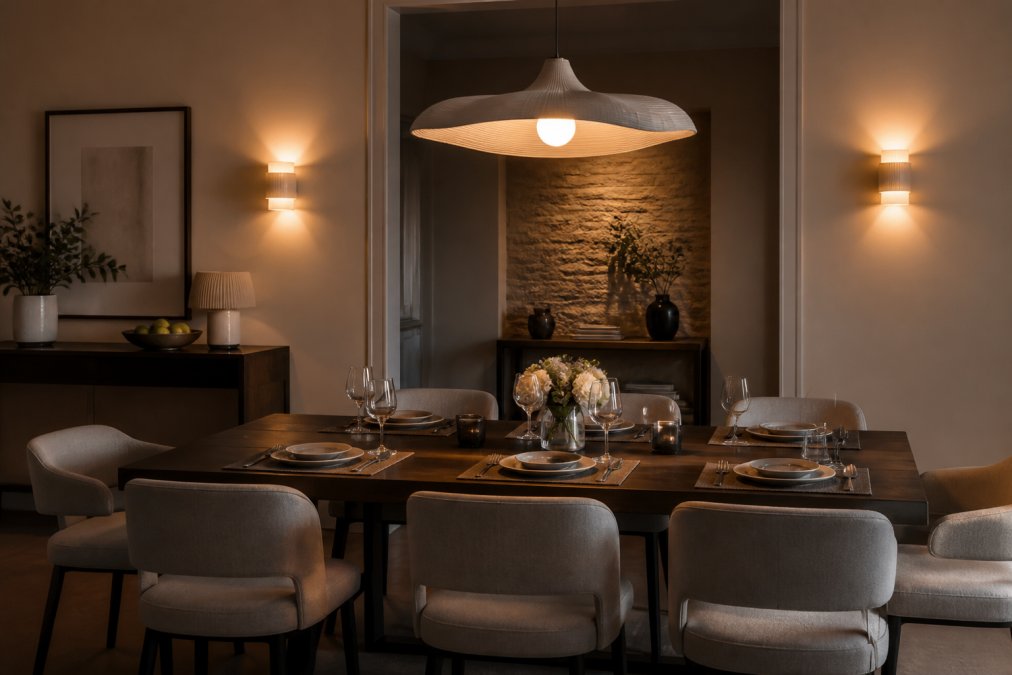
This approach transforms your dining space from functional to genuinely inviting. A pendant alone can feel harsh if it's your only light source. Add a dimmed ambient layer and suddenly the room feels sophisticated and flexible, bright enough for eating, soft enough for entertaining.
Pendant lights work best as task lighting, focusing brightness on the table surface. Wall sconces or a secondary flush mount provide ambient light. Accent lighting might be a picture light above artwork, LED strip lighting behind floating shelves, or a sculptural table lamp on a sideboard.
The dimmable feature becomes essential when layering light. You want to adjust brightness based on the time of day and the occasion. A dinner party calls for different lighting than a quick family meal. Dimmable fixtures give you that control.
When selecting alternatives to premium brands, ensure each layer works together stylistically. A mid-century modern pendant pairs well with matching wall sconces. A contemporary sculptural piece might be offset by minimalist ambient lighting. Cohesion matters more than each individual fixture being expensive.
What to look for in quality dining room fixtures
Quality in lighting fixtures comes down to measurable factors that extend beyond price. First, construction: solid metal (not hollow or flimsy), joints that feel secure, and finishes applied evenly without drips or inconsistencies. Second, electrical components: reliable wiring, secure connections, and bulbs that fit standard sockets so you're not locked into proprietary replacements.
Third, design longevity. Trends in lighting shift quickly, but well-designed fixtures in classic styles remain relevant. Organic modern, mid-century modern, and minimalist designs age better than overly trendy pieces.
Frequently Asked Questions
What is the rule of thumb for lighting height over a dining table?
Mount pendant lights or chandeliers 75-90 centimetres above your dining table surface. This height provides balanced ambient lighting without blocking sightlines across the table. Adjust based on ceiling height: higher ceilings allow fixtures to hang lower proportionally. Measure from the table surface upward, not from the floor, to ensure proper positioning regardless of room dimensions.
What colour temperature is best for a dining room?
Choose warm white light between 2700K and 3000K for dining spaces. This kelvin range creates an inviting, intimate atmosphere that flatters food and encourages conversation. Dimmable fixtures let you adjust intensity for different occasions, brighter for entertaining, softer for relaxed meals. Avoid cool white (4000K+) which can feel clinical and unflattering in dining areas.
Are affordable dining room pendant lights durable enough for daily use?
Quality matters more than price. Budget-friendly alternatives last years when made from solid materials like metal or ceramic with reliable electrical components. Check product reviews for real-world durability reports. The Family Nest offers 30-day returns and free shipping, so you can test fixtures risk-free. Avoid extremely cheap options with thin materials or unclear electrical specs, invest slightly more for longevity.
Can I install dining room lighting myself, or do I need an electrician?
Most pendant lights and flush mounts are straightforward DIY installations if your existing fixture has a compatible electrical box. The Family Nest provides installation guides with every purchase. However, if you're rewiring, adding new circuits, or unsure about electrical safety, hire a licensed electrician. Never attempt work beyond your skill level, safety comes first, and professional installation often costs less than fixing mistakes.