

Table of Contents
- Why Easy to Assemble Furniture Matters for Renters
- Understanding Renter-Friendly Furniture Australia
- Flat Pack Furniture Australia: What Makes It Easy to Assemble
- Modular Furniture Australia: Space-Saving Solutions for Renters
- Step-by-Step Assembly Tips for Easy Furniture Setup
- Furniture Rental Australia: An Alternative to Buying
- When to Hire a Professional Assembly Service
- Building Your Renter-Proof Furniture Collection
Last Updated: July 26, 2026
Why Easy to Assemble Furniture Matters for Renters
For renters in Australia, easy to assemble furniture solves a fundamental problem: you need pieces that are lightweight, portable, and designed to disassemble cleanly when you move. At The Family Nest, we understand that renters need furniture that adapts to changing circumstances without creating stress or damage during relocation.
Modern easy-to-assemble pieces combine genuine durability with portability, they assemble without specialist tools, disassemble without damage, and are light enough for one or two people to handle.
Understanding Renter-Friendly Furniture Australia
Renter-friendly furniture means pieces designed for temporary occupation. The defining feature is reversibility: you should assemble it, use it for two to five years, then disassemble it without structural damage to the piece or your rental property. This rules out furniture requiring permanent wall anchors, leaving mounting holes, or relying on adhesives.
Australian renters face unique constraints. Rental properties tend toward smaller spaces, studios and one-bedroom apartments dominate major cities. Renter-friendly furniture must be space-conscious, with pieces serving multiple functions, folding away, or stacking neatly.
Damage-free disassembly for moving
Damage-free disassembly is the hidden test of whether furniture is truly renter-friendly. Many pieces assemble easily but fall apart during disassembly, with stripped screws, bent dowels, or cracked panels making them unusable after the first move.
The best renter furniture uses fastening systems designed for multiple assembly-disassembly cycles. Click-lock mechanisms excel here because they don't wear out. Cam locks, the rotating metal fittings used in quality flat-pack furniture, also perform well. Standard wood screws degrade with each removal, after three or four moves, screw holes strip and joints become loose.
When preparing to move, disassemble from top to bottom: remove shelves before the frame, disconnect drawers before the base. Keep all hardware in a labelled bag. Taking 30 minutes to disassemble correctly prevents replacement costs that dwarf the original furniture price.
Portability and weight considerations
Weight matters more for renters than homeowners. A 40-kilogram bookshelf is fine if you're staying put; it's a nightmare if you're moving every three years. Renter-friendly furniture typically weighs under 30 kilograms per piece, light enough for two people to handle without equipment, but heavy enough to feel stable and durable.
A modular sofa breaking into three sections is infinitely more portable than a single large frame. A desk with detachable legs takes up half the space in a moving van. Quality renter-friendly furniture achieves lightness through smart design: cross-bracing providing rigidity without bulk, engineered wood stronger than solid timber at half the weight, and joinery distributing load across multiple points.
Flat Pack Furniture Australia: What Makes It Easy to Assemble
Flat-pack furniture dominates the renter market in Australia because it solves the portability problem. It ships in compact boxes, taking minimal space in moving vans, and assembly is standardised and documented, reducing mistakes.
IKEA popularised flat-pack in Australia and remains the largest player, but Australian brands like Castlery and The Family Nest now offer flat-pack options that compete on quality and design. The market has matured enough that "flat-pack" no longer signals "cheap", it signals "designed for modern living."
Click-lock systems and Allen key assembly
The most common assembly systems in modern flat-pack furniture are click-lock mechanisms and Allen key fasteners. Click-lock systems use interlocking plastic or metal connectors that snap together without tools. A shelf slides into a groove, twists, and locks in place. These systems are fast and reversible, after five moves, a click-lock joint is as solid as it was on day one.
Allen key assembly uses small hexagonal wrenches to tighten bolts and screws. This system is slightly stronger for heavy-duty applications but slower to assemble and disassemble. Repeated tightening and loosening can wear bolt holes, particularly in engineered wood.
The best flat-pack furniture uses a hybrid approach: click-lock for structural connections and Allen keys for fine-tuning and weight-bearing joints.
Tool-free furniture recommendations
Tool-free furniture takes click-lock simplicity further: no tools required at all. Some pieces use press-fit connections where components simply push together. Others use cam locks that twist by hand. Assembly becomes a five-minute task rather than a 45-minute project.
The trade-off is that tool-free systems work best for lighter furniture. A tool-free bookshelf works fine for books and decorative items. A tool-free bed frame is less ideal for significant weight and movement. Tool-free systems also tend to be more expensive because the engineering required to achieve strength without fasteners is more complex.
The Family Nest offers several tool-free pieces designed specifically for renters. Their modular shelving uses click-lock connectors requiring no tools. Their lightweight side tables use press-fit legs.
Modular Furniture Australia: Space-Saving Solutions for Renters
Modular furniture is built on a simple principle: components connect to create larger pieces and disconnect to adapt to different spaces. A modular sofa might form an L-shape in one apartment and separate into individual seats in the next.
For renters, modularity solves two problems simultaneously. First, it maximises flexibility, your furniture adapts to the space rather than forcing you to adapt your space. Second, it improves portability. Three separate sofa sections move more easily than one large frame.
The best modular furniture combines flexibility with durability. Pieces should connect and disconnect dozens of times without loosening. Connectors should be simple enough that you don't need a manual to understand them. Individual modules should be light enough that one person can move them alone.
The Family Nest's modular range includes shelving systems, seating, and storage solutions designed around this principle. Their modular shelves use click-lock connectors that work the same way each time. Their modular seating uses universal connection points so you can configure different layouts without needing specific pieces.
Step-by-Step Assembly Tips for Easy Furniture Setup
Even easy-to-assemble furniture requires a process. Following these steps dramatically reduces assembly time and prevents mistakes that damage the piece or your rental property.
Preparing your workspace
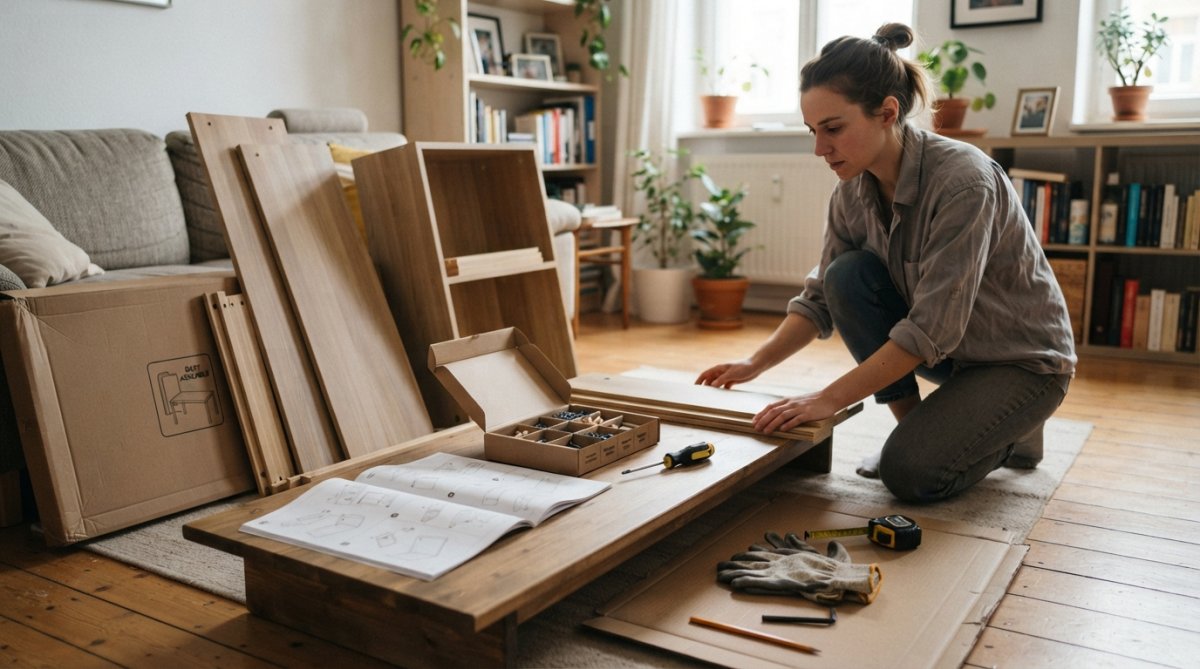
Clear a space large enough to lay out all components. A living room floor works better than a bedroom. Lay down a protective cloth or cardboard if concerned about scratching floors. This is particularly important in rental properties where you want to avoid damage affecting your bond return.
Organise all hardware before you start. Empty bags of screws, bolts, and connectors onto a small tray. Read the instruction manual completely before you start. This reveals if any steps are confusing, if you're missing components, or if the assembly order differs from what you assumed.
Tools you'll actually need
Most flat-pack furniture requires only an Allen key (usually included) and a screwdriver. Some pieces need nothing at all.
For standard flat-pack assembly, you need:
- The Allen key provided in the box
- A Phillips head screwdriver (medium size)
- A rubber mallet (optional, for pressing components together)
- A spirit level (optional, for checking that shelves are straight)
Avoid power tools, they're overkill and increase the risk of over-tightening fasteners and stripping holes. A hand screwdriver gives you better control and feedback about when a screw is properly tightened.
Following instruction manuals effectively
Instruction manuals for flat-pack furniture now use clear diagrams with numbered steps rather than text descriptions. Read each step completely before executing it. Pay attention to the order of assembly, there's usually a reason why steps are sequenced the way they are.
If you're confused by a step, look for alternative resources. Many furniture manufacturers now provide video assembly guides on their websites. The Family Nest includes QR codes in their instruction manuals linking to video guides for their most complex pieces.
Mark your progress as you go. Cross off completed steps or move fasteners from one container to another as you use them. This prevents confusion about whether you've already attached a particular component.
Common mistakes to avoid
The most common assembly mistake is over-tightening fasteners. A screw that's "tight enough" differs from a screw that's "as tight as possible." Over-tightening strips the hole, particularly in engineered wood.
The second common mistake is assembling components in the wrong order. Reading the manual completely before starting prevents this. Before you start, count all the screws, bolts, and connectors in the box and compare to the manual's parts list.
Before you fully tighten the final fasteners, use a spirit level to check that the piece is square and level. Work carefully and deliberately on protective cloth to avoid scratching floors or marking walls.
Furniture Rental Australia: An Alternative to Buying
For some renters, buying furniture, even easy-to-assemble pieces, feels like a commitment they're not ready to make. Furniture rental services offer an alternative. You lease pieces for a fixed period, and the rental company handles delivery, assembly, and removal.
Furniture rental makes sense if you're relocating temporarily, working on a contract, studying for a year, or in a transitional life phase. The trade-off is cost. Renting furniture over three years typically costs more than buying equivalent pieces. A rented sofa might cost $150 per month, totalling $5,400 over three years. Buying a comparable easy-to-assemble sofa costs $1,500-$2,500 upfront. After three years, you own the sofa. With rental, you own nothing.
For most renters, buying easy-to-assemble furniture is more economical than renting. The pieces are affordable, they move with you, and they're genuinely designed for rental situations. Rental makes sense only if your rental situation is genuinely temporary, less than two years.
When to Hire a Professional Assembly Service
Some renters prefer to outsource assembly entirely. Professional assembly services send a technician to your rental property to handle the entire assembly process. This eliminates the time investment and the risk of mistakes.
Professional assembly services are worth considering if you have mobility issues, are assembling multiple large pieces, are uncomfortable with DIY assembly, or need furniture assembled quickly in a new rental.
Cost of professional assembly and call-out fees
Call-out fees vary by location and service provider. In major Australian cities, Sydney, Melbourne, Brisbane, expect $60-$100 for the initial call-out. Some services waive the call-out fee if you're assembling multiple pieces. Hourly rates for assembly technicians range from $50-$80 depending on experience and location.
The total cost for assembling a full bedroom (bed, wardrobes, drawers, nightstands) typically ranges from $300-$500. For comparison, the furniture itself might cost $1,500-$3,000. Assembly adds 10-20% to the total cost. Some retailers offer assembly as part of delivery. The Family Nest includes assembly guides and video tutorials with all their flat-pack pieces and partners with local assembly services for customers who want professional help.
Quality and structural integrity assurance
Professional assembly services provide a guarantee that the piece is assembled correctly and safely. A professional assembler checks that all fasteners are properly tightened, that the piece is level and square, and that it's stable before leaving. They know common assembly mistakes and how to avoid them.
For renters, this assurance is valuable. If your bed frame is assembled incorrectly and fails, you're liable for the damage and replacement. Professional assembly shifts that risk to the service provider. Most professional services guarantee their work, if something fails due to improper assembly, they'll fix it for free.
Building Your Renter-Proof Furniture Collection
The goal isn't to buy one perfect piece of furniture. It's to build a collection of pieces that work together, adapt to different spaces, and survive multiple moves.
Start with essentials: a bed, somewhere to sit, somewhere to eat, and storage. These four categories cover 80% of your needs. Choose pieces that work across multiple spaces. A simple bed frame in a neutral colour works in any bedroom. A modular sofa works in a living room, studio, or even a bedroom if space is tight. Neutral colours, greys, blacks, whites, natural wood, work with different decor styles and rental property aesthetics.
Invest in quality for pieces you use daily. Your bed matters more than your side table. Your sofa matters more than a decorative shelf.
Durable, cost-effective pieces that last
Durability and cost-effectiveness aren't contradictory. A $500 sofa lasting five years costs $100 per year. A $300 sofa needing replacement every two years costs $150 per year.
Look for pieces made from engineered wood rather than particle board. Engineered wood is stronger and more stable, and it disassembles and reassembles without degradation. Check the joinery. Pieces with dowel joints (wooden pegs connecting two pieces) are more durable than pieces with pocket holes. Dowel joints are also more reversible, they can be disassembled dozens of times without losing strength.
Look for metal hardware rather than plastic. A metal corner bracket lasts indefinitely. A plastic connector might crack after a few assembly cycles. The Family Nest focuses on durable, cost-effective pieces. Their bed frames use dowel joinery with metal connectors. Their shelving uses reinforced plastic click-lock connectors designed for repeated use. Their sofas use hardwood frames with quality upholstery.
Multi-functional furniture for small apartments
Small apartments demand multi-functional furniture. A bed with built-in storage eliminates the need for a separate dresser. A sofa that converts to a bed serves double duty. A dining table that folds down when not in use saves space.
Multi-functional furniture is particularly valuable in rental apartments where you can't modify the space itself. The best multi-functional pieces are subtle about their secondary function. A storage bed doesn't look like a storage bed, it looks like a normal bed with drawers underneath.
Modular furniture is inherently multi-functional. A modular sofa can be an L-shape in a large space and a single seat in a small space. A modular shelving system can be a tall bookcase or a low storage bench. This flexibility is what makes modular furniture so valuable for renters who move between different-sized apartments.
Building an easy to assemble furniture collection for renters doesn't require settling for cheap or temporary-feeling pieces. The market now offers genuinely durable, stylish furniture designed specifically for rental situations. The Family Nest leads this market with pieces that combine smart design, quality materials, and thoughtful assembly systems. Their modular ranges, tool-free options, and durable construction mean your furniture works as hard as you do, moving with you, adapting to different spaces, and maintaining its value across multiple relocations. Start with essentials, choose pieces that work across different spaces, and invest in quality where it matters most. Your rental home will feel less temporary and more genuinely yours.
Australian Consumer Law guide to furniture purchases and returns
Sustainability Victoria resource on extending furniture lifespan
Australian Furniture Council standards for flat-pack assembly safety
| Furniture Type | Assembly Time | Tools Required | Portability | Best For |
|---|---|---|---|---|
| Click-lock modular | 20-40 minutes | None | High | Renters moving frequently |
| Allen key flat-pack | 45-90 minutes | Allen key + screwdriver | High | All renters |
| Tool-free pieces | 10-20 minutes | None | Very high | Quick moves, small spaces |
| Professional assembly | 0 minutes (service provider) | N/A | High | Time-constrained renters |
Frequently Asked Questions
Is flat pack furniture good for renters in Australia?
Yes. Flat pack furniture is ideal for renters because it's designed to disassemble and reassemble without damage, making it easy to move between properties. Look for pieces with click-lock systems and sturdy construction. The portability and space-saving design of modular furniture make it particularly suited to rental living, where flexibility and damage-free relocation are essential concerns.
Can I really assemble easy to assemble furniture myself without being handy?
Most easy to assemble furniture is designed for DIY setup. Clear instruction manuals, pre-drilled holes, and simple tools (often just an Allen key) make assembly straightforward. Start by preparing a clean workspace, laying out all parts, and reading the manual fully before beginning. If you're uncertain, professional assembly services are available in Australia, though they do incur additional call-out fees.
What tools do I need to assemble renter-friendly furniture?
Most flat-pack and modular furniture requires minimal tools: an Allen key (usually supplied), a screwdriver, and a rubber mallet. Some tool-free furniture options eliminate even these requirements. Always check the instruction manual for your specific piece. Having a clear workspace and a checklist prevents lost parts and assembly errors.
How do I disassemble furniture without damage when moving rentals?
Document assembly by photographing steps as you build, or save instruction manuals. Disassemble in reverse order, keeping hardware in labelled bags. Use padding around edges to prevent marks. Modular and flat-pack designs are engineered for repeated disassembly, so take your time and avoid forcing joints. Professional removalists in Australia can also disassemble and reassemble furniture if you prefer expert handling.
This article was written using GrandRanker