

Table of Contents
- Why Family Life Destroys the Wrong Upholstery Fabric
- How to Identify Sofa Fabric Before You Buy
- Upholstery Fabric Durability Ratings Explained
- Easy-Clean Upholstery Fabric for Kids and Pets
- The Most Durable Sofa Fabric for Families
- Durability Beyond the Fabric: Frames, Cushions and Repairability
- Conclusion: Choosing Fabric That Survives Your Household
- Frequently Asked Questions
Last Updated: October 14, 2026
Why Family Life Destroys the Wrong Upholstery Fabric
A family sofa is a battlefield: juice spills before breakfast, muddy paws after the school run, and a fortnight of Lego-building on the same two cushions.
That is why how to spot durable furniture fabrics for families matters more than almost any other buying decision in the home. The wrong fabric looks tired within a year; the right one still looks good when the kids have moved out.
You do not need to guess, fabric tells you how it will age, if you know where to look.
How to Identify Sofa Fabric Before You Buy
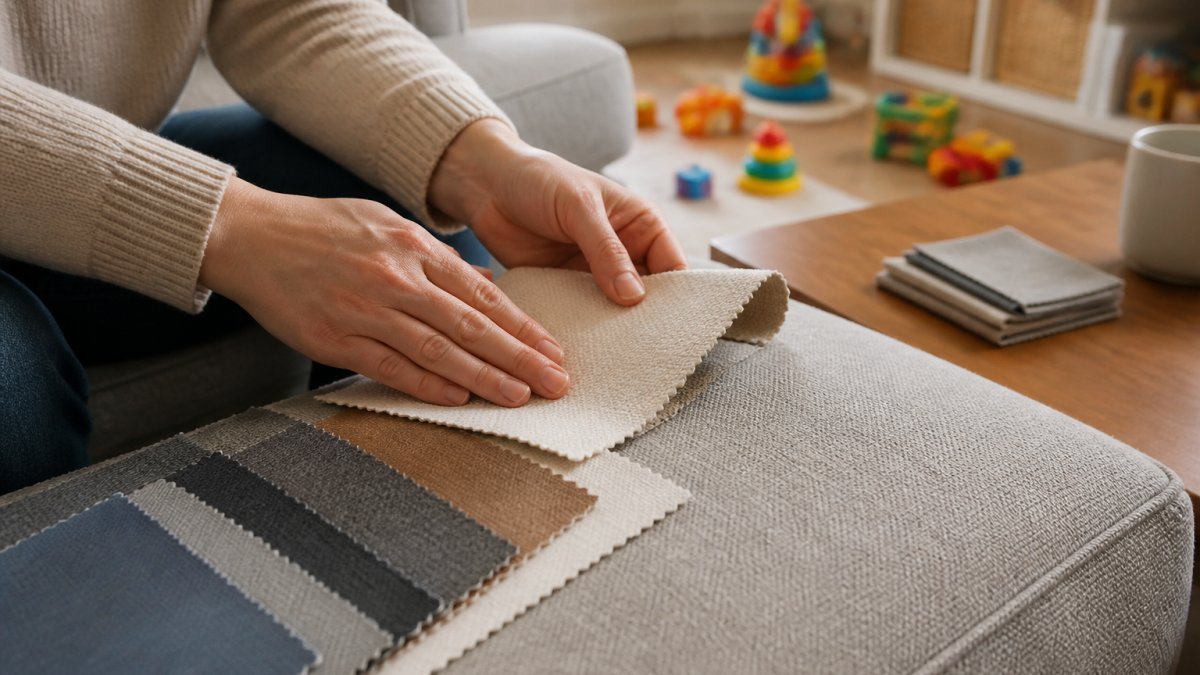
You can identify a sofa fabric by checking three things: the label code, the weave tightness, and how the surface responds to water and rubbing. Most shoppers only read the swing tag name, which tells you almost nothing.
Reading the Label and Asking the Right Questions
Swing tags often say "linen blend" or "premium weave" without numbers. Ask for fibre content as a percentage: "60% polyester, 40% cotton" tells you far more than "soft touch."
Ask these questions before you commit:
- What is the exact fibre mix, by percentage?
- Is there a stain-resistant finish, and what is it called?
- Are the covers removable, and can they be washed?
A retailer who cannot answer these often just does not know, but you deserve better information before buying a sofa your family will use every day.
The Hands-On Inspection Checklist
Run this test in the showroom. It takes minutes and saves years of regret.
- Rub the fabric firmly with your thumb. If fibres lift or pill, it will not survive daily use.
- Scratch lightly with a fingernail. Snagging means loose weave, which catches on pet claws.
- Drip a few drops of water on the surface. If it beads, the finish is working. If it soaks straight in, expect stains.
Upholstery Fabric Durability Ratings Explained
Upholstery fabric durability ratings come from abrasion tests, which measure how many rubs a fabric survives before visible wear. Higher numbers mean better resistance to everyday friction, the most useful number on any fabric spec, but only if you know which test produced it.
Martindale and Wyzenbeek: The Two Tests Behind the Numbers
Most upholstery fabrics sold in Australia use one of two abrasion tests. They are not interchangeable, and the numbers do not mean the same thing.
- Martindale is the test you will see most often on residential and commercial upholstery in Australia. A circular motion rubs the fabric against a standard abrasive pad under a set load. The result is reported in Martindale cycles (sometimes called rubs).
- Wyzenbeek is more common on US-sourced fabrics. A cylinder wrapped in fabric is rubbed back and forth against an abrasive surface. The result is reported in double rubs, one back-and-forth motion counts as two rubs.
A Martindale figure and a Wyzenbeek figure for the same fabric will not match, because the machines, motions, and abrasives differ. Always compare Martindale with Martindale, and Wyzenbeek with Wyzenbeek.
What the Numbers Actually Mean for a Family Home
Use this as a rough guide for residential use.
| Rating band | Typical use | What it means for a family |
|---|---|---|
| Under 15,000 Martindale cycles / under 15,000 Wyzenbeek double rubs | Occasional or decorative use | Wears fast on daily seats. Fine for a spare-room chair. |
| 15,000-25,000 | Light residential | Struggles with kids, pets, and daily lounging. |
| 25,000-40,000 | General residential | A sensible floor for a main family sofa. |
| 40,000+ | Heavy residential and light commercial | The safest zone for busy family living rooms. |
Two things matter here. A high number does not fix a loose weave, abrasion resistance and weave tightness are separate properties. And abrasion is only one measure: stain resistance, colourfastness, and pilling resistance all affect how a fabric ages.
A fabric can pass abrasion testing and still fade badly in strong sunlight, so ask about light fastness if your sofa sits near a window.
How to Ask for Ratings Without Getting Fobbed Off
When a retailer quotes a number, ask three follow-up questions:
- Which test was used, Martindale or Wyzenbeek?
- Was the fabric tested as-is, or after a finish was applied?
- Is the rating for the fabric only, or for the finished upholstered piece?
A retailer who cannot answer these often just does not have the spec sheet to hand, but you deserve the numbers before buying a sofa your family will use every day.
Easy-Clean Upholstery Fabric for Kids and Pets
Easy-clean upholstery fabric for kids and pets shares three traits: a tight weave, a stain-resistant finish, and removable covers. With all three, spills become a five-minute job instead of a permanent mark.
Look for these features:
- Tight, flat weaves such as microfiber or a poly-blend. Dirt sits on the surface rather than sinking in.
- Stain-resistant finishes that make liquid bead up. Test this before you buy.
- Removable, washable covers for the seats your family uses most.
Microfiber resists stains well while feeling soft, but can crush and shine over time, rotate cushions to spread the wear. Velvet is the opposite: rich-looking, but it shows every handprint and is hard to clean once liquid soaks in.
The Most Durable Sofa Fabric for Families
The most durable sofa fabric for families is a tight-weave synthetic blend, usually polyester mixed with a small amount of natural fibre, finished with stain protection. It handles friction, resists spills, and costs less than pure natural options.
Natural fibres still have a place. Here is how they compare:
- Polyester and poly-blends: Strong, colourfast, and easy to clean. Best all-round choice for busy homes.
- Microfiber: Soft, stain-resistant, and hard-wearing. Watch for crushing in heavy-use spots.
- Cotton and organic cotton: Breathable and comfortable, but prone to staining and fading without a finish.
If comfort is your priority, a poly-cotton blend gives softness with better wear than pure cotton. If longevity is the goal, a high-rub polyester wins.
Durability Beyond the Fabric: Frames, Cushions and Repairability
Fabric is only part of the story. A sofa fails early because of a weak frame, tired cushions, or poor suspension far more often than the fabric itself, a tough fabric on a flimsy frame is still a flimsy sofa.
How to Inspect the Frame and Joints
Ask what the frame is made from, then test it in the showroom.
- Frame material. Kiln-dried hardwood and metal frames hold up better than softwood or particle board. Particle board can crumble at the joints under repeated load, especially in humid conditions.
- Joint construction. Dowelled, screwed, and glued joints outlast staples alone. A corner-blocked frame resists racking far better than one held together by staples.
- The lift test. Lift one front corner a few centimetres off the floor. A well-built frame will let the opposite corner lift at roughly the same time. If the frame twists or the opposite leg stays planted, the frame is flexing, a sign of weak joints.
Cushions, Suspension, and What Actually Wears Out First
Cushion and suspension quality determine how a sofa feels after two years, not two weeks.
- Cushion filling. High-resilience (HR) foam keeps its shape longer than low-density foam, which softens and loses loft within a year or two of daily use. Feather-and-down wraps feel luxurious but need regular fluffing and can flatten in high-use seats.
- Suspension. Webbing and springs should feel firm, not saggy, when you sit down. Sinuous (zig-zag) springs are common and serviceable; eight-way hand-tied springs are the traditional benchmark for longevity but cost more. Sit on the edge of the seat, if it collapses or you feel the frame through the cushion, the suspension is weak.
- Cushion cores. Removable, replaceable cushion cores extend a sofa's life by years. If the covers are removable but the foam is not replaceable, you have gained less than you think.
Repairability: The Long-Term Value Question
This is where long-term value shows up, and the question most buyers never ask.
- Removable covers. A sofa with replaceable covers can be refreshed instead of replaced. That matters for renters too, since covers travel better than whole sofas.
- Reupholstery potential. A solid frame can be reupholstered, but a stapled particle-board frame usually cannot justify the cost. Ask whether the frame is built to be reupholstered.
- Spare parts. Can you buy replacement cushions, covers, or legs separately? A sofa with available spare parts has a longer practical service life.
- Cleaning compatibility. Check the care label and any cleaning codes before you buy. Some finishes and stain-resistant treatments can be damaged by the wrong cleaning product, and using an unapproved product can affect your consumer guarantees under Australian Consumer Law. The ACCC publishes guidance on consumer guarantees that is worth reading before you commit.
Australian Competition and Consumer Commission guidance on consumer guarantees
We stock space-saving furniture and smart storage built for real family homes. Our pieces come with easy installation guides, free shipping and free returns, and a 30-day return policy. So if a fabric does not suit your space, sending it back is simple.
Conclusion: Choosing Fabric That Survives Your Household
Choosing a family sofa comes down to a few checks: a tight weave, a high abrasion rating, a stain-resistant finish, and covers you can remove and wash. Get those right and the fabric outlasts the trends.
The harder part is finding furniture that fits a real home, not a showroom.
Get started with The Family Nest and furnish a home that survives your family.
Frequently Asked Questions
How can you tell whether sofa fabric is durable?
Check the abrasion rating first, which measures how many rubs a fabric withstands before showing wear. For family homes, look for 15,000 rubs or higher on general use fabrics, and 30,000 or more for high-traffic lounges. Then test the weave by pressing your thumb into the fabric; a tight weave that resists snagging and pilling holds up better. Finally, confirm the care instructions allow spot cleaning, because durable furniture fabrics still need practical maintenance.
What is the easiest fabric to clean when you have children or pets?
Tightly woven synthetics such as polyester blends and microfiber are the easiest to clean. Their fibres resist absorbing liquids, so spills bead on the surface and wipe away before they soak in. Many performance fabrics also carry a stain-resistant finish that adds extra protection. Loose weaves, velvet and untreated linen are far harder to maintain because liquids sink in quickly and stains set within minutes. Always confirm the care label allows water-based spot cleaning.
Is tightly woven fabric more durable for family furniture?
Yes, generally. A tight weave distributes friction across more threads, which reduces snagging, pilling and thread pulls from claws, buckles and constant sitting. You can test weave density by holding the fabric up to light; if little passes through, the weave is tight. Combine that with a higher abrasion rating and you have a fabric that handles everyday wear far better than a loose, decorative weave.
How do I check furniture quality beyond the fabric?
Fabric is only part of the story. Ask about the frame material, since kiln-dried hardwood outlasts particleboard. Check whether cushion covers are removable and washable, and whether replacement covers can be ordered later. Lift one corner of the sofa; a solid frame feels heavy and does not flex or creak. These construction details often matter more than the fabric itself for long-term value.