

Table of Contents
- Is Flat Pack Furniture Good Quality? The Honest Answer
- Flat Pack Furniture Pros and Cons in Australia
- Materials Matter: Chipboard, MDF, and Solid Wood Explained
- Flat Pack Furniture Durability: What Really Determines Lifespan
- Best Flat Pack Furniture Brands in Australia
- How to Make Flat Pack Furniture Last Longer
- Lifecycle Cost Analysis: Is Flat Pack Worth the Investment?
- Environmental Impact and Sustainability of Flat Pack Furniture
Last Updated: July 29, 2026
Is Flat Pack Furniture Good Quality? The Honest Answer
Whether flat pack furniture offers good quality depends entirely on what you're buying and what you expect from it. The quality spectrum ranges from disposable to genuinely durable. A £50 particle board bookshelf will never perform like a £300 solid wood cabinet, but it also costs a quarter of the price. The key is matching your expectations to your budget and use case.
Flat pack items fail primarily due to poor hardware quality, inadequate edge banding, and weak fastening systems. Understanding what causes these failures helps you identify quality pieces before purchase and reinforce them after assembly to extend their lifespan significantly.
The Quality Spectrum: From Disposable to Investment-Grade
Budget flat pack pieces under £100 use basic chipboard with minimal hardware and thin veneers. These work well for temporary situations or rental spaces but show wobbling or sagging within 1-2 years of regular use.
Mid-range flat pack (£150-£400) uses MDF or higher-grade chipboard with better edge banding and improved hardware. These pieces can last 3-5 years with proper care and represent the sweet spot for most households.
Investment-grade flat pack (£300+) uses solid wood frames, quality cam-locks, and reinforced joinery. Many will last 7-10 years or longer. The Family Nest focuses on this segment, offering pieces designed for longevity rather than disposability.
Flat Pack Furniture Pros and Cons in Australia
Key Advantages for Australian Renters and Small Spaces
Flat pack furniture solves real problems for Australians. For renters, it offers flexibility that traditional furniture cannot match, you can disassemble and move pieces between properties without expensive movers or financial loss.
Space efficiency is another major advantage. Australian apartments tend to be compact, and flat pack's modular design allows customization for awkward layouts. A shelving unit can be adjusted to fit specific wall heights, or a storage bed can maximize floor space in a small bedroom.
Cost-effectiveness matters too. You can furnish an entire room for less than a single solid wood sofa. Assembly is straightforward for most people, pre-drilled holes, colour-coded hardware, and illustrated instructions mean you don't need advanced DIY skills.
Common Drawbacks and Durability Trade-offs
Particle board and chipboard are susceptible to moisture damage, sagging under weight, and deterioration over time. A spilled drink can swell and ruin a chipboard shelf.
Wobbliness is a real concern. Loose fasteners, missing cam-locks, or improper assembly result in unstable pieces. A wobbly desk is annoying; a wobbly bed frame is genuinely problematic.
Disassembly and reassembly damage pieces. Once assembled and taken apart for a move, structural integrity suffers. Cam-locks weaken, wood fibres compress, and fasteners may not tighten as securely.
Long-term value is poor for budget flat pack. An £80 bookshelf lasting two years costs £40 per year. A solid wood bookshelf costing £300 lasting 10 years costs £30 per year and retains resale value.
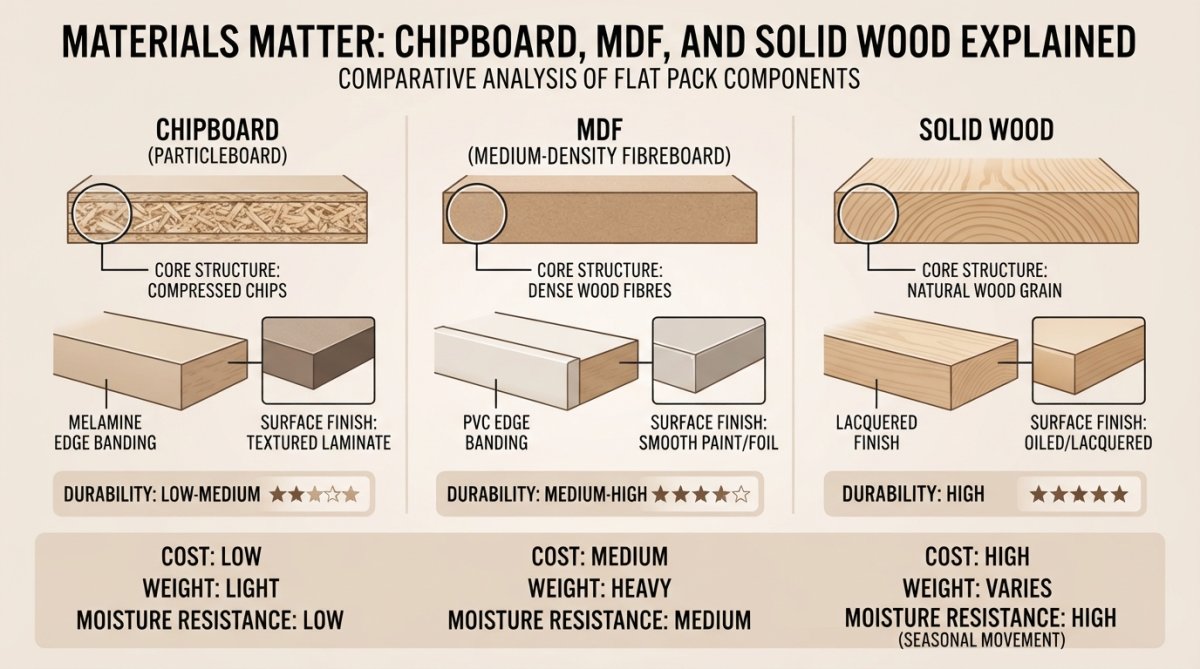
Materials Matter: Chipboard, MDF, and Solid Wood Explained
Particle Board and Chipboard: Budget-Friendly but Fragile
Particle board and chipboard are made from wood waste, sawdust, and shavings compressed with adhesive. They're cheap to manufacture and lightweight but lack durability.
Chipboard is porous and absorbs moisture readily, causing swelling and warping. Edge banding, the thin veneer on exposed edges, is critical for longevity. Without proper edge banding, the material absorbs moisture and deteriorates rapidly. Budget flat pack often uses thin or poor-quality edge banding that peels away after a few years.
Chipboard has poor screw-holding capacity because the material is soft and fibrous. Screws loosen over time, and cam-locks can strip out, leaving no way to tighten joints.
Chipboard is fine for temporary use, a storage box, display shelf for light items, or desk in a student flat. For permanent installations or heavy use, it's a poor choice.
MDF and Veneer: The Mid-Range Sweet Spot
Medium-density fibreboard (MDF) is denser and more stable than chipboard. It machines beautifully, holds fasteners better, and resists warping.
MDF is still vulnerable to moisture but quality edge banding and proper finishing significantly improve moisture resistance. Many mid-range pieces use MDF with solid wood edge banding, providing a durable, attractive finish.
Veneer, a thin layer of real wood glued to MDF or chipboard, adds durability and aesthetics. Real wood veneer resists damage better than paint or laminate and allows for grain patterns that look genuinely high-quality.
MDF with quality veneer and edge banding represents excellent value. A £200 MDF bookshelf will outlast an £80 chipboard shelf by years, justifying the premium.
Solid Wood Flat Pack: Premium Durability at Higher Cost
Solid wood flat pack is less common and more expensive than MDF alternatives. Solid wood is inherently durable, beautiful, and can last decades. It resists moisture better and can be repaired or refinished if damaged.
The drawbacks are weight, cost, and complexity. A solid wood bookshelf is heavy and awkward to move, defeating one of flat pack's main advantages. The price is significantly higher, a solid wood cabinet might cost £400-£600 compared to £150-£250 for a MDF equivalent.
Solid wood flat pack makes sense if you plan to keep furniture for 10+ years and want heirloom-quality pieces. For renters or temporary spaces, it's overkill.
Flat Pack Furniture Durability: What Really Determines Lifespan
Hardware Quality and Structural Integrity
Hardware, cam-locks, screws, dowels, and connecting plates, determines whether flat pack will last or fail. Budget flat pack uses cheap plastic cam-locks and low-grade screws that strip easily. Premium flat pack uses metal cam-locks, pre-threaded inserts, and quality fasteners that remain secure under stress.
Cam-locks are critical. A quality cam-lock is made from hardened plastic or metal, engages smoothly, and tightens securely without stripping wood fibre. Poor-quality cam-locks feel loose, don't tighten fully, and strip out after a few assembly cycles.
Structural integrity depends on whether joints are designed for intended load. Reinforcement, diagonal braces, corner blocks, and back panels, significantly improves stability. Budget flat pack often omits these features.
Why Flat Pack Furniture Fails: Common Failure Points
Loose fasteners are the most common failure. Cam-locks loosen over time due to vibration and material compression. Check and tighten all fasteners monthly for the first year, then quarterly thereafter.
Sagging shelves result from inadequate support or excessive load. Chipboard shelves sag because the material compresses under weight. Longer shelves require centre support at 60cm to prevent sag.
Warping happens when furniture is exposed to moisture or temperature extremes. Proper edge banding and finishing reduce but don't eliminate this risk.
Stripped cam-locks occur when plastic threads wear out or wood fibre compresses. Once stripped, the joint cannot be tightened. Using quality cam-locks and avoiding over-tightening reduces this risk.
Best Flat Pack Furniture Brands in Australia
Quality Indicators: What to Look for When Shopping
Identifying quality flat pack before purchase requires knowing what to examine. Check product descriptions for "solid wood frame," "quality MDF," or "hardwood edge banding." Avoid "particle board" or vague descriptions.
Hardware specifications matter. Look for metal cam-locks rather than plastic and pre-threaded inserts. Weight is a useful proxy for quality, heavier pieces generally use denser materials.
Assembly instructions reveal design quality. Detailed, professional instructions suggest careful design. Vague or poorly translated instructions suggest a budget producer.
Customer reviews on longevity are invaluable. Search for reviews mentioning durability over 2+ years of ownership. Weight limits and specifications should be clearly stated, if a manufacturer won't specify them, that's a red flag.
The Family Nest offers curated selections of flat pack furniture specifically chosen for durability and style. Each piece is selected based on material quality, hardware specifications, and customer longevity data. Free shipping and free returns within 30 days mean you can try pieces risk-free.
How to Make Flat Pack Furniture Last Longer
Assembly Best Practices for Maximum Stability
Proper assembly is the single most important factor in flat pack longevity. Read the entire assembly guide before beginning and lay out all hardware and components to ensure nothing is missing.
Use the right tools. A cordless drill with the correct bit size tightens fasteners evenly without stripping. Use the provided wrench to tighten cam-locks fully but not excessively.
Ensure the piece is level and square before final tightening. Tighten fasteners in a cross pattern rather than all on one side to ensure even pressure and prevent warping.
Double-check all fasteners before using the piece. Give each joint a firm push to ensure it doesn't move.
Maintenance, Repair, and Reinforcement Strategies
Regular maintenance prevents most flat pack failures. Monthly for the first year, then quarterly thereafter, check all fasteners and tighten any that have loosened.
Protect surfaces from moisture. Use coasters under drinks, wipe spills immediately, and avoid placing furniture in high-humidity areas. If a piece must be in a damp environment, apply waterproof finish.
Reinforce weak joints with additional hardware. A metal corner brace or angle support on the underside dramatically improves stability and extends lifespan.
If a cam-lock strips, replacement inserts are available. Drill out the damaged insert and install a larger one, this repair typically costs less than £5.
For sagging shelves, add centre support. A wooden dowel or metal rod underneath the shelf at the midpoint prevents sag and distributes weight evenly.
Lifecycle Cost Analysis: Is Flat Pack Worth the Investment?
The true cost of flat pack isn't the purchase price, it's the cost per year of ownership. A £50 bookshelf lasting two years costs £25 per year. A £200 bookshelf lasting 10 years costs £20 per year.
For renters, flat pack offers unmatched value. You can furnish an entire apartment for £500-£1,000 and leave it behind without financial loss.
For homeowners staying 5+ years, the calculation shifts. A solid wood bookshelf costing £400 lasting 15 years provides better long-term value than replacing a £150 MDF bookshelf every 5 years.
The sweet spot for most Australian households is mid-range MDF flat pack with quality hardware. Pieces in the £150-£350 range offer genuine durability, attractive finishes, and reasonable value, lasting 5-7 years with proper care.
| Furniture Type | Purchase Price | Expected Lifespan | Cost Per Year | Best For |
|---|---|---|---|---|
| Budget Chipboard | £50-£100 | 2 years | £25-£50 | Temporary use, student housing |
| Mid-Range MDF | £150-£350 | 5-7 years | £21-£70 | Renters, homeowners, general use |
| Quality Solid Wood | £300-£600 | 10-15 years | £20-£60 | Long-term investment, heirloom pieces |
Environmental Impact and Sustainability of Flat Pack Furniture
Flat pack has a complicated environmental profile. It uses less material and packaging than traditional furniture and is more efficient to transport, reducing carbon emissions. However, its short lifespan means it ends up in landfills far more quickly than durable alternatives.
Chipboard and MDF are made from wood waste and sawdust. Plastic hardware contributes to plastic waste, while quality flat pack uses metal hardware, which is recyclable and more durable.
The most environmentally responsible approach is buying durable flat pack that lasts as long as possible. A mid-range MDF piece kept for 7 years has lower environmental impact than a budget chipboard piece replaced every 2 years.
Is flat pack furniture good quality? The answer depends on what you buy and how you care for it. Budget pieces are disposable and should be treated as temporary solutions. Mid-range MDF flat pack with quality hardware offers genuine durability and excellent value for most households. Premium solid wood flat pack provides heirloom-quality pieces for long-term ownership.
The Family Nest specializes in curated mid-range flat pack furniture designed for durability and style. With free shipping, free returns within 30 days, and easy assembly guides, you can furnish your home confidently, knowing each piece is selected for quality and longevity. Explore the collection today and discover how thoughtfully chosen flat pack furniture can transform your space without breaking your budget.
Frequently Asked Questions
Is flat pack furniture good quality for long-term use?
Flat pack furniture quality varies significantly by brand, material, and price point. Budget options using chipboard may last 2-3 years with regular use, whilst mid-range MDF pieces often reach 5-7 years, and solid wood flat pack can last 10+ years. Quality depends on hardware durability, assembly precision, and maintenance. The key is matching the piece to your needs: renters benefit from modular, durable options; families need sturdy construction. Research specific brands and read customer reviews before purchasing.
What are the disadvantages of flat pack furniture?
Common drawbacks include wobbly or unstable construction if not assembled correctly, limited durability with budget materials like particle board, difficulty disassembling for moving, and time-consuming assembly. Cheaper flat pack pieces often have weak cam-locks and fasteners that loosen over time. Edge banding may peel, and structural integrity can suffer from moisture exposure. However, mid-range and premium flat pack options address many of these issues with better hardware and materials.
How can I make flat pack furniture last longer?
Follow assembly instructions carefully, use all provided hardware, and don't skip pre-drilled holes or fasteners. Ensure pieces are level and stable before loading with weight. Reinforce weak joints with metal brackets or wood glue if needed. Keep furniture away from moisture and direct sunlight to prevent warping and edge banding peeling. Tighten fasteners every 6-12 months, and avoid overloading shelves. For renters, choose modular designs that disassemble easily without damage, allowing reuse across multiple homes.
Are there any flat pack furniture brands with proven durability in Australia?
Quality varies by brand and product line. Look for manufacturers offering solid wood or high-grade MDF construction, metal hardware (not plastic cam-locks), and thick edge banding. Brands positioning themselves as mid-priced or investment-grade typically offer better durability than budget alternatives. Check customer reviews on Australian retail sites, look for warranty periods, and verify return policies. The Family Nest provides easy installation guides and 30-day returns, reducing risk when trying new pieces.
This article was written using GrandRanker