

Table of Contents
- Does Memory Foam Actually Help Back Pain?
- Signs Your Mattress Is Causing Back Pain
- The Importance of Firmness Levels for Back Support
- Best Mattress for Back Pain: What to Look For
- Memory Foam vs. Latex Mattress for Back Pain
- The Break-In Period: Why Your Back May Hurt at First
- Pros and Cons of Memory Foam for Back Pain
- Conclusion: Is Memory Foam Worth the Investment?
Last Updated: August 27, 2026
Does Memory Foam Actually Help Back Pain?
Memory foam can help back pain, but only if you choose the right firmness level, your body weight and sleep position align with the mattress design, and you understand what memory foam actually does. Memory foam works by conforming to your body's shape, distributing pressure more evenly than traditional spring mattresses. However, pressure relief alone doesn't solve back pain. You also need core support, the ability of the mattress to keep your spine aligned neutrally throughout the night without excessive sinkage.
How Memory Foam Affects Spinal Alignment
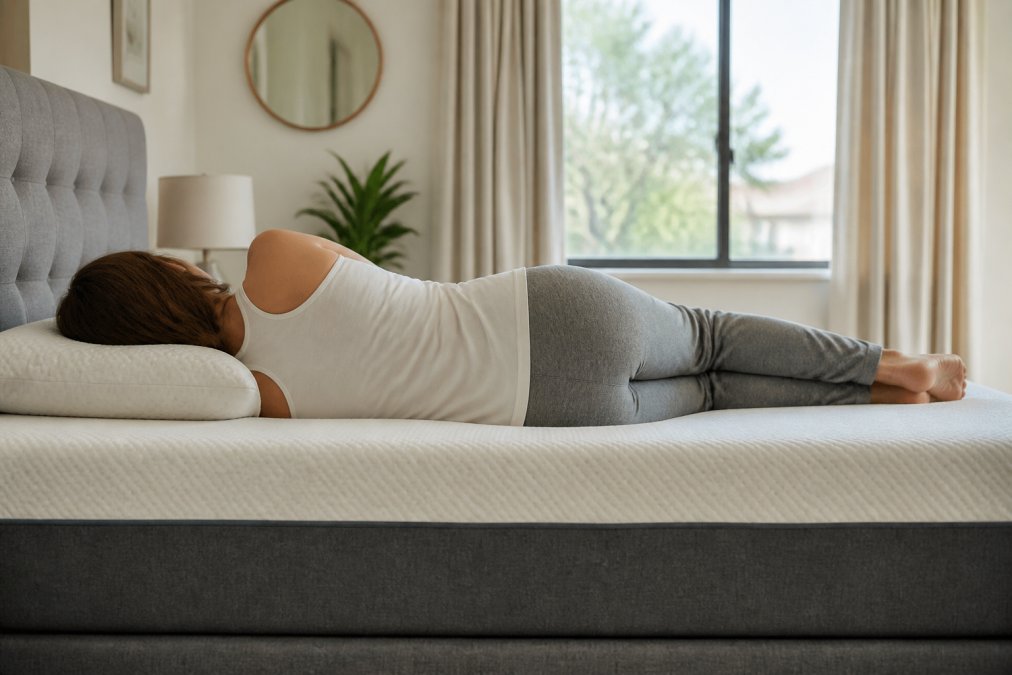
When your spine stays neutral, your muscles and ligaments relax fully. Memory foam achieves this by adapting to your body's contours rather than forcing your body to adapt to the mattress. As you lie down, the foam softens in response to your body heat and gradually supports your weight. A quality memory foam mattress with proper density will cradle your shoulders and hips while maintaining support under your lower back and neck, preventing the "hammocking" effect where your spine sags into a curve.
Density matters enormously. Low-density foam (below 4 pounds per cubic foot) compresses too quickly and fails to maintain spinal alignment (peer-reviewed research). Medium-density foam (4-5 pounds per cubic foot) offers the balance most sleepers need. High-density foam (above 5 pounds per cubic foot) provides firmer support but can feel less conforming.
Pressure Relief vs. Core Support
These two properties often work against each other. Pressure relief comes from the top comfort layers, the softer foam that conforms to your body. Core support comes from denser foam underneath, which resists compression and keeps your spine from sinking too far.
Too much pressure relief without adequate core support creates the "stuck in quicksand" feeling, where your hips sink deeply and your spine exits neutral alignment. Too much core support without pressure relief leaves pressure points unrelieved, causing pain and disrupting sleep. The best memory foam mattresses balance these with a layered approach: softer foam on top for pressure relief, transitioning to denser foam below for spinal support.
Signs Your Mattress Is Causing Back Pain
Your mattress is likely causing back pain if pain is worse in the morning and improves within 30 minutes of getting up, pain is localized to your lower back or shoulders, you sleep fine on other mattresses, and pain worsens the longer you stay in bed. These patterns suggest your mattress isn't supporting your body properly.
Your mattress is probably not the primary cause if pain is constant throughout the day regardless of sleep, pain radiates down your leg (suggesting nerve involvement), you have a diagnosed condition like herniated discs or sciatica, or pain doesn't improve with position changes. In these cases, consult a healthcare provider before investing in a new mattress.
When you switch to a firmer mattress after years on a soft one, your muscles and ligaments adjust to proper spinal alignment. This adjustment period typically lasts 2-4 weeks (peer-reviewed research). If pain persists beyond that, the mattress isn't the right fit.
The Importance of Firmness Levels for Back Support
Firmness is the single most misunderstood mattress specification. It's not an objective measurement but a subjective feel that varies by body weight, sleep position, and personal preference. The mattress industry uses a 1-10 firmness scale, where 1 is pillow-soft and 10 is concrete-hard. For back pain relief, the "sweet spot" is typically 6-7 (medium-firm), but this shifts based on your body type and how you sleep.
Medium-Firm: The Sweet Spot for Most Sleepers
Medium-firm memory foam mattresses deliver the balance most back pain sufferers need: enough conforming pressure relief to unload pressure points, combined with sufficient core support to maintain spinal alignment. This firmness level works well for back sleepers and stomach sleepers, the two positions that most benefit from spinal support. When you lie on your back on a medium-firm mattress, your hips and shoulders sink slightly into the comfort layers while your lower back stays supported. Side sleepers also benefit from medium-firm, though they often prefer slightly softer options (5-6) to relieve shoulder and hip pressure.
Some mattresses offer customisable comfort layers, allowing you to adjust firmness if your initial choice doesn't suit you.
Sleep Position and Body Weight Matter
Lighter sleepers (under 70 kg) often need softer mattresses (5-6 firmness) because their body weight alone doesn't compress the foam enough to feel supported on firmer options (peer-reviewed research). Heavier sleepers (over 90 kg) often need firmer mattresses (7-8) because softer options compress too much under their weight, causing excessive sinkage and loss of spinal alignment.
Sleep position compounds this. Back sleepers benefit from slightly firmer support than side sleepers because the spine is more vulnerable to misalignment in supine positions. Stomach sleepers need the firmest options available, as this position naturally twists the spine and requires maximum core support to minimize rotation.
Best Mattress for Back Pain: What to Look For
Choosing a mattress for back pain requires evaluating specific technical properties beyond firmness alone.
Density, Sinkage, and Weight Distribution
Foam density directly correlates with durability and support. Memory foam rated 4-5 pounds per cubic foot offers the best balance for most sleepers. Below 4 pounds, the foam breaks down faster and fails to maintain support after 5-7 years. Above 5.5 pounds, the foam becomes less responsive and may feel overly firm to lighter sleepers.
Sinkage, how far your body compresses into the mattress, should be 5-8 cm for most sleepers. Less than 5 cm suggests insufficient pressure relief; more than 8 cm indicates too much sinkage and likely loss of spinal alignment.
Memory foam excels at weight distribution. Unlike spring mattresses, which concentrate support under pressure points, memory foam spreads your weight across a larger surface area, reducing peak pressure on your shoulders, hips, and lower back.
Temperature Regulation and Motion Isolation
Memory foam's heat retention is a common complaint. Modern memory foam mattresses address this through cooling technologies. Some mattresses use gel-infused comfort layers that dissipate heat more effectively, while others incorporate airflow systems designed to maintain temperature regulation throughout the night.
Motion isolation, the ability of the mattress to absorb movement without transferring it across the surface, matters if you share your bed. Memory foam naturally excels at motion isolation compared to spring mattresses, making it ideal for couples where one person has back pain.
Memory Foam vs. Latex Mattress for Back Pain
Both materials can support back health; the choice depends on your priorities. Latex mattresses offer faster response than memory foam and sleep cooler because they don't trap heat as readily. However, latex provides less pressure relief than memory foam and typically costs more.
For back pain specifically, memory foam has a slight edge because pressure relief matters more than responsiveness. The gradual conforming action of memory foam allows pressure to distribute evenly across a larger surface, reducing peak pressure on sensitive areas. Latex durability is superior, a quality latex mattress lasts 10-12 years compared to 7-9 years for memory foam. For most back pain sufferers prioritising immediate relief and affordable options, memory foam remains the better choice.
The Break-In Period: Why Your Back May Hurt at First
When you switch from a soft mattress to a medium-firm memory foam mattress, your body is suddenly forced into proper spinal alignment after potentially years of misalignment. Your muscles, ligaments, and intervertebral discs have adapted to the old position and must readjust.
This adjustment period causes temporary soreness, similar to muscle soreness after starting an exercise program. Your back muscles are working differently, engaging stabiliser muscles they haven't used properly. The soreness typically peaks around day 5-7, then gradually improves as your body adapts. By week 3-4, most sleepers report significant improvement. If pain continues beyond 4 weeks or worsens after initial improvement, the mattress likely isn't the right fit.

Pros and Cons of Memory Foam for Back Pain
Key Advantages
Pressure relief is superior. Memory foam distributes weight more evenly than any other common mattress type, reducing peak pressure on your shoulders, hips, and lower back.
Motion isolation protects sleep quality. If you share your bed, memory foam's motion isolation means your partner's movements won't disrupt your sleep, allowing deeper recovery.
Customisable firmness options abound. Memory foam comes in multiple densities and configurations. Some brands offer customisable firmness settings, letting you adjust the mattress to your needs.
Spinal alignment support is reliable. When properly matched to your body weight and sleep position, memory foam maintains neutral spine alignment consistently throughout the night.
Affordable entry point to orthopaedic support. Quality memory foam mattresses can be a more affordable option compared to equivalent latex or hybrid options.
Real Drawbacks to Consider
Heat retention disrupts sleep for many. Memory foam traps body heat, and while newer models include cooling technologies, they may not suit very warm sleepers.
Break-in period requires patience. The 2-4 week adjustment period deters many buyers. Initial soreness can feel like the mattress is making your pain worse, even though it's temporary.
Durability is shorter than alternatives. A quality memory foam mattress lasts 7-9 years, compared to 10-12 years for latex or 12-15 years for premium hybrids.
Edge support is often weak. Memory foam mattresses typically have softer edges than spring mattresses, affecting stability if you sit on the edge frequently.
Off-gassing odour is common initially. New memory foam mattresses emit a chemical smell for the first few days to weeks. While this dissipates, it bothers some sleepers.
One-size-fits-all approaches fail. A medium-firm mattress that works beautifully for a 80 kg back sleeper may be wrong for a 100 kg side sleeper. Body weight and sleep position matter enormously.
| Consideration | Memory Foam | Latex | Hybrid |
|---|---|---|---|
| Pressure Relief | Excellent | Good | Very Good |
| Spinal Support | Very Good | Good | Excellent |
| Motion Isolation | Excellent | Fair | Good |
| Heat Retention | High | Low | Medium |
| Durability | 7-9 years | 10-12 years | 10-12 years |
| Price Entry Point | Pricing varies; check website | Pricing varies; check website | Pricing varies; check website |
| Best For Back Pain | Medium-firm | Firmer options | Hybrid-firm |
Conclusion: Is Memory Foam Worth the Investment?
Memory foam bedding is worth the investment for back pain if you choose the correct firmness for your body weight and sleep position, commit to the break-in period, and select a mattress with adequate density and core support.
The evidence is clear that pressure relief and spinal alignment support matter for back pain recovery. Memory foam delivers both more effectively than spring mattresses. At The Family Nest, we recognise that quality sleep is foundational to home comfort. A mattress that supports your spine properly transforms not just your mornings but your entire recovery process. According to research from the Sleep Health Foundation, quality sleep directly correlates with pain perception and recovery rates.
Start by assessing your body weight, identifying your sleep position, and honestly evaluating whether your current mattress maintains neutral spine alignment. If you're waking with stiffness or morning pain that improves within 30 minutes of getting up, your mattress is likely the cause. A medium-firm memory foam mattress with 4-5 pound density foam, combined with a 3-4 week break-in period, resolves this for most sleepers.
The Family Nest's 30-day return policy and free returns remove the financial risk from this decision. If a memory foam mattress doesn't improve your back pain within that window, you can return it without loss. This safety net makes it worth testing whether memory foam is the solution your back has been waiting for.
Frequently Asked Questions
Q: Does memory foam help with lower back pain?
A: Memory foam can help lower back pain by contouring to your body's shape and distributing weight evenly across the sleep surface. This reduces pressure points and promotes spinal alignment when the mattress has adequate density and core support. However, effectiveness depends on the mattress firmness matching your body weight and sleep position. A medium-firm memory foam mattress typically provides the best balance of pressure relief and lumbar support for most people experiencing lower back discomfort.
Q: What should I look for in a mattress for back support?
A: Look for a mattress with medium-firm to firm support, high-density foam (ideally 5cm or thicker for the support layer), and adequate lumbar support in the lower back region. The mattress should prevent excessive sinkage while still providing pressure point relief. Check that it offers good motion isolation to minimise disturbance from a partner, and ensure the cover allows temperature regulation. A trial period of at least 30 nights lets you test whether it actually relieves your back pain before committing fully.
Q: Is a firm or soft mattress better for back pain?
A: A medium-firm mattress is generally best for back pain, as it balances support with contouring. A mattress that's too soft allows your spine to sink unevenly, straining the lower back. A mattress that's too firm prevents proper pressure relief and can create gaps between your body and the surface, also causing discomfort. Your ideal firmness depends on your body weight, sleep position, and any underlying spinal conditions. Side sleepers often need slightly softer support than back sleepers, whilst heavier individuals benefit from firmer density.
Q: Are there any downsides to memory foam bedding?
A: Memory foam can retain heat, making some sleepers feel uncomfortably warm, though newer models include cooling technologies. It also has a break-in period of 2-4 weeks where your body adjusts to the new surface, and back pain may temporarily worsen before improving. Memory foam mattresses can develop body impressions over time and may not be suitable if you prefer a very responsive, bouncy feel. Additionally, lower-quality foam can off-gas a chemical odour when new, so choose brands that use certified, low-VOC materials.
Q: How long does a memory foam mattress last?
A: A quality memory foam mattress typically lasts 7-10 years with proper care. High-density foam (above 80kg/m³) lasts longer than lower-density alternatives. Lifespan depends on your body weight, mattress care, and how often you rotate or flip it. Investing in a mattress with a substantial warranty (10-15 years) and a reputable brand usually indicates better material durability. Regular maintenance, such as using a mattress protector and keeping the bedroom well-ventilated, helps extend the life of your mattress and prevents premature sagging.
Investing in a quality mattress designed for back support isn't luxury, it's foundational self-care. The Family Nest provides expertly curated bedding options with free shipping and straightforward returns, ensuring you can find the right mattress without the typical furniture-buying friction. Explore memory foam options that match your specific needs, and give your back the aligned support it deserves.
This article was written using GrandRanker