

Table of Contents
- What Counts as a Mid-Century Modern Decor Dupe
- Quick Comparison: Real Pieces vs Affordable Alternatives
- Affordable Mid-Century Modern Furniture That Looks the Part
- Reproduction Mid-Century Modern Furniture: What You Get for the Price
- Mid-Century Modern Decor on a Budget: Accents That Do the Heavy Lifting
- Mid-Century Modern Lighting Dupes With Retro Flair
- How to Check Quality Before You Buy a Dupe
- Where to Shop for Mid-Century Modern Decor Dupes
- Frequently Asked Questions
Last Updated: October 8, 2026
What Counts as a Mid-Century Modern Decor Dupe
A mid-century modern decor dupe borrows the defining look of a designer original, clean lines, organic shapes, tapered legs, warm wood tones, without the designer price tag.
The style has barely left Australian living rooms since the 1950s. Low-profile sofas, teak sideboards and slim-legged coffee tables keep resurfacing because they suit small spaces and renters who move often, which is why the dupe market is so crowded, and why so much of it disappoints.
Three tiers exist, and knowing which one you're buying changes everything:
- Authentic vintage: original pieces from the era, often restored, priced accordingly
- Reproduction: a new piece built to match original dimensions and materials
- Inspired-by: a contemporary design that echoes the silhouette without copying it
Most shoppers want the third tier: it's the most affordable and easiest to live with.
Quick Comparison: Real Pieces vs Affordable Alternatives
The table below maps the three tiers against cost, authenticity and how easy each is to source.
| Tier | Typical Cost | Authenticity | Where to Find It |
|---|---|---|---|
| Authentic vintage | Highest | Original, aged | Auction houses, estate sales, secondhand dealers |
| Reproduction | Mid to high | Matches original specs | Specialist replica retailers |
| Inspired-by | Lowest | Stylistic only | Large furniture retailers, online marketplaces |
For most first apartments, inspired-by wins on value. Reproductions suit buyers who want exact proportions of a known design. Authentic vintage is a collector's game, with restoration costs rarely shown in the sticker price.
According to the Australian Competition and Consumer Commission's guidance on country of origin and product claims, retailers must be accurate about how they describe goods, which matters when a listing calls something "vintage style" versus genuinely vintage.
Affordable Mid-Century Modern Furniture That Looks the Part
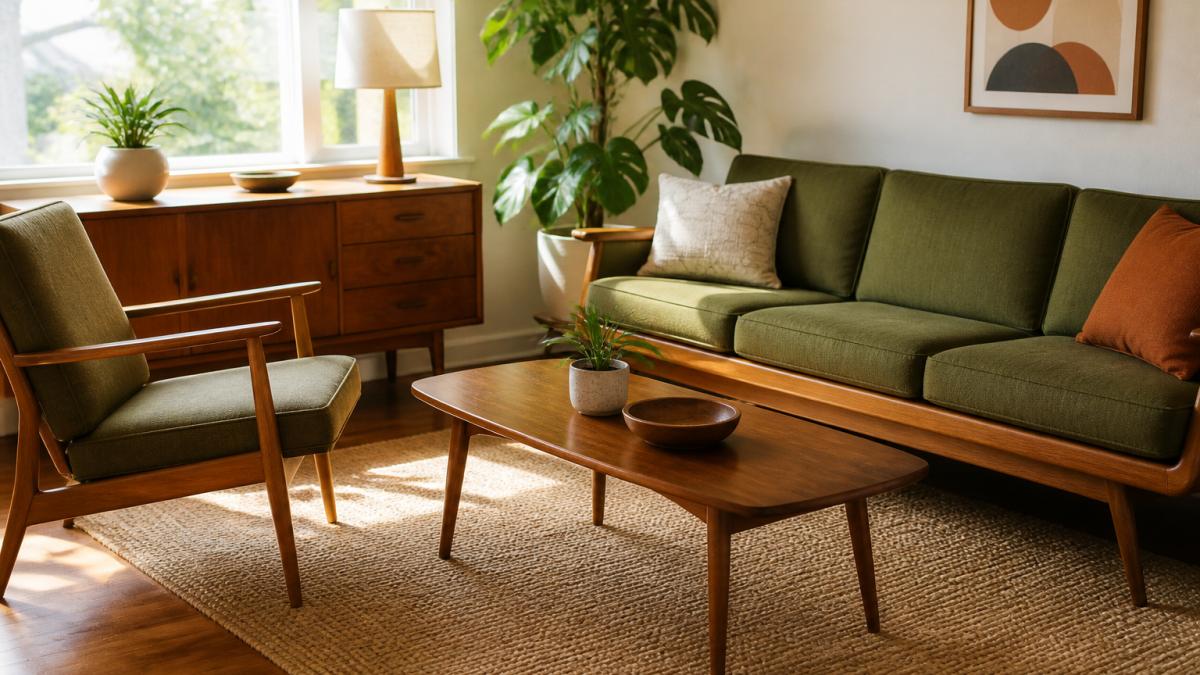
Affordable mid-century modern furniture lives or dies on three details: leg shape, wood tone and overall height. Nail those and a budget piece reads as considered, not cheap.
Sofas and Lounge Chairs
The MORABO sofa from IKEA is a solid entry point for that low, boxy silhouette with slim legs, and being a named model makes it easy to check in person.
For an accent chair, the EKENÄSET armchair carries the angled back and tapered legs that define the era. Pair it with a neutral sofa and it does the styling work.
Coffee Tables, Side Tables and Benches
The STOCKHOLM coffee table is one of the cleaner interpretations of the mid-century coffee table, low, wide and warm-toned. The EKENÄSET bench works the same angle at the foot of a bed or in an entryway.
For bedside tables, the HAIOOU mid-century pair offers tapered solid pine legs and a single drawer. At roughly $90 for both according to the retailer listing, it's a fraction of a designer pair.
Reproduction Mid-Century Modern Furniture: What You Get for the Price
Reproduction mid-century modern furniture costs more than inspired-by pieces because you're paying for accuracy, not just a look. A true reproduction matches the original's dimensions, joinery and often materials; an inspired-by piece borrows the silhouette and stops there.
The price gap is usually the cost of three things: timber, joinery and tooling. A reproduction maker sources solid timber in the right species and runs the same angled cuts.
That difference is invisible online and obvious in person. Check these when comparing a reproduction listing against an inspired-by listing at a similar price:
- Timber species and grade. Teak, walnut and oak are the era's signature timbers. A listing that says "wood effect" or "timber-look laminate" is not a reproduction, regardless of the price.
- Joinery method. Look for mortise-and-tenon, dowel or bracket joints at the leg-to-frame connection. Screws driven straight into a board are the giveaway of an inspired-by build.
- Dimensions. A reproduction will usually publish the original's dimensions to the centimetre. If the listing only gives a general size, it's a stylistic copy.
What the warranty actually tells you
A warranty says more about confidence in construction than any product photo.
| Retailer | Model | Reported Warranty | Reported Returns |
|---|---|---|---|
| Sohnne | Factory-direct replicas | 5 years | 60 days |
| Rove Concepts | Mid-century reproductions | Not stated in listing | Not stated in listing |
| AllModern | Mid-century aesthetic range | Not stated in listing | Not stated in listing |
When a retailer doesn't publish warranty or return terms, treat that as a data point rather than a dealbreaker. Under the consumer guarantees set out by the ACCC's consumer guarantees guidance, goods must be of acceptable quality and match their description, and remedies apply when they don't, regardless of what the retailer's own policy says.
Where reproductions make sense
Reproductions make sense when you want the exact proportions of a known design and plan to keep the piece for years. They make less sense for a rental you'll leave in 18 months, or a room where the piece sits against a wall and is never seen from the side.
The honest trade-off is this: a reproduction buys you the silhouette plus the construction. An inspired-by piece buys you the silhouette. If the silhouette is all you need, don't pay for the rest.
Mid-Century Modern Decor on a Budget: Accents That Do the Heavy Lifting
Mid-century modern decor on a budget is really about accents, not big-ticket furniture. A plain sofa with the right lamp, plant and cushions reads as styled; an expensive sofa with nothing else doesn't.
Start with the palette. Earth tones, brown, olive green and orange are the era's signature colours, and they're cheap to introduce through textiles:
- Cushion covers in mustard or burnt orange
- A woven throw in an oatmeal or tan tone
- Ceramic vases in matte finishes
None cost much, and all push a neutral room toward the era. The trick is restraint: two or three accents in the same family beat a scattered mix of every retro colour.
Mid-Century Modern Lighting Dupes With Retro Flair
Mid-century modern lighting is where dupes pay off fastest.
Look for three things: a shade opaque enough to cast warm light rather than glare, a stem or arm with a visible joint (the era's tell), and a base heavy enough not to tip when brushed past.
Lantern-style floor lamps and slim tripod designs are the safest bets for a rental, adding height without mounting. Pair one with a warm bulb and a plain wall and you've got the look.
How to Check Quality Before You Buy a Dupe
Quality checks take two minutes and save you a return. Match the check to the tier you're buying, because a $90 pair of bedside tables and a $1,200 reproduction chair fail in different ways.
For inspired-by pieces under about $300
At this price the risk is thin material and short-lived fittings, not joinery failure. Run through this list before you commit:
- Press the seat or tabletop with your palm. Flex means thin material underneath. A side table that bows under hand pressure will bow under a lamp.
- Check the leg joinery. Tapered legs should attach with a bracket or dowel, not just screws into particleboard. Screws into composite board strip out within a year of normal use.
- Look at the finish edge. Veneer that stops short of the edge will lift within months, especially in humid rooms. Run a fingernail along the edge and feel for a lip.
For reproductions and vintage pieces above about $500
At this price the risk shifts from material thinness to joinery and finish quality. The checks get more specific:
- Ask for the timber species and grade. Teak, walnut and oak are the era's signature timbers. "Wood effect" at this price is a red flag.
- Ask for the joinery method at the leg-to-frame connection. Mortise-and-tenon, dowel or bracket joints are the era-appropriate answer. Screws into a board are not.
- Ask for the original dimensions. A true reproduction will publish them to the centimetre. A stylistic copy won't.
The one check that catches most problems
Ask the seller, in writing, for the timber species, the joinery method and the original dimensions. If they can't answer all three, you're being charged reproduction prices for an inspired-by build. Keep the reply. Under the consumer guarantees set out by the ACCC's consumer guarantees guidance, products must be of acceptable quality and match their description, and remedies apply when they don't.
Where to Shop for Mid-Century Modern Decor Dupes
Where you shop matters as much as what you buy, because availability, shipping and returns vary enormously between sellers.
Large furniture retailers are a starting point. Online marketplaces are cheaper but riskier, especially for larger pieces where return shipping can cost more than the item.
Specialist replica retailers sit in the middle. You pay more than a marketplace price but get stated warranties and better construction.
For renters, the deciding factor is often disassembly.
That's where we'd point you to The Family Nest. Our range is built around exactly this problem: space-saving furniture and organisation pieces that assemble with the guides provided, ship free, and come with a 30-day return policy and free returns if the fit isn't right. Secure checkout and clear installation instructions round it out.
Frequently Asked Questions
How can I decorate my home in a mid-century modern style on a budget?
Start with the pieces people notice first: a low-profile sofa or lounge chair, a coffee table with tapered legs, and one warm-toned wood item such as a side table or bench. Mix in cheaper accents like retro lighting, earth-tone cushions and houseplants to carry the style through the room. Shopping mid-century modern decor dupes rather than originals keeps the look consistent without stretching your budget, and buying one statement piece at a time makes it easier to stay on track.
What is the difference between vintage and reproduction mid-century modern furniture?
Vintage pieces were made in the original mid-century era, so they carry real history but often come with wear, fading and limited stock. Reproduction mid-century modern furniture is newly made to match those designs, so you get the same tapered legs and clean lines with new upholstery and a warranty. Contemporary inspired-by pieces borrow the look more loosely. Reproductions usually suit renters and first-home buyers because they are easier to replace and move.
How can I tell whether mid-century modern furniture is good quality?
Check the joints first: solid timber frames with dowels or screws hold up better than stapled particleboard. Look at the legs, because solid wood or metal with a proper finish will not wobble or split. Feel the weight, as a sturdy piece rarely feels hollow. Ask about the warranty and return window before buying, and read reviews that mention how the item held up after a year.
What colours work well with mid-century modern decor?
Warm earth tones do most of the work: brown, olive green and muted orange sit naturally alongside teak and other warm wood tones. Keep walls and larger furniture neutral, then use cushions, rugs and decorative accents to bring in the stronger retro colours. A single mustard or burnt orange piece against a cream sofa reads clearly as mid-century without overwhelming a small space. Add a houseplant or two to soften the palette.
Where can I find affordable mid-century modern furniture and decor?
Flat-pack retailers, online marketplaces and specialist replica stores all carry mid-century styles at different price points. Check delivery costs and whether assembly is required before you commit, since these can change the real total. If you are renting, favour pieces that disassemble easily so they survive your next move.
Furnishing a first place in this style shouldn't mean choosing between a look you love and a budget you can live with. The Family Nest stocks space-saving furniture, smart organisation and ambient lighting designed for renters and families who move, with free shipping, free returns and a 30-day window to change your mind. Browse the collection and build the room you actually want to come home to.