

Table of Contents
- Why Rug Size Makes or Breaks a Small Bedroom
- How to Measure for an Area Rug in a Compact Room
- Bedroom Rug Size Chart: Matching Dimensions to Bed Size
- Rug Placement Under Bed: Three Layouts That Work
- Small Bedroom Solutions When a Full Rug Will Not Fit
- Rug Thickness, Door Clearance and Furniture Stability
- Conclusion
- Frequently Asked Questions
Last Updated: October 13, 2026
Why Rug Size Makes or Breaks a Small Bedroom
Choosing the right rug size for a small bedroom is the difference between a room that feels finished and one that feels cramped.
A rug that's too small floats like a postage stamp; one that's too big swallows the room and hides the floor you need to see.
The fix takes a tape measure and five minutes of planning.
How to Measure for an Area Rug in a Compact Room
Measuring for an area rug starts with the floor you can actually use. Grab a tape measure, a notepad, and painter's tape. Measure the room wall to wall, then the bed including the frame, the gap between them is your working space.
Step 1: Map the Floor Space You Can Actually Use
Walk the room and note where doors swing, wardrobes open, and walkways run. These zones can't sit under a rug.
- Measure the room wall to wall
- Mark door swing areas and wardrobe clearance
- Note the main walkway path around the bed
What's left is where a rug can go, often less than you expect. Many small bedrooms have only 60-90 cm of usable floor on each side of the bed. If side clearance is under 60 cm, switch to a runner or foot-of-bed layout.
Step 2: Check Bed Frame and Leg Style
Your bed frame changes how a rug sits underneath it. A bed on legs lets the rug slide under; a solid-base frame or deep valance hides the rug edge.
- Legged frames: the rug can extend under and the legs sit on top
- Solid-base or platform beds: the rug edge disappears, so size matters less under the bed
- Divan bases: usually no clearance, so plan for a rug that stops at the frame edge
Moving from a divan base to a legged frame? Your rug will look smaller than you pictured, because the legs lift the bed and expose more floor.
Step 3: Run the Painter's Tape Layout Test
Before you buy, mark the rug's footprint on the floor with painter's tape, the most useful check you can do.
- Measure your intended rug size on the floor and outline it with tape.
- Walk around the bed. Does the tape line sit where you want the rug edge?
- Open doors and wardrobe doors. Does the tape get caught?
- Place a bedside table or a box where the table will sit. Does it still fit?
- Stand where you get out of bed. Is there tape under your feet?
If the tape outline feels cramped or blocks a door, size down or switch to a runner layout. The tape test costs nothing and prevents the most common return reason: a rug that looked right online but crowded the room in person.
Step 4: Check Door and Drawer Clearance
Slide a ruler under any door that opens into the room and measure the gap.
- Under 1 cm: a thick pile rug will catch. Choose a flatweave or low-pile rug.
- 1-2 cm: most medium-pile rugs will clear, but check the rug's total thickness including the pad.
- Over 2 cm: you have room for most pile heights.
Do the same for wardrobe doors and bed storage drawers, a rug that blocks a drawer or scuffs a door becomes a daily annoyance.
Step 5: Confirm Walkway Width
The main walkway around the bed should stay at least 60 cm wide. Measure from the rug edge to the nearest wall or wardrobe; if the gap is under 60 cm, size down or move to a runner layout. With your usable floor dimensions, bed frame type, and clearance checks done, you can match those numbers to a standard rug size with confidence.
Bedroom Rug Size Chart: Matching Dimensions to Bed Size
A bedroom rug size chart takes the guesswork out of ordering. The right rug extends beyond the bed on both sides and at the foot, so your feet land on soft fibres when you get up. But bed size alone isn't enough, factor in room dimensions and how much bare floor you want to see.
Standard Rug Sizes in Centimetres and Metres
Most bedroom rugs come in a handful of standard sizes:
| Rug Size (cm) | Rug Size (m) | Best For |
|---|---|---|
| 160 x 230 | 1.6 x 2.3 | Single and twin beds |
| 200 x 290 | 2 x 2.9 | Double and queen beds |
| 240 x 330 | 2.4 x 3.3 | Queen and king beds |
| 200 x 200 | 2 x 2 | Square rooms, corner beds |
| 80 x 250 | 0.8 x 2.5 | Runners beside the bed |
Rug Size Under Queen Bed and Other Common Beds
A rug size under a queen bed should be at least 200 x 290 cm for full coverage, giving roughly 50 cm of rug on each side and at the foot. For a king bed, go up to 240 x 330 cm; a single or twin works with 160 x 230 cm. If the room is tight, runners on each side are a smart compromise.
Decision Chart: Bed Size, Room Dimensions, and Exposed Floor Border
Use this chart to pick a rug size based on your bed and room, not just the bed. The "exposed floor border" is the bare floor you want to see around the rug; in a small room, aim for 30-50 cm on the sides and foot.
| Bed Size | Room Width (approx.) | Recommended Rug Size | Exposed Floor Border |
|---|---|---|---|
| Single/Twin | Under 2.5 m | 160 x 230 cm | 30-40 cm sides, 40 cm foot |
| Single/Twin | Over 2.5 m | 200 x 290 cm | 50 cm sides, 50 cm foot |
| Double | Under 3 m | 200 x 290 cm | 40 cm sides, 40 cm foot |
| Double | Over 3 m | 240 x 330 cm | 50 cm sides, 50 cm foot |
| Queen | Under 3.2 m | 200 x 290 cm | 30-40 cm sides, 40 cm foot |
| Queen | Over 3.2 m | 240 x 330 cm | 50 cm sides, 50 cm foot |
| King | Under 3.5 m | 240 x 330 cm | 30-40 cm sides, 40 cm foot |
| King | Over 3.5 m | 240 x 330 cm or larger | 50 cm sides, 50 cm foot |
If your room is narrower than the "under" column, a full-coverage rug may not fit. Switch to a partial-coverage layout or runners.
How Bed Frame and Leg Style Change the Chart
The chart above assumes a legged bed frame where the rug slides underneath. Your frame style changes the recommendation:
- Legged frames: the rug extends under the bed. Use the chart as written.
- Solid-base or platform beds: the rug edge disappears under the bed. You can often size down by one step because the visible rug area is what matters.
- Divan bases: no clearance under the bed. The rug stops at the frame edge. Add 10-15 cm to your side clearance measurement to account for the frame.
What If No Standard Size Fits?
If your room is too narrow for a full-coverage rug, you have three alternatives:
- Runners beside the bed: one runner on each side, leaving the centre floor bare. Best when side clearance is under 60 cm.
- Rug at the foot of the bed: a rectangular rug that tucks under the bottom third of the bed. Best when you want a soft landing but side space is tight.
- Bedside rugs: small mats on each side of the bed. Best when you only need comfort where your feet land.
Each option keeps the walkway clear and stops the rug from swallowing the room. In a compact bedroom, a runner layout often looks more deliberate than a too-small full rug.
Rug Placement Under Bed: Three Layouts That Work
Rug placement under a bed comes down to three layouts, each suiting a different room size. Pick the one that matches your floor space, not the one that looks best in photos.
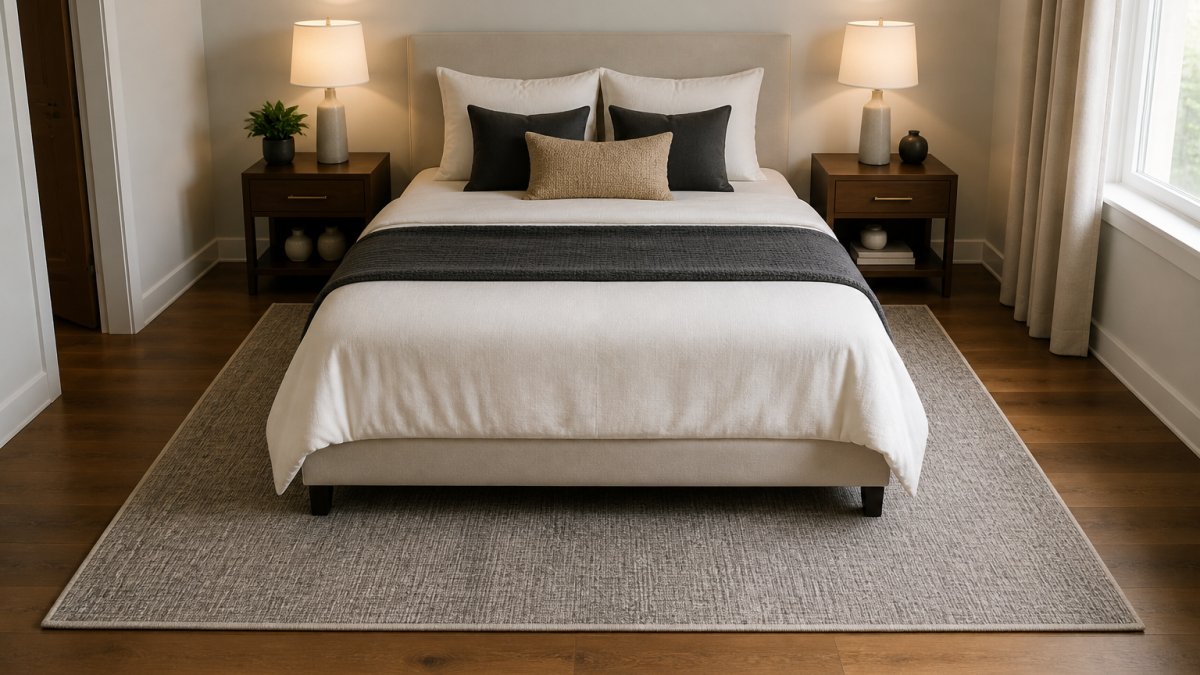
Layout 1: Full Coverage Under the Bed
The rug sits fully under the bed with even borders on all sides. This classic layout works best with at least 60 cm of clear floor around the bed.
- Rug extends 50-60 cm beyond each side
- Foot of the bed sits fully on the rug
- Bedside tables rest on the rug or just off it
This layout anchors the bed and makes the room feel intentional. It needs the most floor space of the three.
Layout 2: Partial Coverage at the Foot
The rug starts under the bottom third of the bed and runs into the room, saving space while still giving you a soft landing when you step out of bed.
- Rug tucks under the foot of the bed only
- Front legs sit on the rug, back legs stay on the floor
- Works well when side clearance is tight
Layout 3: Runners Beside the Bed
Two runners flank the bed instead of one large rug, the go-to choice for a small bedroom where a full rug won't fit.
- One runner on each side of the bed
- Leaves the centre floor bare
- Keeps walkways clear and easy to clean
Small Bedroom Solutions When a Full Rug Will Not Fit
When a full-size rug won't fit, you still have options that look deliberate. Work with the room instead of forcing a large rug into it.
- Layer a small rug over a larger neutral one for a custom look
- Use a runner at the foot of the bed to define the sleeping zone
- Choose a round or square rug for awkward corners
A rug pad matters more than most people think: it keeps the rug flat, stops it sliding, and adds cushion underfoot. On timber or tile, a non-slip backing prevents the tripping hazard of a curling edge.
Rug Thickness, Door Clearance and Furniture Stability
Rug thickness is the detail most guides skip, and it causes the most returns. A thick, plush rug can block a door, wobble a bedside table, and make a small room feel tighter. Check door clearance before you buy: if the gap is under 1 cm, choose flatweave or low-pile. Furniture stability matters too, a bedside table on four thin legs can rock on a thick rug, while a solid base sits fine.
- Low pile (under 1 cm): best for doors and rolling chairs
- Medium pile (1-2 cm): good all-rounder for bedrooms
- High pile (over 2 cm): cosy but blocks doors and wobbles furniture
Conclusion
Getting the rug size right in a small bedroom is a measuring job, not a guessing game. Measure your usable floor, check your bed frame and door clearance, then match your rug to the room rather than the bed alone.
At The Family Nest, we offer home essentials built for compact spaces, with free shipping and free returns, a 30-day return policy, and easy installation guides so you can try a size without the risk.
Frequently Asked Questions
What size rug is best for a small bedroom?
For a small bedroom with a queen bed, a 160 x 230 cm rug usually works well. It fits under the lower two-thirds of the bed and extends about 50 to 60 cm on each side, giving you soft footing when you get up. If the room is tighter, a 120 x 170 cm rug placed at the foot of the bed or two runners beside the bed can work instead. Always measure your room first, because bed size alone does not tell the full story.
How should a rug be placed under a bed in a small bedroom?
The most common approach is to slide the rug under the bottom half or two-thirds of the bed, leaving the head of the bed on bare floor. This anchors the bed visually and gives you soft landing space on both sides. In a compact room, you can also place the rug entirely at the foot of the bed or run two runners along each side. Whichever layout you pick, check that the rug lies flat and does not bunch near doorways.
Should a bedroom rug go under the bedside tables?
It depends on the layout. If your rug is wide enough, placing bedside tables fully on the rug creates a cohesive look and protects the floor underneath. In a small bedroom, though, the rug often sits only under the bed and the walking area beside it, leaving tables on bare floor. Both options work. What matters is that the rug extends far enough beside the bed that your feet land on it when you get up, rather than on cold boards.
How much rug should show around a bed?
A good rule is to aim for 50 to 60 cm of rug visible on each side of the bed and 60 to 75 cm at the foot. This gives you enough coverage to step onto comfortably without swallowing the whole floor. In a small bedroom, you may need to reduce that to 40 cm per side. If you cannot achieve at least 40 cm of visible rug on both sides, consider a smaller rug placed only at the foot or beside the bed instead.