

Table of Contents
- Why Rental Small Space Design Is Different
- Renter-Friendly Wall Decor Without Losing Your Bond
- Multi-Functional Furniture for Small Spaces That Actually Works
- Temporary Lighting Solutions for Renters
- Acoustic Management in Small Rentals
- Sustainable and Budget-Friendly Rental Design
- Small Space Interior Design Tips: Common Mistakes to Avoid
- Frequently Asked Questions
Last Updated: September 14, 2026
Why Rental Small Space Design Is Different
Small space interior design tips for renters start with a hard truth: you're decorating a home you don't own. Every choice must pass two tests, does it look good, and will it survive an inspection or a move without costing your bond?
That constraint makes rental design its own discipline. Permanent fixtures like built-in shelving are off the table, so the work shifts to portable solutions. The best rental spaces aren't the most expensive, they're the ones where every piece earns its footprint and can leave with you.
The throughline: treat your rental as a temporary installation, not a renovation. Design for disassembly, and you'll get a home that feels considered without risking your bond.
A common mistake is buying furniture sized for a house you'll own one day. Renters move more often, and heavy pieces that don't fit a new floor plan become a liability.
Renter-Friendly Wall Decor Without Losing Your Bond
Renter-friendly wall decor attaches without permanent damage and removes cleanly, leaving the surface as found. That rules out nails, screws, and most standard adhesives, but leaves plenty of options.
Temporary wallpaper leads the category. Modern peel-and-stick versions use removable adhesive that grips painted plasterboard and releases without tearing paint, if you follow the removal instructions. For smaller statements, adhesive hooks, tension rods, and freestanding picture ledges handle wall art without a single hole.
The trick nobody mentions: test any adhesive product on a hidden patch first, like behind a door or inside a wardrobe. Paint finishes vary, and what releases cleanly on one wall can lift a patch on another. Leave it for a week, then peel slowly.
Multi-Functional Furniture for Small Spaces That Actually Works
Multi-functional furniture for small spaces serves two or more purposes in one footprint, typically through folding, nesting, or concealed storage. It works because it attacks the real problem in a small rental: not a lack of items, but a lack of floor area.
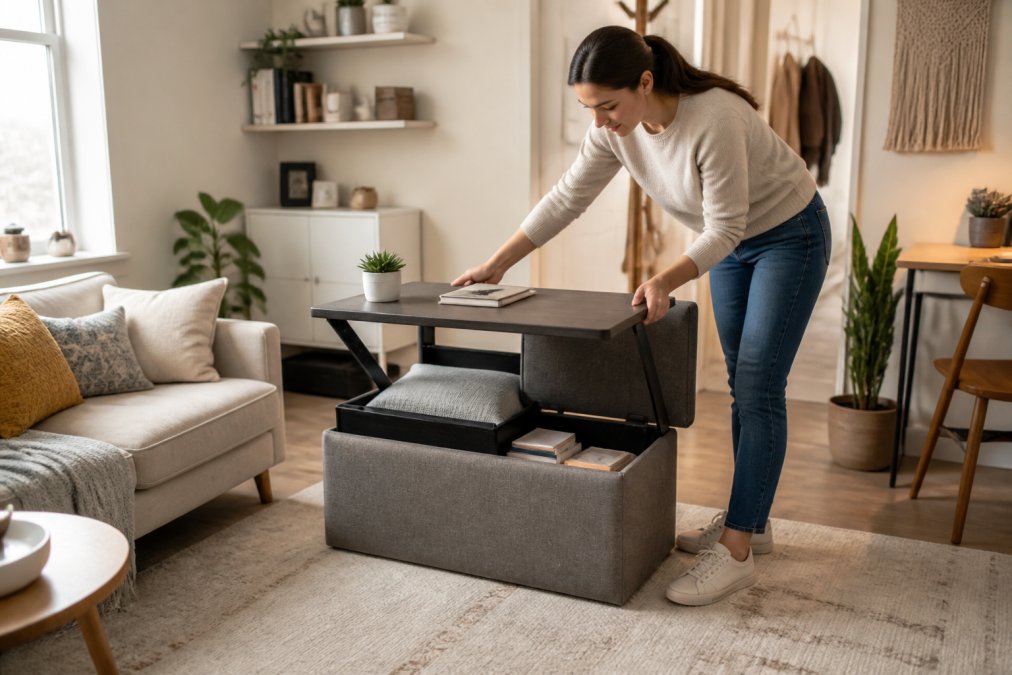
What most guides miss: multi-functional pieces vary enormously in build quality, and the cheap ones fail at the joint. A fold-out desk that wobbles after six months is worse than a fixed table. Look for solid joining hardware, a stated weight capacity, and disassembly for your next move.
| Furniture Type | Dual Purpose | Best For | Watch Out For |
|---|---|---|---|
| Storage ottoman | Seat plus concealed storage | Bedrooms, living rooms | Weak lids on budget models |
| Fold-out desk | Workspace plus console | Studio apartments | Wobbly hinges over time |
| Nesting tables | Side table plus extra surface | Entertaining in tight rooms | Thin tops that scratch |
| Bed with under-bed drawers | Sleep plus vertical storage | Small bedrooms | Hard to move assembled |
| Modular shelving | Display plus room divider | Open-plan rentals | Needs wall anchoring for safety |
Vertical storage does the same job from a different angle. Floor-to-ceiling shelving and over-door organisers turn dead wall height into usable capacity, which matters more in a rental than in a home you can renovate.
Temporary Lighting Solutions for Renters
Temporary lighting solutions are plug-in or battery-powered fixtures that improve a room's light without touching fixed wiring. That matters legally as much as aesthetically: in most tenancy agreements, altering the electrical installation without the landlord's written consent is a breach, and hardwired changes generally require a licensed electrician (Minimum standards (Private rentals)). Plug-in and battery fixtures sidestep the question.
Bad overhead lighting is the fastest way to make a small room feel smaller. A single ceiling fixture casts light straight down, leaves corners in shadow, and flattens every surface. The fix is layered light from three heights: overhead, mid-level (table and floor lamps), and low (a small lamp on a shelf or the floor).
Floor lamps do the heavy lifting. A well-placed floor lamp in a dark corner adds light and the illusion of space, lifting the eye upward and removing the shadow that closes a room in. Look for a slim base and a shade that throws light both up and down.
Plug-in pendants and wall sconces are the next step up. A plug-in pendant hangs from a ceiling hook or a weight-rated adhesive pad, with a fabric cord running to a nearby socket. A plug-in sconce mounts with a removable adhesive strip or a picture hook. Both reverse in minutes.
Battery and rechargeable lamps have improved enough to be genuinely useful. A rechargeable table lamp with a warm LED can sit on a bookshelf, windowsill, or bedside table with no cord, ideal where sockets are scarce or badly placed.
Get the colour temperature right. Warm bulbs in the 2700K to 3000K range make a small rental feel cozy rather than clinical; cool white (4000K and above) flattens a room and makes cheap finishes look cheaper. Aim for 2700K in living and sleeping areas, and 3000K to 4000K only in task areas.
Watch the lumens, not just the watts. As a rough guide, a living room wants 1000 to 2000 lumens total across all sources, a bedroom 1000 to 1500, and a desk task light 400 to 500 at the work surface. Layering several lower-output lamps usually beats one bright fixture.
Plan your plug points before you buy. Count the sockets, note which are switched, and decide which lamp goes where. A multi-socket adaptor or slim extension lead with a flat plug runs two or three lamps from one outlet without a tangle.
Acoustic Management in Small Rentals
Acoustic management reduces noise and echo using soft, removable materials. It's the gap most rental guides skip, and the one that changes how a small apartment actually feels to live in.
Small rooms with hard floors, bare walls, and large windows echo badly. The fix is soft mass: an area rug with a felt underlay, heavy curtains, upholstered furniture, and textured cushions. Layering rugs cuts echo while defining zones in a studio.
For noise from neighbours or a shared hallway, a tension rod with a heavy curtain across a doorway or shared wall absorbs a surprising amount, non-permanent and it comes with you when you leave.
Sustainable and Budget-Friendly Rental Design
Sustainable rental design means choosing pieces that are reusable, repairable, and easy to resell or pass on, rather than disposable items that end up in landfill after one lease. It's also the cheapest way to furnish a rental, which is why it belongs in any honest set of small space interior design tips for renters.
Start with secondhand, and know what to look for. Solid timber from a marketplace, op shop, or kerbside collection is often better built than new flat-pack at the same price, and holds value if you resell. Check joints by lifting one corner and listening for a creak, look for water rings and veneer lifting, and test drawers and doors for smooth travel.
Repair before you replace. A wobbly chair leg is usually a loose screw or dried-out glue joint, fixable with wood glue and a clamp. A scratched timber surface can be sanded and oiled. A sagging sofa cushion can be refilled with a cheap insert. These DIY fixes stretch a bond-friendly budget furthest.
Modify what you already own. A secondhand sideboard becomes a TV unit with hairpin legs. A plain bookshelf can be backed with removable wallpaper for a built-in look. A cheap flat-pack desk can be stiffened with an L-bracket. All reversible at move-out.
Buy new only where it matters. Products you buy new must be of acceptable quality and fit for purpose, with remedies, repair, replacement, or refund, if they aren't (Consumer rights and guarantees). That's a good reason to buy new for anything structural, like a bed frame or mattress, and keep your receipts. For everything else, secondhand is better value.
Budget-conscious swaps that pay off:
- Swap fixed shelving for freestanding modular units you can rearrange
- Use tension rods instead of curtain tracks for window treatments
- Choose removable adhesive hooks over drilled fixtures
- Buy washable, neutral cushion covers instead of new cushions
- Layer a secondhand rug over an existing one for warmth and zoning
- Replace a lampshade rather than the whole lamp
- Use removable wallpaper on a single feature wall instead of repainting
Negotiate minor changes in writing. To paint a wall, hang a shelf, or install a curtain track, ask the landlord or property manager by email first. Frame it as an improvement you'll reverse at your own cost, and offer a colour from the existing palette. Many landlords say yes to reversible changes because a well-presented rental is easier to re-let. Get the agreement in writing.
Know the difference between wear and tear and damage. Fair wear and tear is deterioration from ordinary living, faded curtains, minor scuffs, worn carpet in walkways, and you can't be charged for it (Repairs and maintenance). Damage goes beyond that: a burn in the carpet, a hole in the wall, a broken fixture. Document the property's condition at the start of the tenancy with dated photos.
Small Space Interior Design Tips: Common Mistakes to Avoid
The most common rental design mistakes all trace back to ignoring the move-out date. Here are the ones we see most often.
Buying for the current room only. A piece that fits this apartment may not fit the next. Favour modular, space-saving designs that adapt.
Overfilling the space. Decluttering and layout optimisation beat decoration every time. Fewer, better pieces read as larger than a room crammed with accents.
Ignoring the floor plan before buying. Measure the wall, doorway, and lift or stairwell before ordering. Furniture that won't fit through the door is a return waiting to happen.
Skipping lighting until last. Lighting changes a room more than paint does, and it's the easiest rental upgrade to reverse.
Forgetting aesthetic cohesion. A single colour palette across textiles, wall art, and window treatments makes a small rental feel intentional rather than assembled from leftovers.
Small space living asks you to solve a design problem under a lease, and that's genuinely harder than decorating a home you own. The Family Nest exists for exactly this: space-saving furniture and smart organisation that assembles with the included guides, ships free with free returns, and comes with a 30-day return policy so you can check the fit before you commit. If a piece doesn't work in your floor plan, send it back without losing money. Get started with The Family Nest and build a rental that feels like home, then takes an afternoon to pack up.
Frequently Asked Questions
How can I decorate my rental apartment without damaging walls?
Use removable adhesive hooks and strips instead of nails or screws. These products hold framed art, lightweight shelves and mirrors securely, then lift off cleanly when you move out. Temporary wallpaper is another option: it applies like contact paper and peels away without leaving residue. Always test a small patch first, and check your lease for any clauses about wall fixtures before you start.
What are the best space-saving furniture ideas for small rentals?
Look for multi-functional furniture for small spaces: ottomans with hidden storage, extendable tables, and bed frames with drawers underneath. Modular pieces that break down flat make moving easier. Measure your floor plan before buying, and prioritise items that serve two purposes. A sofa bed replaces both a couch and a guest bed; a wall-mounted drop-leaf desk replaces a full home office setup.
Can I change the lighting in a rental property?
Yes, with temporary lighting solutions for renters. Swap ceiling fixtures using plug-in pendants that hang from existing hooks, or add floor lamps and clip-on lights that need no wiring. Smart bulbs screw into existing sockets and let you adjust warmth and brightness without an electrician. Keep the original fixtures stored safely so you can reinstall them at the end of your lease.
How do I make a small rental room look bigger?
Use floor-to-ceiling curtains to draw the eye upward, choose area rugs that cover most of the floor to create a sense of space, and keep visual weight low with light-coloured furniture. Mirrors placed opposite windows double the natural light. Decluttering and using vertical storage keeps surfaces clear, which makes any room feel larger without structural changes.