

Table of Contents
- Why Space-Saving Furniture Matters in Studio Living
- Multifunctional Furniture for Small Apartments: Top Solutions
- Best Storage Solutions for Small Apartments
- How to Zone a Studio Apartment for Maximum Function
- Durability and Maintenance of Transformable Furniture
- Ergonomic Considerations for Small-Space Living
- DIY vs. Store-Bought Space-Saving Solutions
- Getting Started: Your Studio Apartment Furniture Plan
Last Updated: August 10, 2026
Why Space-Saving Furniture Matters in Studio Living
Studio apartments demand intentional furniture choices. When your entire living space measures 300-400 square feet, the difference between a cluttered studio and a functional one hinges on what you choose to bring in. According to Australian Bureau of Statistics housing data, studio and one-bedroom apartments represent the fastest-growing housing segment in Australian cities, particularly in Sydney and Melbourne.
Space-saving furniture for studio apartments isn't a luxury, it's the foundation of liveable small-space design. The right multifunctional pieces transform a studio from a place you tolerate into a space you actually enjoy. When you choose thoughtfully, you gain practical advantages: you can move between zones without feeling hemmed in, you have room for guests, and you reduce visual clutter, which research in environmental psychology suggests directly impacts stress levels in confined spaces.
Multifunctional Furniture for Small Apartments: Top Solutions
The best space-saving furniture serves multiple purposes without looking like a compromise.
Storage Beds and Wall Beds
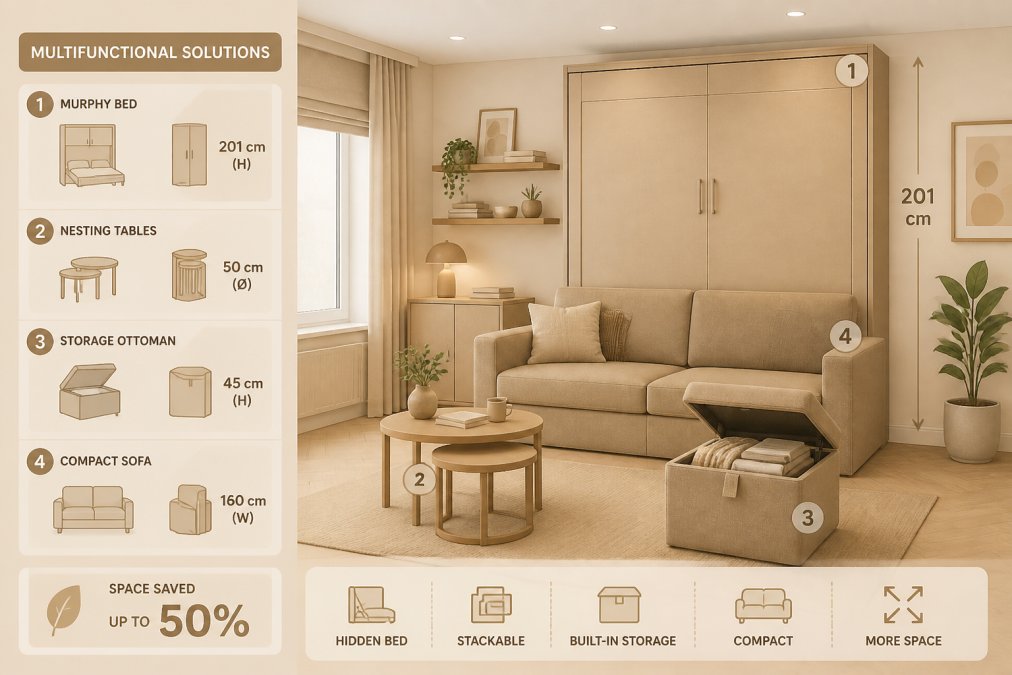
A storage bed transforms your bedroom zone without consuming precious floor space. Wall beds (Murphy beds) fold vertically into a cabinet, freeing an entire room's worth of floor space when closed.
The Palermo DIY Wall Bed (Queen) exemplifies this category. Its hydraulic mechanism ensures smooth, safe operation, with a slow-fall safety feature that prevents sudden dropping. The frame accommodates standard Australian mattresses up to 20cm thick. Installation requires securing it to a load-bearing wall, but DIY hardware and detailed instructions make it achievable for most people.
Wall beds work best when you prioritize comfort. Unlike sofa beds, which compromise on both seating and sleeping, a wall bed provides a genuine mattress and proper support. For studios where the bedroom zone doubles as a living area, the space recovery justifies the investment.
Convertible Sofa Beds
A convertible sofa bed serves as primary seating during the day and transforms into a guest bed at night. Quality matters significantly, cheap sofa beds often sacrifice comfort in both configurations.
The Ecosa Rio Sofa Bed delivers genuine comfort in both modes. Its three-seater configuration (Queen size when extended) provides substantial seating for daily use, with a straightforward conversion mechanism. The breathable fabric withstands regular use, and free next-day delivery to most Australian metropolitan areas removes friction from the buying process.
Sofa beds work best in studios where you have a defined living area separate from your sleeping zone. The real value emerges when you frequently host guests, eliminating the need for a separate guest room.
Nesting Tables and Ottomans with Hidden Storage
Nesting tables solve a specific problem: you need surface space for coffee, work, or dining, but a full-sized table wastes space when unused. The IKEA KRAGSTA Nest of Tables (set of 2) is affordable and straightforward, two tables nest into one footprint.
Ottomans with hidden storage do double duty as seating and storage. The Artiss Storage Ottoman Bed (140cm Boucle Fabric) combines three functions: seat, storage for blankets or seasonal items, and fold-out guest bed. Hidden storage matters in studios because visual clutter amplifies the feeling of cramped space.
Best Storage Solutions for Small Apartments
Storage solutions for small apartments must be vertical-first. When floor space is limited, your only direction is up.
Wall-Mounted Desks and Workstations
If you work from home, a wall-mounted desk is essential. The Vendline Wall Mounted Foldaway Murphy Desk collapses to just 70mm depth when closed, transforming into a slim cabinet that doesn't interrupt your room's visual flow. When you need to work, it folds down to provide a functional desk surface with integrated storage for notebooks, pens, and slim laptops.
Height adjustability during installation matters. You can position it for seated work or standing use, adapting to your posture preferences. The limitation is desktop space, this isn't a solution for extensive work setups involving multiple monitors. For studios where a dedicated work zone is essential, a wall-mounted desk reclaims 1.5-2 square metres of floor space compared to a traditional desk.
Modular and Vertical Storage Systems
Modular shelving systems allow you to build storage that fits your exact space and needs. Unlike fixed shelving, modular systems adapt as your life changes. Vertical storage exploits the one resource studios have in abundance: wall space.
The Freedom APARTMENT 01 Fabric Modular Sofa demonstrates modularity in seating. Individual sections rearrange independently, adapting to different layouts and occasions. This flexibility is valuable in studios where your needs shift.
How to Zone a Studio Apartment for Maximum Function
Creating distinct living areas without walls is the psychological foundation of studio living. When your bedroom, kitchen, living room, and workspace occupy the same physical space, visual and spatial separation becomes critical.
Creating Distinct Living Areas Without Walls
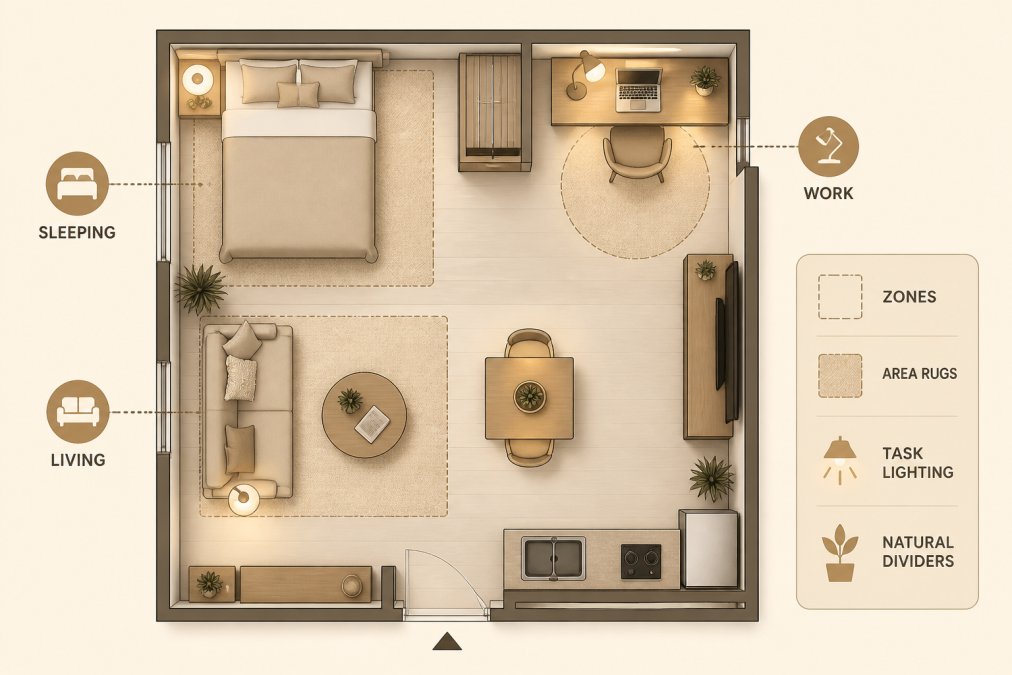
Zoning relies on furniture placement, area rugs, lighting, and colour to create psychological boundaries. Area rugs define zones instantly, a rug under your sofa marks the living area; a different rug under your dining table marks the eating zone; a third rug beside your bed delineates the sleeping area.
Lighting reinforces zones. A pendant light over your dining table, task lighting at your desk, and ambient lighting in your living area create visual separation even when zones are adjacent. Furniture height variation matters too, a low sofa paired with a tall bookshelf creates visual interest and defines boundaries.
Colour and material consistency within zones reinforces separation. If your living area features warm wood tones and soft fabrics, your work zone might use cooler materials and cleaner lines.
Furniture Arrangement and Floor Plan Strategy
The most effective studio floor plans follow logical traffic flow. Position your sofa to face into the room rather than against a wall, this arrangement makes the space feel larger and creates a natural gathering point.
Multifunctional furniture should cluster by function. Your work zone groups the desk, chair, and storage together. Your sleeping zone includes the bed, nightstand, and personal storage. Your living zone contains the sofa, coffee table, and entertainment. This clustering reduces visual chaos and makes each zone feel purposeful.
Measure before buying. Studio apartments have awkward dimensions, alcoves, and angled ceilings. A piece that looks perfect in a showroom might not fit through your doorway. Most retailers provide detailed dimensions and return policies to address this challenge.
Vertical storage placement matters as much as floor-based furniture. Keep work-related storage near your desk, living area storage near your sofa, and bedroom storage near your bed.
Durability and Maintenance of Transformable Furniture
Space-saving furniture often relies on mechanical components, hinges, hydraulics, folding mechanisms, that require proper maintenance to function reliably over years of use.
Wall beds depend on hydraulic systems to operate smoothly. Regular inspection for leaks or sluggish movement prevents problems before they become serious. Most mechanisms benefit from occasional lubrication with silicone spray (never WD-40). Check that the slow-fall mechanism engages properly.
Sofa bed frames experience stress from repeated conversion. Look for frame reinforcement in hardwood or metal rather than particle board. Quality sofa beds use eight-way hand-tied springs or high-density foam cores that withstand frequent use.
Folding desks and tables accumulate stress at hinge points. Inspect hinges regularly for looseness or damage. Tighten bolts before they become critical failures.
The durability difference between budget and quality space-saving furniture is significant. A cheap wall bed might work reliably for 3-4 years before hydraulic failure. A quality unit functions smoothly for 10+ years with minimal maintenance.
Ergonomic Considerations for Small-Space Living
Living in a studio doesn't mean compromising on ergonomic comfort. In fact, the confined space makes ergonomics more critical.
Desk height matters even for a wall-mounted workspace. Your elbows should rest at approximately 90 degrees when seated, with your monitor at eye level. Many wall-mounted desks allow height adjustment during installation.
Seating deserves investment. A cheap office chair used for work creates cumulative strain. Even in a small studio, a proper ergonomic chair or chair with lumbar support prevents back problems over time.
Bed quality affects sleep quality, which cascades into overall health. A proper mattress, even in a wall bed, supports your spine and improves sleep quality.
Lighting affects posture and eye strain. Poor lighting encourages slouching and squinting. Task lighting at your desk and ambient lighting in your living area reduce eye fatigue.
DIY vs. Store-Bought Space-Saving Solutions
The choice between DIY and store-bought depends on your skills, budget, and timeline.
Store-bought advantages are substantial. Retailers like The Family Nest provide tested designs, quality assurance, and straightforward assembly. Free shipping and 30-day returns remove financial risk. Professional design means the furniture functions reliably from day one.
DIY advantages centre on customisation and cost. Building your own shelving, desk, or storage allows you to match exact dimensions and aesthetics. The trade-off is time investment and risk.
For renters, store-bought is typically better. Rental agreements often prohibit permanent modifications, making removable, portable furniture essential.
For homeowners planning long-term residence, DIY becomes more viable. You can invest in custom solutions that match your exact space and aesthetic preferences.
Quality matters more than origin. A well-made store-bought nesting table outperforms a poorly constructed DIY equivalent.
Getting Started: Your Studio Apartment Furniture Plan
Creating a functional studio starts with honest assessment of your space and needs.
Measure everything: room dimensions, ceiling height, doorway widths, window placement, and existing fixed features. These measurements determine what furniture will physically fit and function.
Identify your priorities. Do you work from home? Frequently host guests? Need significant storage? Your answers determine which space-saving solutions matter most.
Create a rough floor plan using graph paper or a digital tool. Test furniture placement before buying to prevent expensive mistakes.
Start with foundational pieces: a bed (storage bed or wall bed), seating (sofa bed or modular sofa), and work surface if needed. Add storage solutions next. Finish with accessories: nesting tables, area rugs, lighting, and decor.
The Family Nest simplifies this process. Their curated selection focuses on pieces that work specifically in compact spaces. Free shipping and easy installation mean you're not paying extra for logistics. The 30-day return policy lets you test pieces in your actual space before committing.
| Furniture Type | Best For | Space Savings | Installation Complexity |
|---|---|---|---|
| Wall beds/Murphy beds | Studio bedrooms needing maximum floor space | 10-15 sq m when closed | Moderate, requires wall mounting |
| Storage beds | Studios with permanent residence | 3-5 sq m underbed storage | Simple, standard bed assembly |
| Convertible sofa beds | Living areas with guest sleeping needs | Dual function in one footprint | Simple, mostly assembly |
| Wall-mounted desks | Home offices in compact spaces | 1.5-2 sq m floor space | Simple, wall mounting required |
| Nesting tables | Flexible surface space | Compact storage when nested | Minimal, no assembly |
| Storage ottomans | Living areas needing seating and storage | Hidden storage capacity | Minimal, no assembly |
| Modular shelving | Vertical storage maximisation | Adapts to available wall space | Moderate, wall mounting required |
The difference between a studio apartment that feels cramped and one that feels spacious comes down to furniture choices. Space-saving furniture for studio apartments isn't about fitting more stuff in, it's about choosing pieces that serve multiple functions, eliminate visual clutter, and create distinct zones within a single open space.
The Family Nest specialises in exactly this challenge. Their curated collection includes storage beds, wall-mounted desks, modular solutions, and convertible seating designed specifically for compact living. With free shipping, easy installation guides, and a 30-day return policy, you can test these solutions in your actual space without financial risk. Start with one foundational piece, then build from there. Your studio will transform from a space you tolerate into one you genuinely enjoy living in.
Frequently Asked Questions
How do you arrange furniture in a small studio apartment?
Start by identifying your zones: sleeping, working, and living areas. Use multifunctional pieces like storage beds or sofa beds to anchor each zone. Position wall-mounted desks vertically to free up floor space, and arrange seating to face each other to create intimate conversation areas. Nesting tables and ottomans fill gaps without overwhelming the space. Keep pathways clear between zones to maintain an open-concept feel and maximise visual space.
Can I easily disassemble and move space-saving furniture when I relocate?
Most quality space-saving furniture is designed with renters in mind. Wall-mounted pieces like desks and murphy beds require secure installation but can be removed without permanent damage if installed correctly. Modular sofas and nesting tables come apart easily. The Family Nest provides detailed assembly guides and free returns within 30 days, making relocation straightforward. Always check installation requirements before purchasing, and ensure you have the right wall type (load-bearing walls are essential for heavier items like murphy beds).
What makes space-saving furniture from The Family Nest different from cheaper alternatives?
The Family Nest combines quality construction with practical design features that cheaper alternatives often miss. Our furniture includes easy-assembly guides, free shipping and returns, and a 30-day return policy, reducing relocation stress. Durability is built in, so transformable mechanisms last years rather than months. The curated selection focuses on pieces that genuinely maximise your studio layout without sacrificing comfort or aesthetics, backed by reliable customer support for the whole family.
This article was written using GrandRanker