

Table of Contents
- 1. Vertical Storage Solutions: Make Walls Work for You
- 2. Space-Saving Furniture for Small Apartments That Multitask
- 3. Vertical Storage Ideas for Renters: Non-Permanent Solutions
- 4. Under-Bed Storage Hacks: Reclaim Hidden Space
- 5. Closet Organisation Systems: Maximise Every Centimetre
- 6. Decluttering and Organisation Tips for Compact Living
- 7. Hidden Storage Compartments and Dead Space Solutions
- Summary: Storage Solutions for Tiny Apartments
- Frequently Asked Questions
Last Updated: October 3, 2026
1. Vertical Storage Solutions: Make Walls Work for You
Vertical storage is the simplest storage solutions for tiny apartments to reclaim usable floor space. Instead of spreading things across surfaces, you're moving them up. This transforms dead wall space into functional storage that keeps your rooms feeling open and uncluttered.
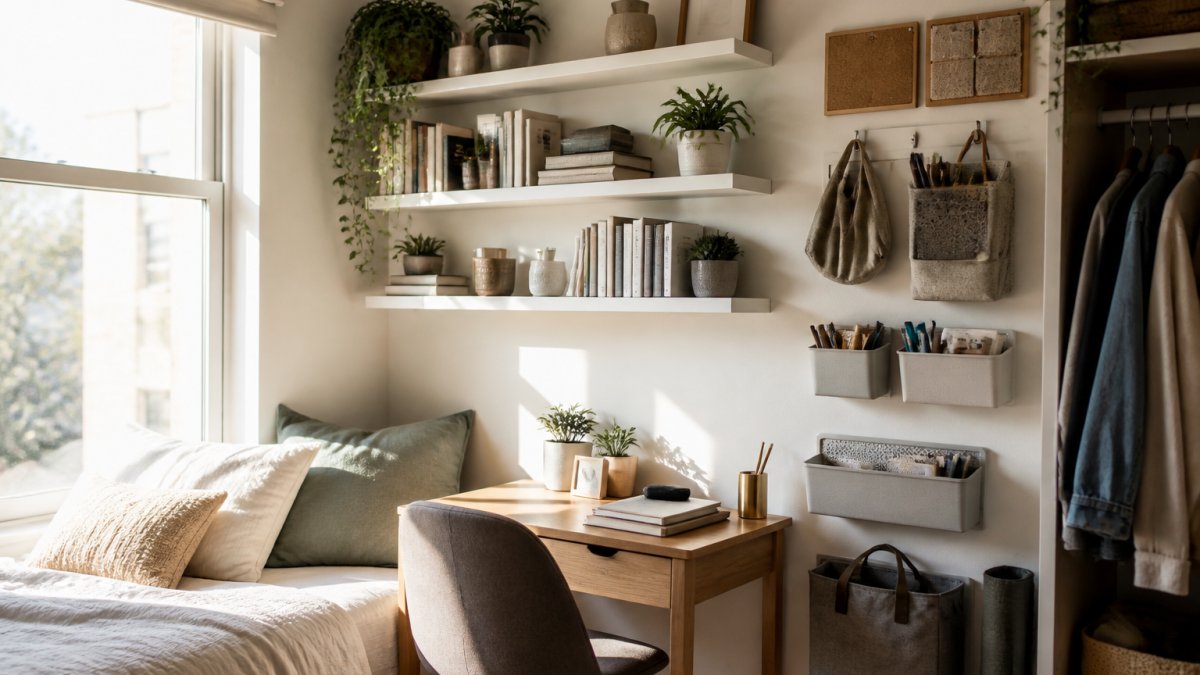
Floating Shelves for Display and Storage
Floating shelves give you storage without the visual weight of traditional cabinets. They're clean, minimal, and they work in any room. A shelf holding 20 books takes up no floor footprint at all, it's pure vertical gain.
The trick is distributing weight evenly. Most floating shelves handle books, plants, and lightweight décor comfortably. Heavy items need proper wall anchors. In a rental, you'll want to check your lease before drilling, but many landlords allow small holes if you patch them on exit.
Wall-Mounted Pegboards and Organisers
A pegboard is controlled chaos. You customise the layout, add hooks and shelves where you need them, and everything stays visible. For a kitchen, pegboards hold utensils, pans, and spices. In a bedroom, they organise jewellery, scarves, and accessories.
The SKÅDIS Pegboard from IKEA includes customisable hooks and shelves. It mounts directly to the wall and lets you rearrange as your needs change. The downside: it requires drilling, which won't work in every rental situation.
2. Space-Saving Furniture for Small Apartments That Multitask
Every piece of furniture in a tiny apartment should earn its space by doing more than one job. A chair that's just a chair is wasted real estate. A chair with storage inside is solving two problems at once.
Ottomans with Internal Storage
An ottoman with storage is the definition of multifunctional furniture. It's a footrest, extra seating, a side table, and a storage box all in one object. For a small living room, this is non-negotiable.
Look for ottomans with a hinged top and a spacious cavity inside. They work best for storing blankets, magazines, or seasonal items you don't access daily. The ottoman from Fantastic Furniture includes a padded lid for comfort.
The limitation: internal storage volume is modest compared to a dedicated cabinet. But for a studio or one-bedroom apartment, the space savings and dual functionality outweigh that trade-off.
Modular Shelving Units as Room Dividers
The IKEA KALLAX shelving unit is a workhorse for tiny apartments. It's a shelving system that doubles as a room divider, creating visual separation between spaces without eating up square metres like a full wall would.
A 4x4 KALLAX configuration can be oriented vertically or horizontally. You fill it with boxes, baskets, or leave shelves open for display. It's modular, so you add or remove sections as your needs change. The catch: it requires floor space, so it's best suited for studios where you're trying to carve out zones rather than apartments where every floor centimetre is precious.
3. Vertical Storage Ideas for Renters: Non-Permanent Solutions
Renters face a constraint homeowners don't: you can't drill into walls or make permanent changes. But non-permanent storage solutions exist, and they're often cheaper than permanent alternatives.
Over-the-Door Organisers
An over-the-door organiser is the renter's best friend. It uses space that already exists, the back of a door, and requires zero drilling. Just hang it on the door frame with the provided hooks.
Over-the-door organisers from Kmart come with multiple pockets or shelves. They work brilliantly for shoes, accessories, cleaning supplies, or pantry items. The trade-off: they add weight to the door, which can make it swing shut faster or feel heavier when opening.
Tension Rods and Hanging Systems
Tension rods are ingenious for renters. They wedge between two walls without fasteners, holding hanging organisers, scarves, belts, or lightweight clothing. They're temporary, adjustable, and leave no marks.
Place a tension rod inside a closet to create a second hanging rail, instantly doubling your hanging capacity. Or use one between two walls in a bedroom to hang a fabric organiser. They vary in cost depending on width and weight capacity.
4. Under-Bed Storage Hacks: Reclaim Hidden Space
The space under your bed is wasted real estate in most apartments. A bed frame sits 30-50 centimetres above the floor. That's room for storage boxes, and most people ignore it completely.
Under-bed storage boxes with wheels make access easy. You slide them out when you need something, slide them back when you're done. Clear plastic lets you see contents without opening the box. Latching lids keep dust out.
Target's under-bed storage boxes are designed for bulky, seasonal items: winter blankets, extra pillows, out-of-season clothing. They're designed for bulky, seasonal items: winter blankets, extra pillows, out-of-season clothing.
5. Closet Organisation Systems: Maximise Every Centimetre
A closet is often the largest storage space in a tiny apartment. Wasting it is a luxury you can't afford. Most closets come with a single rail and a shelf.
Stackable drawer organisers let you create vertical storage inside your closet.
Howard's Storage World stackable organisers interlock for stability and fit inside standard wardrobes. They interlock for stability and fit inside standard wardrobes. The trade-off: they work best for small, folded items.
Add a second hanging rail below your existing one to double your hanging capacity. Tension rods work here too, no drilling required.
6. Decluttering and Organisation Tips for Compact Living
Storage solutions only work if you're not storing things you don't need. A tiny apartment forces you to be ruthless about what stays and what goes. This is actually a gift, clutter costs you mental energy and physical space.
The Seasonal Rotation Strategy
You don't need to keep every item accessible year-round. Winter coats take up space in summer. Summer clothes take up space in winter. Rotate seasonal items into off-site storage or a storage unit.
Many people keep 70% of their wardrobe in rotation and store 30% seasonally. This cuts your active closet space by a third without losing anything. A self-storage unit can be a reasonable option if you're storing a season's worth of clothing, hobby gear, or furniture you're not using.
Budget-Friendly DIY Storage Hacks
You don't need expensive organisers to make storage work. Repurpose what you have:
- Mason jars hold small items like buttons, pins, or jewellery
- Shoeboxes stack neatly in closets and drawers
- Fabric bags from old clothing stores hold soft items
- Tension rods create a second hanging rail in your wardrobe
- Magnetic strips from IKEA hold kitchen knives and metal tools on walls
These hacks cost almost nothing and work as well as branded solutions.
The Psychological Impact of Clutter Reduction
Clutter isn't just a space problem, it's a mental load. Studies in environmental psychology show that visual clutter increases cognitive stress and reduces focus. A cluttered room makes you feel more anxious, even if you don't consciously notice it.
When you reduce clutter, you're not just freeing up floor space. You're reducing the mental noise in your environment. A clean, organised apartment feels bigger, calmer, and more liveable. This is why decluttering often feels like a relief beyond the practical benefits.
7. Hidden Storage Compartments and Dead Space Solutions
Every apartment has dead space: corners that are hard to reach, gaps between furniture, awkward alcoves.
Corner shelving units fit into corners that would otherwise sit empty.
Under-stair storage works if your apartment has stairs. Drawers or cabinets built into the space under steps reclaim hundreds of litres of storage.
Wall-mounted cabinets above doors are another dead space solution. The wall space between the top of a door frame and the ceiling is usually empty.
The Family Nest's range of space-saving furniture and organisation solutions is designed specifically for apartments where every centimetre matters.
Summary: Storage Solutions for Tiny Apartments
| Solution | Best For | Installation | Cost Range |
|---|---|---|---|
| Floating shelves | Books, plants, décor | Requires drilling | $20-$50 |
| Wall-mounted pegboards | Kitchen utensils, accessories | Requires drilling | $25-$60 |
| Ottomans with storage | Blankets, magazines, seating | No installation | $59-$150 |
| Over-the-door organisers | Shoes, accessories, pantry items | No installation | $10-$30 |
| Tension rods | Hanging organisers, clothing | No installation | $15-$40 |
| Under-bed storage boxes | Seasonal clothing, bulky items | No installation | $15-$40 |
| Stackable drawer organisers | Small folded items, accessories | No installation | $12-$25 |
| Corner shelving | Dead corner space | Requires drilling | $30-$80 |
The reality of tiny apartment living is this: you can't store everything. You'll choose between keeping items and keeping sanity. The best storage solutions work with this constraint, not against it.
Start with one category, your closet, your kitchen, your bedroom. Implement one or two solutions. See what works. Then move to the next space. Storage isn't a one-time project; it's an ongoing conversation with your space.
At The Family Nest, we understand that apartment living means making every choice count. Our space-saving furniture and organisation solutions are built for real apartments with real constraints.
IKEA's space-saving furniture guide for small apartments
Howard's Storage World's closet organisation systems
Storage King's secure self-storage solutions for seasonal rotation
Frequently Asked Questions
What are the best storage solutions for tiny apartments?
The most effective storage solutions for tiny apartments combine vertical storage, multifunctional furniture, and under-bed compartments. Floating shelves maximise wall space without consuming floor area, whilst ottomans with internal storage serve dual purposes. Over-the-door organisers, stackable drawers, and wall-mounted pegboards utilise dead space efficiently. The key is choosing solutions that match your lifestyle: renters benefit from non-permanent options, whilst homeowners can invest in built-in systems. Combining several approaches, vertical storage, hidden compartments, and compact furniture, creates a clutter-free environment that feels larger.
How can space-saving furniture for small apartments actually make a difference?
Space-saving furniture works by consolidating functions into single pieces, eliminating the need for multiple items. A storage ottoman replaces a footrest, coffee table, and storage chest. Modular shelving units serve as both room dividers and storage, creating definition without consuming extra floor area. These pieces reduce visual clutter and free up centimetres of floor space, which feels substantial in compact living. The psychological benefit is equally important: fewer separate items means less visual noise, making your apartment feel more spacious and organised.
Are vertical storage ideas for renters really non-permanent?
Yes, many vertical storage solutions work well for renters. Over-the-door organisers require no installation, tension rods hang between walls without drilling, and adhesive hooks hold lightweight shelves temporarily. Pegboards and floating shelves do require wall mounting, but damage-free adhesive strips or removable wall anchors minimise impact. When relocating, you simply remove the hardware and patch small holes, a standard part of bond return expectations. The Family Nest's easy installation guides make it simple to set up and take down storage without landlord disputes.
How do I declutter a small apartment without feeling overwhelmed?
Start by adopting a seasonal rotation strategy: store off-season clothing, decorations, and gear in under-bed boxes or external storage. This immediately reduces what's visible. Next, categorise items by frequency of use, daily items stay accessible, whilst occasional-use pieces move to higher shelves or storage. Apply the minimalism principle: keep only what serves a purpose or brings joy. Use stackable organisers to group similar items, making inventory clear and preventing duplicate purchases. Budget-friendly DIY solutions like repurposed containers and drawer dividers cost little but dramatically improve organisation. The psychological impact is significant: reducing visible clutter lowers stress and creates a sense of control over your space.
Can I really install storage solutions myself without tools or experience?
Many solutions require no tools or expertise. Over-the-door organisers hang with hooks, stackable drawers assemble by interlocking, and under-bed storage boxes roll into place. The Family Nest provides detailed installation guides for every product, and their free shipping and easy returns mean you can try solutions risk-free. Some solutions like floating shelves or pegboards do require basic drilling, but most hardware stores offer installation services if you're uncomfortable. Starting with tool-free options like over-the-door organisers and under-bed boxes lets you build confidence before tackling wall-mounted pieces.