

Table of Contents
- Why Sustainable Luxury Furniture Brands Are Worth Comparing
- Side-by-Side Comparison: Luxury Furniture Brands at a Glance
- Best Sustainable Furniture Brands: Brand-by-Brand Profiles
- Sustainable Furniture Materials: What to Look For
- Ethical Furniture Brands: Reading the Proof Behind the Claims
- Durable Furniture Buying Guide: Total Cost of Ownership
- Circularity and End-of-Life: What Happens After You're Done
- Conclusion: Choosing the Right Sustainable Luxury Brand
- Frequently Asked Questions
Last Updated: October 6, 2026
Why Sustainable Luxury Furniture Brands Are Worth Comparing
A sofa that costs more than a holiday usually earns its keep over 15 years, not five. That single idea is why comparing sustainable luxury furniture brands matters: the cheap option gets replaced three times while the good one gets repaired. This guide from The Family Nest sets out to make that comparison honest. We look at materials, credentials, repairability and total cost of ownership so you can judge which luxury furniture brands actually justify their price.
The sustainable furniture market rewards patience. Many buyers find that a well-made piece outlasts three budget replacements, which changes the maths entirely.
Side-by-Side Comparison: Luxury Furniture Brands at a Glance
Most roundups list brands without ever putting them on the same scale. Below is a like-for-like comparison of five brands that appear repeatedly in sustainable furniture coverage, scored against the same five criteria so you can see where each one actually stands.
| Brand | Materials Focus | Credential Evidence | Repairability | Circularity | Starting Price |
|---|---|---|---|---|---|
| Avocado | Certified wood, organic textiles | Named in sustainable furniture guides | Moderate | Limited public detail | From $299 |
| Sabai | Recycled and natural fibres | Named in sustainable furniture guides | High (modular) | Modular replacement parts | From $645 |
| Ethnicraft | Solid timber | Vetted for FSC, B Corp or GREENGUARD Gold | Moderate | Solid timber can be refinished | Not stated |
| Mater | Reclaimed and renewable materials | Vetted for FSC, B Corp or GREENGUARD Gold | Moderate | Reclaimed inputs, refinishable | Not stated |
| The Family Nest | Space-saving, easy-assembly pieces | Free returns, 30-day policy | High (easy disassembly) | Designed for disassembly and reuse | See website |
Prices above come from published sustainable furniture guides and are not Australia-specific. Check current pricing, delivery costs and lead times before you commit.
How We Scored Each Brand
We scored on five factors: material sourcing, third-party credentials, repairability, durability and price transparency. Each brand gets a simple high, moderate or low rating rather than a false-precision number.
- Material sourcing: reclaimed, recycled or certified renewable inputs score higher than unspecified timber.
- Credentials: named certifications beat vague "eco-friendly" language every time.
- Repairability: modular designs and available spare parts win.
- Durability: solid joinery and replaceable covers matter more than finish.
- Transparency: brands that publish sourcing details score higher than those that don't.
Why a Scoring Method Matters More Than a Brand List
A brand list tells you what exists. A scoring method tells you how to judge the next brand you encounter, including ones not on this page. That is the difference between a shopping list and a buying framework.
What This Comparison Does Not Cover
No public source we reviewed publishes comparable emissions data, wage audits or full lifecycle assessments for every brand on this list. Where that data is missing, we say so rather than guess. Use this as a starting filter, then ask each brand directly for the evidence behind its claims before you buy.
Best Sustainable Furniture Brands: Brand-by-Brand Profiles
The best sustainable luxury furniture brands combine verified materials with genuine repairability, not just a green logo. Here is what each one offers, and where the public evidence runs out.
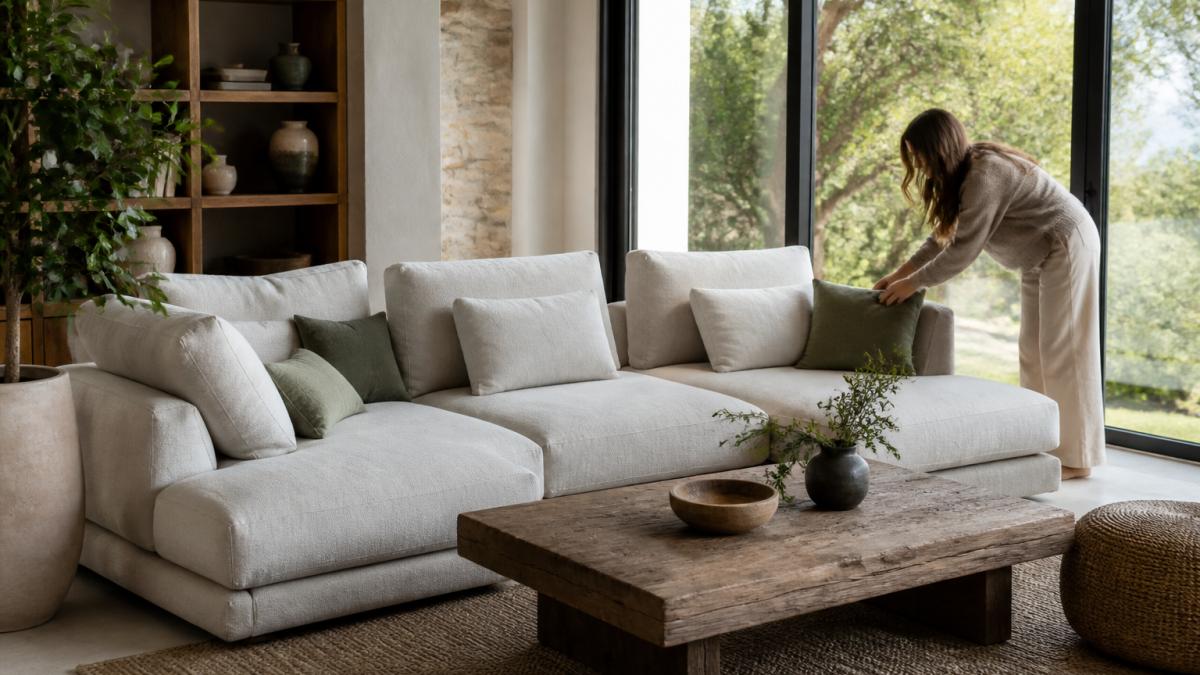
Avocado: Heirloom-Quality Construction
Avocado appears in sustainable furniture guides as an heirloom-quality option, with prices listed from $299. The appeal is construction built to be handed down rather than replaced. The catch: the supplied guides don't detail specific certifications or product specs, so ask for proof of sourcing before buying.
What to verify before purchase: named certification for the timber used, the warranty length on frames versus upholstery, and whether replacement covers or cushions are sold separately.
Sabai: Repairable, Modular Sofas
Sabai is noted for repairable, modular sofas starting at $645. Modular design means you can replace a single worn cushion instead of the whole couch, which extends product lifespan considerably. Repair terms and configuration options aren't specified in the source material, so confirm those directly.
What to verify before purchase: which components are individually replaceable, how long spare parts stay in stock after a model is discontinued, and whether the fabric range includes certified recycled or organic textiles.
Ethnicraft and Mater: Credential-Vetted Design
Both Ethnicraft and Mater appear in guides whose selections are vetted for FSC, B Corp or GREENGUARD Gold credentials. That vetting signals third-party verification, though the sources don't specify which credential applies to which brand. Pricing isn't stated either. Treat both as strong candidates pending direct confirmation.
What to verify before purchase: which specific certification applies to the exact product you're buying (not just the brand), the timber species and origin, and the finish used, low-VOC finishes matter as much as the frame.
The Family Nest: Practical, Move-Friendly Pieces
For renters and young families, The Family Nest takes a different angle: furniture designed to be assembled, disassembled and moved without damage. Free shipping and free returns, easy installation with provided guides, and a 30-day return policy remove most of the risk from buying online. If you've been burned by damaged deliveries before, that returns policy is the safety net.
What to verify before purchase: the assembly method (tool-free versus tools required), the weight and pack dimensions for moving, and whether individual components can be reordered if one is damaged in transit.
Product-Level Comparison: What to Check on Equivalent Pieces
Brand-level claims are easy to make. Product-level evidence is harder. When comparing two sofas, two dining tables or two bed frames across these brands, line up the same six data points:
| Data point | Why it matters |
|---|---|
| Frame material and joinery | Solid certified timber with mortise-and-tenon or dowel joinery outlasts particleboard and staples |
| Upholstery or finish | Natural fibres and low-VOC finishes protect indoor air quality and wear better |
| Country of manufacture | Shorter, documented supply chains are easier to verify |
| Lead time | Long lead times can signal made-to-order quality, or poor logistics |
| Warranty terms | Frame warranties of 10+ years signal confidence; 1-year warranties do not |
| Spare parts availability | Replaceable covers, cushions and legs determine real lifespan |
If a brand can't answer all six, that silence is itself a data point.
Sustainable Furniture Materials: What to Look For
The most sustainable furniture materials are reclaimed wood, recycled metals, certified timber and organic textiles finished with low-VOC products. Everything else is marketing until proven.
Start with the frame. Solid certified wood outlasts particleboard by a wide margin. Then check the finish: non-toxic, low-VOC finishes protect indoor air quality as well as the environment. Upholstery should be natural fibres or recycled content where possible.
- Reclaimed wood: gives old timber a second life and often looks better with age.
- Recycled materials: steel and aluminium recycle without losing quality.
- Renewable materials: fast-growing timber and natural fibres reduce pressure on old-growth forests.
- Organic textiles: fewer chemical inputs across the supply chain.
Ask one question of any brand: where did this come from, and can you prove it? Traceability is the difference between a claim and a credential.
Ethical Furniture Brands: Reading the Proof Behind the Claims
Ethical furniture brands publish evidence: certifications, supply-chain transparency and fair-wage statements. Words like "eco-friendly" cost nothing to print, so look for third-party verification instead.
The Australian Competition and Consumer Commission's guidance on environmental claims is blunt about this: businesses must be able to substantiate green claims, and vague or overstated environmental language can breach consumer law. That gives you real use. If a brand can't back up a claim, it shouldn't be making it.
Check for named certifications rather than logos without context. FSC covers responsible forestry (Home). B Corp covers broader social and environmental performance. GREENGUARD Gold covers low chemical emissions. Any of these is worth more than a paragraph of green prose.
Durable Furniture Buying Guide: Total Cost of Ownership
Total cost of ownership is where luxury furniture earns its reputation. A $2,000 sofa that lasts 15 years costs about $133 a year. A $600 sofa replaced every four years costs $150 a year, and that's before delivery and assembly.
Run the maths on lifespan, not sticker price:
| Factor | Budget Piece | Luxury Piece |
|---|---|---|
| Upfront cost | Lower | Higher |
| Lifespan | 3-5 years | 10-15+ years |
| Repairs | Rarely possible | Often supported |
| Resale value | Minimal | Meaningful |
| Cost per year | Often higher | Often lower |
Beyond the numbers, think about moving costs. Heavy furniture that can't be disassembled gets left behind or damaged in transit. Easy assembly and disassembly is a genuine financial advantage for anyone renting.
Circularity and End-of-Life: What Happens After You're Done
Circular design means a piece can be repaired, refurbished, resold or recycled instead of sent to landfill. For luxury furniture, circularity is the strongest sustainability argument there is.
Modular sofas let you replace one component. Solid timber can be sanded and refinished. Metal frames can be recycled indefinitely. Take-back programs and refurbishment services close the loop further, though availability varies by brand and region.
When you're comparing options, ask three questions: can it be repaired, can it be resold, and can it be recycled? A yes to all three is worth more than any certification badge.
Conclusion: Choosing the Right Sustainable Luxury Brand
The hard part isn't finding a sustainable luxury furniture brand. It's finding one that proves its claims, survives a move and still looks good in a decade.
At The Family Nest, we built our range around exactly that problem: space-saving designs, easy installation with provided guides, free shipping and free returns, and a 30-day return policy so you can test a piece in your own space without risk.
Frequently Asked Questions
What makes a furniture brand sustainable?
A sustainable furniture brand uses responsibly sourced materials like certified wood, reclaimed timber or recycled content, applies low-VOC and non-toxic finishes, and can show third-party verification such as FSC, B Corp or GREENGUARD Gold credentials. It also considers product lifespan, repairability and end-of-life take-back or refurbishment options. Brands that publish supply-chain transparency details and ethical labour commitments give you more to verify than those relying on vague green language alone.
Which luxury furniture brands use responsibly sourced materials?
Among the brands compared here, Avocado is noted for heirloom-quality furniture, Sabai for repairable modular sofas, and Ethnicraft and Mater appear in guides whose selections are vetted for FSC, B Corp or GREENGUARD Gold credentials. The specific certification for each brand is not always stated in available sources, so check the brand's own documentation before buying. Look for certified wood, organic textiles and low-VOC finishes as baseline markers of responsible sourcing.
Is sustainable luxury furniture worth the higher price?
It depends on how long you keep the piece. A sofa that can be repaired and reupholstered rather than replaced spreads its cost over many more years, which changes the total cost of ownership. Sabai's repairable modular design and Avocado's heirloom-quality positioning both point to longer product lifespans. If you factor in repairability, resale value and warranty coverage, the upfront premium often narrows considerably against cheaper furniture replaced every few years.
How can you tell whether sustainable furniture is genuinely eco-friendly?
Look for third-party verification rather than brand self-description. Certifications like FSC for wood, GREENGUARD Gold for low emissions, and B Corp for overall ethical performance are independently assessed. Check whether the brand publishes supply-chain transparency information, specific material origins, and take-back or refurbishment programs. If a brand claims sustainability without naming a certification, a material source or a measurable target, treat the claim as unverified until you find documentation.
What should you check before buying sustainable furniture online?
Confirm the materials and any certifications, the warranty length, and whether spare parts or repair services are available. Check the return policy and who covers return shipping, since furniture returns are costly. For renters or people who move often, verify whether the piece disassembles and reassembles without damage. Also check delivery coverage and lead times for your area, as regional availability affects both cost and how quickly you receive the item.