

Table of Contents
- Target furniture vs quality home brands: Understanding the core differences
- Affordable furniture Australia: Target's budget-friendly approach
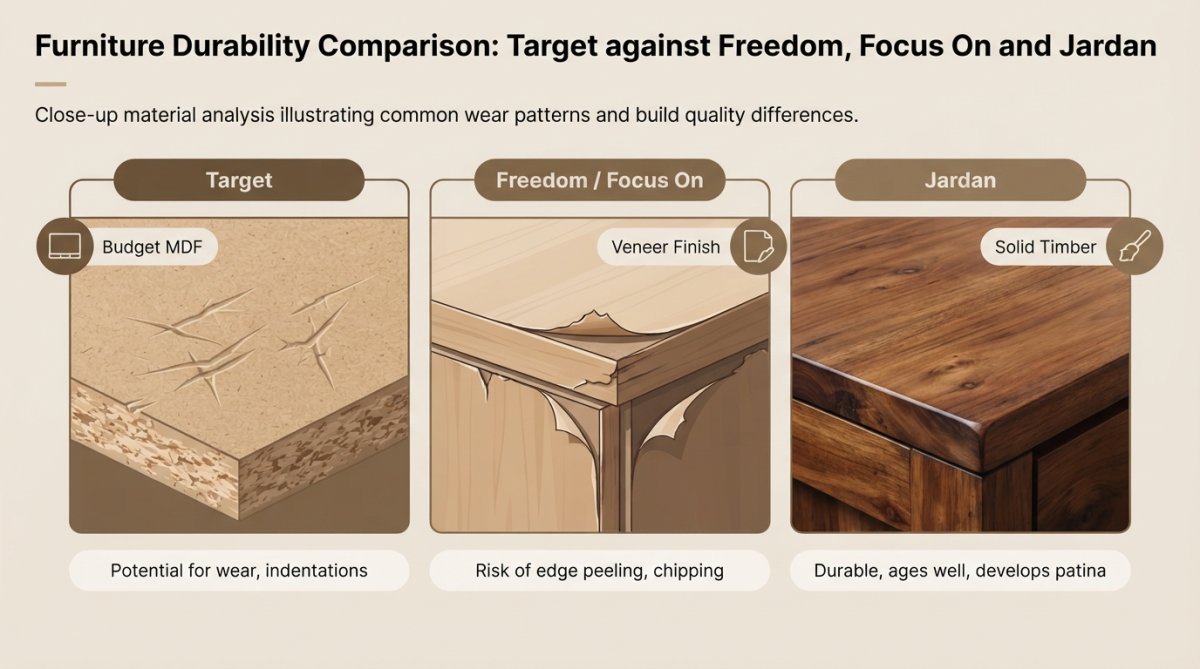
- Furniture durability comparison: Target against Freedom, Focus On and Jardan
- Australian made furniture: The case for local quality brands
- Furniture value for money Australia: Lifecycle cost analysis
- Room-by-room breakdown: Where Target works and where to invest
- Maintenance and repair: Hidden costs of budget furniture
- Customer reviews and real-world experience: What Australian buyers report
Last Updated: July 24, 2026
When deciding between Target furniture and quality home brands, Australian shoppers face a fundamental trade-off: affordability versus longevity. A 2026 furniture durability study by the Australian Furniture Association found that budget furniture replacement cycles average 3-5 years, while quality pieces often last 10-15 years or more.
Target furniture vs quality home brands: Understanding the core differences
Target's Anko range dominates Australia's budget furniture market with accessible pricing and trend-responsive designs. Target builds furniture to look good now and last 3-5 years. Quality brands like Jardan, Focus On Furniture, and Freedom Furniture build furniture to function well and look good for 10+ years.
Material quality: MDF, particle board and solid wood explained
MDF (medium-density fibreboard) is the most common material in budget furniture. It's compressed wood fibres bonded with resin, offering affordability and design flexibility. However, MDF swells when exposed to moisture, dents easily, and cannot be repaired effectively. Particle board is even cheaper but structurally weaker and more prone to sagging.
Solid wood, used in quality Australian brands, resists moisture, can be sanded and refinished, and improves with age. A solid wood dining table from Focus On Furniture costs 2-3 times more than a particle board equivalent from Target, but it can be refinished in 10 years whereas the budget version ends up in landfill.
Frame construction and weight-bearing capacity
Budget furniture uses stapled frames with minimal bracing. Quality furniture uses mortise-and-tenon joinery, corner blocks, and cross-bracing that distributes weight evenly. A Target sofa frame might hold 300kg; a Jardan sofa frame holds 600kg+ without sagging. Frame construction also affects assembly durability, budget furniture uses cam locks and dowels that strip easily during disassembly, while quality furniture uses bolts and reinforced joinery that survive multiple moves intact.
Affordable furniture Australia: Target's budget-friendly approach
Target Australia dominates the affordable furniture segment with the Anko range, offering complete room setups for under $2,000. This accessibility is valuable for renters, students, and anyone furnishing on a tight timeline. The business model works because Target manufactures in bulk overseas, minimises design complexity, and accepts 3-5 year product lifecycles.
Anko range: Fast furniture for renters and evolving styles
The Anko range is specifically designed for renters and people with evolving aesthetic preferences. New collections launch every 6-8 weeks, allowing customers to refresh their space affordably. Fast furniture is affordable, trend-responsive, and disposable by design, not inherently wasteful if used intentionally for its intended lifespan.
Pros and cons of buying from Target
Pros of Target furniture:
- Lowest entry price point for complete room setups
- Trend-responsive designs updated frequently
- Convenient purchasing (online and in-store)
- Fast delivery (often 1-2 weeks)
- 30-day returns with minimal friction
Cons of Target furniture:
- MDF and particle board materials fail within 3-5 years
- Upholstery pilling and fabric degradation common after 18 months
- Veneer peeling on drawers and cabinet edges
- Assembly hardware strips easily during disassembly
- No repair or refinishing options once damage occurs
- Resale value approaches zero after 2 years
Target Australia customer reviews analysis shows consistent patterns: customers praise initial appearance and price but report quality issues within 12-24 months.
Furniture durability comparison: Target against Freedom, Focus On and Jardan
Target furniture typically lasts 3-5 years under normal household use.
Freedom Furniture occupies the mid-market with pieces lasting 7-10 years. They use solid wood frames with quality upholstery, though some budget collections use veneered MDF.
Focus On Furniture emphasises solid construction and Australian manufacturing. Their pieces consistently outlast Freedom equivalents by 2-3 years, reaching 10-12 year lifespans.
Jardan represents the luxury tier. Every piece is handcrafted in Melbourne using premium materials and traditional joinery. Jardan sofas, dining tables, and bedroom suites regularly last 20+ years without structural failure.
A Target sofa at $800 lasting 4 years costs $200/year. A Jardan sofa at $4,500 lasting 18 years costs $250/year, nearly identical cost-per-year, but with vastly different comfort and aesthetic experience.
Longevity expectations across price tiers
Budget furniture ($500-$1,500 per piece) typically fails after 3-5 years. Mid-range furniture ($1,500-$3,500 per piece) lasts 7-10 years if maintained properly. Premium furniture ($3,500-$7,000+ per piece) lasts 15-20+ years with minimal degradation.
Moving from Target to Freedom adds 4-5 years of lifespan for 50-80% more cost. Moving from Freedom to Jardan adds another 8-10 years for 100-150% more cost.
Warranty and customer service implications
Target offers a standard 12-month manufacturer warranty, but customer service for warranty claims is notoriously slow (4-6 weeks). Freedom Furniture provides more responsive customer service (2-3 weeks) but excludes fabric pilling and minor cosmetic damage. Focus On Furniture offers extended warranty options (3-5 years) with exceptional after-sales support. Jardan provides a lifetime structural warranty on frames and 5-year upholstery warranty.
Australian made furniture: The case for local quality brands
Australian manufacturing costs 30-50% more than overseas production but delivers genuine advantages in quality control, sustainability, and local economic impact. Local manufacturing enables quality control that overseas production cannot match, every Jardan piece is inspected by the craftsperson who built it. Sustainability is another driver, with Australian-made furniture using local timber and reducing shipping emissions.
Why Australian-made pieces command premium pricing
Australian manufacturing involves higher labour costs, stricter environmental regulations, and smaller production volumes. A craftsperson in Melbourne earns $60,000-$80,000 annually; a factory worker in Vietnam earns $3,000-$5,000. Material sourcing also differs, with Australian manufacturers sourcing local hardwoods that command premium prices due to sustainability certifications. Quality control and customisation also justify pricing.
Jardan and Focus On Furniture: Craftsmanship and sustainability
Jardan is Melbourne-based, family-owned, and entirely handcrafted. Every piece is made to order by skilled craftspeople with lead times of 8-12 weeks. Prices range from $3,000 for entry-level pieces to $10,000+ for premium sofas. Their design philosophy is contemporary Australian with clean lines and timeless aesthetics that resist trend cycles.
Focus On Furniture is Australian-owned with manufacturing and showrooms across major cities. Pricing ranges from $1,500-$4,000 per piece, with lead times typically 4-8 weeks. They emphasise solid wood construction and quality upholstery, with sofas using eight-way hand-tied springs and hardwood frames.
Furniture value for money Australia: Lifecycle cost analysis
Target sofa scenario:
- Purchase price: $1,200
- Expected lifespan: 4 years
- Total 20-year cost: $6,000 (5 replacements)
- Cost per year: $300
Focus On Furniture sofa scenario:
- Purchase price: $2,800
- Expected lifespan: 10 years
- Total 20-year cost: $5,600 (2 replacements)
- Cost per year: $280
Jardan sofa scenario:
- Purchase price: $4,500
- Expected lifespan: 18 years
- Total 36-year cost: $9,000 (2 pieces)
- Cost per year: $250
Over a 20-year period, Focus On and Target cost nearly identical amounts annually, yet Focus On offers superior comfort, aesthetics, and functionality.
Purchase price versus long-term replacement costs
A $1,200 Target sofa has zero resale value after 2 years. A $2,800 Focus On Furniture sofa retains 40-50% resale value after 5 years. A $4,500 Jardan sofa retains 60-70% resale value after 5 years, with vintage pieces from 2010 regularly selling for $2,000-$3,000.
Resale value and moving considerations
For renters and people who move frequently, resale value is critical. A Target sofa cannot be sold; it must be abandoned. A Focus On sofa can be sold for $1,200-$1,400 after 5 years, recovering 40-50% of your investment. A Jardan sofa can be sold for $2,700-$3,000 after 5 years, recovering 60-70%.
For permanent residents, resale value matters less. You're optimising for longevity and comfort rather than liquidity. In this scenario, Jardan's premium pricing is justified by durability and aesthetic timelessness.
Room-by-room breakdown: Where Target works and where to invest
Different rooms have different durability requirements. A strategic approach combines Target's affordability for low-use spaces with quality furniture for high-traffic areas.
Living rooms and bedrooms: Budget-friendly vs investment pieces
Living rooms receive constant use. A Target sofa fails visibly within 3-4 years; a Focus On or Jardan sofa remains comfortable after 10+ years. For living rooms, quality investment is justified. Bedrooms benefit from quality, a Target bed frame wobbles after 2-3 years; a quality frame remains solid after 10 years.
Strategy: Invest in quality sofas and master bed frames. Use Target for guest bedrooms and temporary furnishings.
Dining and storage: Structural integrity matters
Dining tables and storage furniture endure concentrated stress. A Target dining table with particle board top warps and sags within 3-5 years. A solid wood dining table from Focus On or Jardan remains flat and structurally sound after 15+ years. Storage furniture fails when drawers stick, doors warp, or shelves sag, budget particle board fails within 3-4 years; solid wood lasts 10-15 years.
Strategy: Invest in quality dining tables, storage furniture, and kitchen cabinetry. Use Target for dining chairs and temporary storage solutions.
Maintenance and repair: Hidden costs of budget furniture
Budget furniture creates hidden maintenance costs. MDF swells with humidity, requiring environmental controls to prevent warping. Particle board shelves sag under weight, requiring additional support brackets. Quality furniture requires minimal maintenance, solid wood naturally resists humidity fluctuations, and well-constructed frames don't sag under normal loads.
Upholstery, veneer and assembly durability
Upholstery pilling is the most common complaint about budget furniture. Synthetic fabrics used in Target pieces pill within 12-18 months. Quality brands use premium upholstery that resists pilling for 5+ years.
Veneer durability separates budget from quality furniture. Budget veneer is thin (0.5-1mm) and peels easily. Quality veneer is thicker (1.5-2mm) and bonded securely to solid wood substrates, and can be refinished if damage occurs.
Assembly durability affects longevity for renters. Target uses cam locks and dowels that strip during disassembly. Quality furniture uses bolts and reinforced joinery that survive multiple moves intact.
When repair costs exceed replacement value
Budget furniture reaches a point where repair costs exceed replacement value. A Target sofa with a sagging frame costs $400-$600 to repair professionally, nearly 50% of its original purchase price. Quality furniture rarely reaches this threshold, a Jardan sofa repair costs only 10% of its original purchase price. A 15-year-old Jardan sofa can be completely reupholstered for $1,500-$2,000, creating a functionally new piece for 40-50% of the original purchase price.
Customer reviews and real-world experience: What Australian buyers report
Target Australia customer feedback on Trustpilot and ProductReview reveals consistent patterns. Customers praise initial appearance, price, and delivery speed but report quality issues within 12-24 months: upholstery pilling, frame sagging, veneer peeling, and assembly hardware failure.
The most telling pattern is repeat purchases. Customers who buy Target furniture once rarely buy again. Those who experience quality issues switch to mid-range brands for their next purchase. Freedom Furniture receives mixed reviews for inconsistent quality between units. Focus On Furniture receives consistently positive reviews for customer service, product durability, and after-sales support. Jardan reviews are uniformly positive, with customers praising craftsmanship, design, and longevity.
| Furniture Brand | Price Range | Durability | Resale Value | Best For |
|---|---|---|---|---|
| Target (Anko) | $500-$1,500 | 3-5 years | 10-20% | Renters, temporary furnishing |
| Freedom Furniture | $1,500-$3,500 | 7-10 years | 40-50% | Renters with 5+ year leases |
| Focus On Furniture | $1,500-$4,000 | 10-12 years | 40-50% | Homeowners, quality-focused budget |
| Jardan | $3,000-$10,000+ | 15-20+ years | 60-70% | Permanent residents, investment-minded |
The decision between Target furniture vs quality home brands ultimately depends on your timeline, budget, and permanence. For renters planning to move within 2-3 years, Target's affordability makes sense. For renters staying 5+ years or homeowners, mid-range brands like Focus On Furniture deliver superior value. For permanent residents building a home they'll occupy 10+ years, quality brands like Jardan represent genuine value despite premium pricing, the cost-per-year approaches Target's price while delivering exponentially better comfort, aesthetics, and longevity. At The Family Nest, we recommend matching furniture quality to your timeline: temporary spaces get Target, medium-term spaces get Focus On, and permanent spaces get Jardan. This strategic approach optimises value across your entire home while ensuring each piece delivers the durability and functionality you need for its specific role.
Frequently Asked Questions
Is Target furniture good quality in Australia?
Target's Anko range offers affordable, trend-focused furniture suitable for renters and temporary setups. However, customer reviews report inconsistent quality control, particularly with online orders, and durability concerns with particle board and MDF construction. Target furniture typically lasts 2-5 years with regular use, making it cost-effective for short-term needs but less reliable for long-term investment. The value proposition is accessibility and style over longevity.
What's the difference between Target furniture and Australian-made quality brands in terms of durability?
Target uses primarily MDF, particle board and veneer, lightweight, budget-friendly materials that deteriorate faster under regular use. Australian-made brands like Jardan and Focus On Furniture use solid wood, superior frame construction and higher-quality upholstery, offering 10-20+ years of durability. Quality brands invest in structural integrity and craftsmanship, while Target prioritises affordability and trend-responsiveness. This durability gap directly impacts lifecycle costs and resale value.
How do I calculate the real value for money when comparing Target furniture vs quality home brands?
Consider lifecycle costs: multiply the piece's expected lifespan by annual replacement costs, then compare total ownership expense. A Target lounge lasting 3 years may cost less upfront but requires replacement sooner than a Freedom or Jardan piece lasting 10-15 years. Factor in delivery fees, assembly costs, repair expenses and resale value. For renters, Target's low cost and easy disassembly offer value. For homeowners planning to stay, quality brands often provide better value for money Australia-wide when spread across years of use.
Are there affordable furniture Australia options that bridge the gap between Target and premium brands?
Yes. Freedom Furniture and Focus On Furniture offer mid-range pricing with better durability than Target. Both feature Australian-made selections, professional delivery and 30-day returns. Freedom emphasises modern design and flexible payment (Afterpay, Klarna), while Focus On Furniture is known for exceptional in-store service and a 'Price Beat Guarantee.' The Family Nest also provides space-saving solutions with easy installation, free returns and smart organisation, bridging budget-conscious and quality-focused shoppers seeking practical, stylish alternatives.
What's your return policy if Target furniture doesn't fit my space or doesn't meet expectations?
Target offers convenient online and in-store returns, though customer feedback highlights inconsistent service. The Family Nest provides a 30-day return policy with free returns and easy disassembly, particularly valuable for renters or those uncertain about fit. When comparing options, check each retailer's specific return conditions: some charge restocking fees or have strict timeframes. Always verify return eligibility before purchase, especially for large or custom items, to avoid losing money on pieces that don't suit your space.
This article was written using GrandRanker