

Table of Contents
- Where to Buy Modern Furniture on a Budget: Top Stores Compared
- How to Furnish an Apartment on a Budget
- Space-Saving Furniture Ideas for Small Homes
- Tips for Buying Furniture Online
- Room-by-Room Budget Allocation
- Material Durability: How to Spot Furniture That Lasts
- Mixing New and Second-Hand Pieces
- Conclusion: Where to Buy Modern Furniture on a Budget
- Frequently Asked Questions
Last Updated: September 15, 2026
Where to Buy Modern Furniture on a Budget: Top Stores Compared
Finding where to buy modern furniture on a budget comes down to matching the right retailer to your room, your timeline and how much assembly you're willing to do. This guide from The Family Nest compares the major options, then walks through room-by-room budgets, material checks and styling tricks that stretch every dollar.
Budget isn't just about the sticker price. It's about what a piece costs you per year of use, which is why the durability section below matters as much as the price tags.
Below, we'll show you exactly how to furnish a whole apartment without blowing your budget, including a simple allocation framework most shoppers never use.
The Family Nest: Free Shipping and Easy Returns
The Family Nest is our top pick for budget-conscious shoppers who want modern pieces without the online-furniture gamble. Every order ships free and returns are free too, backed by a 30-day return policy and secure SSL checkout. Assembly guides come in the box, so a flat-pack bookshelf or modular sofa doesn't turn into a weekend project.
What most reviews miss is how much free returns change your risk calculation. Ordering a sofa online is normally a bet, because return freight can cost more than the sofa. When returns are free, you can measure, order and send it back if the scale is wrong.
IKEA, Castlery, Article, Wayfair and Blu Dot
Each of these retailers solves a different version of the same problem. Here's how they stack up on price, delivery and assembly:
| Retailer | Best For | Assembly | Watch Out For |
|---|---|---|---|
| IKEA | Lowest prices, flat-pack | Self-assembly required | Time-consuming builds |
| Castlery | Mid-range sofas and beds | Assembly service available | Fewer showrooms |
| Article | Online-only modern design | Some assembly | No stores to test comfort |
| Wayfair | Widest selection | Varies by brand | Mixed quality |
| Blu Dot | Statement pieces | Minimal assembly | Higher price point |
How to Furnish an Apartment on a Budget
Furnishing an apartment on a budget works best when you buy the big anchors first and fill gaps second. Beds, sofas and dining tables set the tone for a room; rugs, lamps and cushions are where you save. But the sequencing matters as much as the split, and most guides skip the mechanics.
A common mistake is buying everything in one weekend. Spread purchases over two or three months and you'll catch clearance sale cycles instead of paying full price. Retailers typically clear floor stock at the end of a season and again in the post-Christmas period, so a sofa bought in late January can cost noticeably less than the same sofa in November (ACCC sweep finds concerning Black Friday 'sales' advertising). If you can wait, wait.
Here is a workable order of operations for a first apartment:
- Measure first, buy second. Measure every wall, doorway, lift and stairwell before ordering. A sofa that won't fit through the lift is a return waiting to happen, and even free returns cost you time.
- Buy the sleep and sit pieces new. Mattress, sofa and desk chair are the three items where hygiene, warranty and comfort justify buying new. Everything else can wait or be sourced second-hand.
- Add storage before decor. Storage keeps a small home functional; decor is the last layer. Buying decor first is the most common budget mistake because it fills the room without solving the space problem.
- Layer in decor last. Cushions, rugs and lighting are where you add personality cheaply, and they are the easiest items to swap as your taste changes.
A practical budget split for a first apartment is roughly 40% on the living room, 30% on the bedroom, 20% on storage and organisation, and 10% on decor (moneysmart.gov.au). The living room takes the biggest share because the sofa is the single most-used and most expensive piece you'll buy. Bedroom spend should go to the mattress and bed frame first; bedside tables and lighting can wait. Storage covers wardrobes, shelving and organisation solutions that keep a small home functional. The decor slice covers cushions, rugs and accent pieces.
| Room | Share of Budget | Priority Purchase |
|---|---|---|
| Living room | 40% | Sofa or modular seating |
| Bedroom | 30% | Mattress and bed frame |
| Storage | 20% | Wardrobes and shelving |
| Decor | 10% | Rugs, lighting, cushions |
If you're furnishing a home office setup as well, pull that from the storage slice rather than the living room. A desk and chair are functional storage-adjacent items, not living room anchors.
The unique angle most guides miss: treat the budget as a per-year cost, not a sticker price. A $400 sofa that lasts two years costs $200 a year. A $900 sofa that lasts ten years costs $90 a year. Once you frame it that way, the mid-range option often wins on total cost even though it loses on the price tag. That calculation is the single most useful budgeting tool for furniture, and it is why the material durability section below matters as much as the price tags.
Space-Saving Furniture Ideas for Small Homes
Space-saving furniture is any piece that does two jobs at once: storage that doubles as seating, or a table that folds flat against the wall.
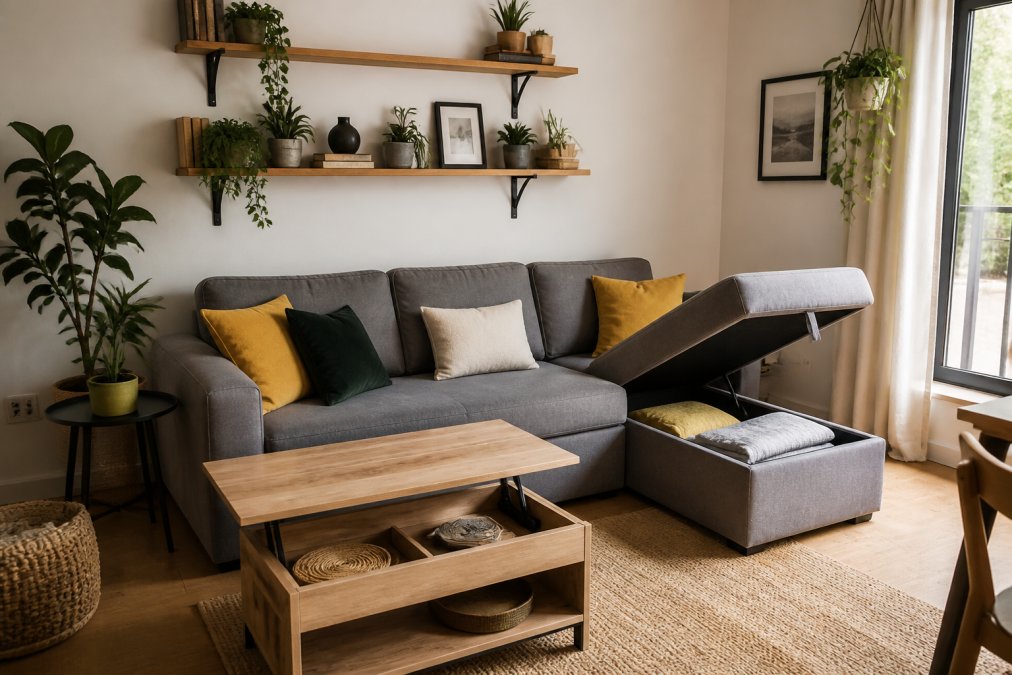
Look for modular sofas you can reconfigure as your space changes, wall-mounted shelving that frees up floor area, and nesting tables that tuck away when guests leave. An ergonomic design matters here too, because a desk that folds down still needs to sit at the right height. For renters, anything that disassembles easily is worth more than something that looks slightly better but stays behind when you move.
Tips for Buying Furniture Online
Buying furniture online safely means checking three things before you pay: exact dimensions, the return policy and real customer reviews.
Compare the listed measurements against your space with a tape measure, not your eye. Read the return terms closely, because "free returns" sometimes excludes bulky items (Repair, replace, refund, cancel). Sort reviews by newest and look for uploaded photos, which show the piece in real rooms rather than a studio set. Finally, check the warranty period on frames and mechanisms, since that's where cheap furniture fails first.
Room-by-Room Budget Allocation
A workable split for a first apartment is roughly 40% on the living room, 30% on the bedroom, 20% on storage and organisation, and 10% on decor.
The living room takes the biggest share because the sofa is the single most-used and most expensive piece you'll buy. Bedroom spend should go to the mattress and bed frame first; bedside tables and lighting can wait. Storage covers wardrobes, shelving and organisation solutions that keep a small home functional. The decor slice covers cushions, rugs and accent pieces, which is where you add personality without much cost.
| Room | Share of Budget | Priority Purchase |
|---|---|---|
| Living room | 40% | Sofa or modular seating |
| Bedroom | 30% | Mattress and bed frame |
| Storage | 20% | Wardrobes and shelving |
| Decor | 10% | Rugs, lighting, cushions |
If you're furnishing a home office setup as well, pull that from the storage slice rather than the living room.
Material Durability: How to Spot Furniture That Lasts
Durable materials are the difference between furniture that lasts a decade and furniture that sags within a year. Check the frame, the joinery and the upholstery before you check the price.
Solid wood frames outlast particleboard, which swells and crumbles when it gets damp. Look for joinery that's screwed and glued rather than stapled. On upholstery, a tight weave holds up better than loose fabric, and removable covers make cleaning realistic. Warranties tell you what the maker believes about its own product: a long frame warranty signals confidence, while a short one signals the opposite.
Mixing New and Second-Hand Pieces
Mixing new and second-hand furniture is the fastest way to furnish a home on a small budget without it looking like a showroom. Buy the pieces you sit and sleep on new, and source the rest second-hand.
Sofas, mattresses and desk chairs are worth buying new for hygiene, warranty and comfort. Coffee tables, bookshelves, dining chairs and accent pieces are excellent second-hand finds, and solid timber from an older piece often beats new flat-pack on durability.
Conclusion: Where to Buy Modern Furniture on a Budget
Frequently Asked Questions
Where is the best place to get affordable furniture?
The best place depends on your priorities. The Family Nest offers free shipping and free returns with a 30-day return policy, which suits renters who want to try pieces without risk. Compare delivery fees, warranty periods and assembly instructions before you commit.
What are the best affordable furniture brands for modern homes?
The Family Nest curates space-saving furniture and home decor with easy installation guides, making it a practical choice for first apartments and family homes.
How do I identify quality modern furniture on a budget?
Check the frame material first. Solid wood or metal frames outlast particleboard. Look for durable materials like top-grain leather or tight-weave upholstery. Read customer reviews for photos and notes on assembly instructions. Confirm the warranty period covers structural frames. A slightly higher price point often means better value for money over five years than a cheaper piece that needs replacing.
Is it better to buy furniture online or in-store for value?
Online shopping can offer convenience and a wide selection. In-store shopping lets you test comfort and see the showroom experience. Check the return policy either way. The Family Nest offers free returns within 30 days, which removes much of the risk of buying sight unseen.