

Table of Contents
- How Bedroom Clutter Affects Sleep Quality
- The Psychological Effects of Clutter on Your Mind
- Physical Health Consequences of Not Decluttering
- How to Declutter Your Bedroom Fast
- Bedroom Organisation Ideas That Actually Work
- The Hidden Cost of Clutter: Time, Money, and Energy
- Building Your Decluttered Bedroom Sanctuary
- Conclusion
Last Updated: August 29, 2026
How Bedroom Clutter Affects Sleep Quality
Clutter disrupts your sleep by keeping your brain in a state of mild alert. When your nervous system encounters visual chaos, piles of clothes, scattered items, stacks of papers, it cannot fully relax into the restorative state sleep requires.

Your bedroom should signal safety to your nervous system. Clutter sends the opposite message: there's work to be done, decisions to be made. This keeps your mind partially engaged even as you're trying to fall asleep. Sleep hygiene experts emphasise that a tidy bedroom is foundational to restorative sleep. The visual noise of clutter competes for your attention, making deep sleep cycles harder to achieve. Over time, poor sleep compounds, you wake less refreshed, cognitive function suffers, and stress rises, making the clutter feel even more overwhelming to address.
The Psychological Effects of Clutter on Your Mind
Clutter creates psychological stress by signalling unfinished business to your brain. Each item represents a decision not made, a task not completed, or a memory not processed. This "cognitive load" means your mind constantly processes clutter even when you're not consciously thinking about it, resulting in persistent, low-level anxiety that drains mental energy.
Your prefrontal cortex, responsible for decision-making and focus, can finally allocate resources to meaningful tasks once you declutter. The psychological weight lifts noticeably. Clutter also reinforces negative self-perception, you internalise disorganisation as a reflection of yourself, creating narratives like "I'm messy" or "unable to get my life together." These narratives compound over time. Decluttering reclaims your sense of agency and capability.
The peace of mind from an organised space is measurable in how you carry yourself through the day. You think more clearly, make better decisions, and feel more in control.
Physical Health Consequences of Not Decluttering
A cluttered bedroom has real physical health consequences. Dust accumulates in piles of clothes and stacked items. Allergens settle into surfaces rarely cleaned because they're covered with belongings. For those with asthma, allergies, or respiratory sensitivity, a cluttered bedroom becomes a genuine health hazard.
Clutter also creates environments where pests thrive. Insects and dust mites proliferate in disorganised spaces, reducing bedroom hygiene. Elevated cortisol levels from chronic exposure to disorganised environments affect immune function, metabolism, and overall wellbeing. You're not imagining feeling more run-down in a cluttered space; your body is literally under more stress.
A cluttered bedroom also forces inefficient movement through the space. You trip over items, squeeze past piles, and navigate obstacles each morning and night. These micro-stressors accumulate throughout your day, and small injuries become more likely. Your body never fully relaxes because the environment itself is hazardous.
How to Declutter Your Bedroom Fast
Speed matters when decluttering because momentum builds motivation. The faster you see results, the more committed you become to maintaining them. Begin by removing everything from one category at a time rather than tackling the entire room simultaneously. Choose one area, your wardrobe, nightstand, or under-bed storage, and complete it fully before moving to the next.
The 50% Rule: A Practical Starting Point
The 50% rule is straightforward: if you haven't used something in the past year and can't articulate a specific future use for it, remove it. This eliminates the paralysis of "but I might need it someday." Apply this ruthlessly to clothing, books, decorative items, and anything stored under the bed.
Start with your wardrobe. Pull out every item and try on pieces you haven't worn recently. If they don't fit, don't make you feel good, or don't suit your current life, they go. Most people wear roughly 20% of their wardrobe 80% of the time.
Items to Remove Immediately
Broken items you've been meaning to fix for months should leave without deliberation. Duplicate items, three phone chargers when you only use one, keep only what you actively use. Expired items like old medications or skincare products past their date should go. Items belonging in other rooms, kitchen items, office supplies, and laundry should be relocated immediately.
Sentimental items kept out of guilt or obligation deserve reconsideration. If you want to preserve memories, photograph the item and let it go. This frees up space and mental energy.
| Category | Action | Outcome |
|---|---|---|
| Broken items | Remove immediately | Frees space, eliminates visual reminders of incompletion |
| Duplicates | Keep one, remove extras | Reduces volume, clarifies what you actually use |
| Expired products | Discard safely | Improves hygiene, prevents accidental use |
| Out-of-place items | Relocate to correct room | Declutters bedroom, organises entire home |
| Guilt-driven keepsakes | Photograph, then remove | Preserves memory, reclaims physical space |
Bedroom Organisation Ideas That Actually Work
Organisation systems fail when they're too complex. The best systems are simple enough that you'll actually use them consistently. Group similar items together: all socks in one drawer section, all jewellery in one container, all books on one shelf. This creates visual order and makes finding things effortless.
Smart Storage Solutions for Small Spaces
Under-bed storage is wasted potential in most bedrooms. The All Set 34L Clear Underbed Storage Container uses the space efficiently while keeping contents visible and protected from dust. For clothing storage, MUJI Clothes Organisers offer modular, stackable solutions that adapt to your specific needs. Expandable bamboo drawer dividers like those from tidy.af Bamboo Drawer Dividers prevent clothes from collapsing into chaos.
Vacuum storage bags compress bulky items like winter duvets by up to 80%, freeing valuable storage space. Nightstands with built-in storage keep bedside essentials organised and accessible without surface clutter.
Creating Daily Maintenance Habits
Spend five minutes each evening returning items to their designated places. Make your bed each morning, this single habit creates immediate order and signals that the space is maintained. Implement a "one in, one out" rule: if you bring something new into your bedroom, something of similar size leaves.
Create a small donation box in your wardrobe. When you try something on and realise you don't wear it, it goes directly into the donation container rather than back on the hanger. This removes the decision-making friction that keeps unworn items in circulation.
The Hidden Cost of Clutter: Time, Money, and Energy
Clutter has a financial cost most people don't calculate. You buy duplicates of items you already own but can't find, extra phone chargers, and replacement tools. You purchase storage solutions to manage clutter instead of addressing the root cause. Over time, these redundant purchases add up significantly.
There's also a time cost. Searching for items in cluttered spaces takes longer. Getting ready in the morning takes longer when your wardrobe is disorganised. Cleaning takes dramatically longer when you have to move items around to access surfaces. The energy cost is subtler but more pervasive, decision fatigue compounds in cluttered spaces, depleting mental resources before you've even left your bedroom.
Building Your Decluttered Bedroom Sanctuary
Once you've decluttered, create a space that genuinely supports rest and recovery. Be intentional about what you bring back into the room.
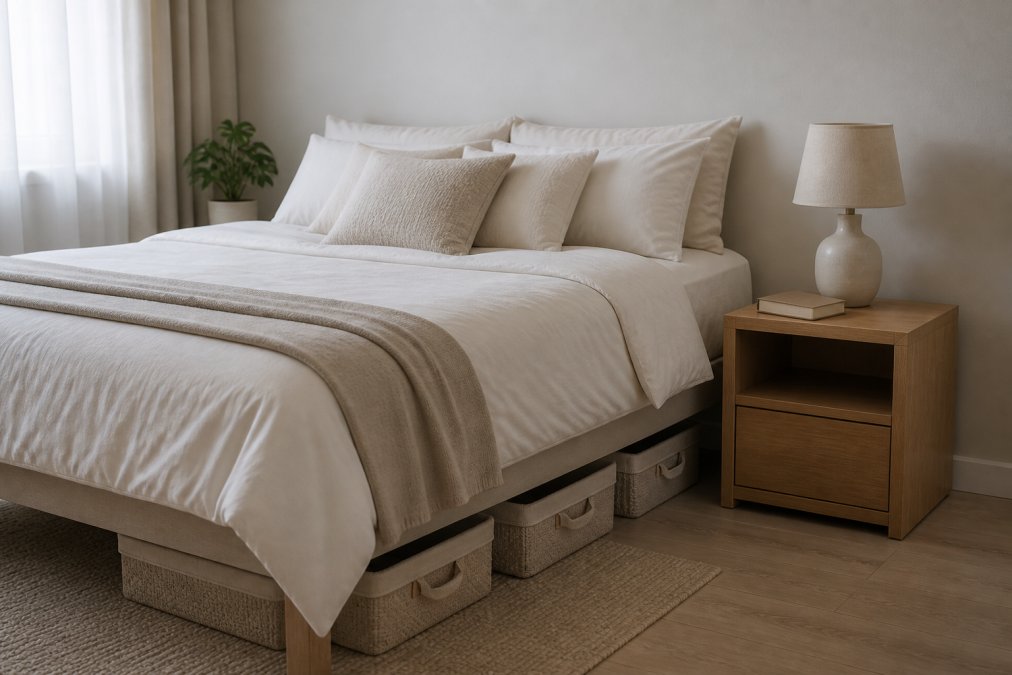
Limit your colour palette to calming, neutral tones. Soft, warm lighting signals to your body that it's time to wind down. Your nightstand should hold only essentials: a lamp, perhaps a book, and a glass of water. Everything else creates unnecessary visual noise.
Invest in storage solutions that work with your lifestyle. If you tend toward clutter, choose systems with built-in containment, drawers rather than open shelves, covered storage rather than exposed baskets. The goal is making it easy to maintain organisation without constant effort.
The consequences of not decluttering your bedroom compound over time. Poor sleep quality, psychological stress, reduced physical health, and accumulated time and financial costs create a difficult cycle. But the inverse is equally true: a decluttered bedroom creates a positive cycle of better sleep, clearer thinking, improved wellbeing, and greater efficiency.
The Family Nest provides storage solutions and organisational tools that make maintaining a decluttered space effortless. Start with one area, apply the 50% rule ruthlessly, and build a maintenance habit that takes just five minutes daily. Your bedroom, and your wellbeing, will transform.
Frequently Asked Questions
Why does a messy bedroom affect sleep quality so much?
Visual clutter triggers your brain to stay in a heightened state of alertness, preventing the mental relaxation needed for sleep. A cluttered bedroom environment increases cortisol levels and makes it harder for your body to switch into sleep mode. The brain perceives clutter as unfinished tasks, keeping you mentally stimulated when you should be winding down. A calm, organised bedroom signals to your nervous system that it's safe to rest, allowing deeper, more restorative sleep.
What are the biggest decluttering mistakes to avoid?
Common mistakes include trying to declutter everything at once, which causes overwhelm and abandonment of the project. Keeping items out of guilt or obligation rather than genuine usefulness adds unnecessary weight to your space. Failing to create proper organisation systems means clutter returns quickly after decluttering. Rushing the process without sorting items into clear categories (keep, donate, discard) leads to poor decisions. The most costly mistake is not establishing daily maintenance habits, so clutter accumulates again within weeks.
How does bedroom clutter impact mental health and focus?
Clutter creates constant visual noise that drains mental energy and reduces your ability to concentrate. Your brain struggles to filter out irrelevant information in a cluttered environment, leaving less cognitive capacity for important tasks and decisions. This mental exhaustion often leads to increased stress, anxiety, and difficulty with executive function. A decluttered bedroom reduces decision fatigue and mental load, improving mood, clarity, and emotional resilience. Creating a peaceful sanctuary through organisation directly supports better mental health outcomes.
What's the fastest way to declutter a bedroom without feeling overwhelmed?
Start with the 50% rule: remove at least half of what's on surfaces and in visible areas. Focus on one category at a time rather than moving room to room, which prevents decision fatigue. Set a timer for 15-30 minute sessions to avoid burnout whilst maintaining momentum. Remove items to donate or discard immediately rather than storing them in your room. If the task feels too large, consider professional organising services that provide hands-on support and structured decluttering packages to accelerate the process.
This article was written using GrandRanker