

Table of Contents
- Is Mid Range Furniture a Good Investment? The Short Answer
- Mid-Range vs Budget Furniture: Where the Money Goes
- Mid-Range vs High-End Furniture: What You Actually Pay For
- Furniture Durability and Lifespan: How Long Should It Last?
- How to Tell If a Sofa Is Good Quality (and Spot It Online)
- Which Furniture Pieces Are Worth Spending More On
- When Mid Range Furniture Is Not Worth It
- How to Plan a Furniture Budget That Balances Cost and Quality
- Frequently Asked Questions
Last Updated: October 11, 2026
Is Mid Range Furniture a Good Investment? The Short Answer
For most homes, mid range furniture is a good investment.
Budget furniture is cheap to buy and quick to replace. Mid range furniture sits in the middle.
The catch? Mid range only pays off when you choose well. A poorly made mid range sofa is no better than a cheap one.
Here is the honest answer: mid range furniture is worth it for pieces you use daily.
Mid-Range vs Budget Furniture: Where the Money Goes
Budget furniture keeps costs down by cutting materials and construction. Mid range furniture spends more on the parts that decide how long a piece lasts.
The main differences:
- Frame: Budget uses particleboard or thin metal. Mid range uses solid wood or hardwood.
- Joinery: Budget relies on staples and glue. Mid range uses screws, dowels and corner blocks.
- Foam: Budget foam flattens within a year or two. Mid range foam holds its shape.
- Fabric: Budget fabric pills and fades. Mid range fabric resists wear.
- Finish: Budget veneer chips easily. Mid range veneer is thicker and better bonded.
None of these show up in a product photo. That is why cheap furniture looks fine online and disappoints in person.
Mid-Range vs High-End Furniture: What You Actually Pay For
Most advice tells you to "spend more for quality" without defining the tiers. That is unhelpful when you are standing in a showroom. So let us define them, then compare all three side by side.
A working definition for the local market:
These bands shift with retailer, style and material, so treat them as a starting frame rather than a fixed rule.
The Three Tiers Compared
| Factor | Budget | Mid Range | Premium |
|---|---|---|---|
| Frame | Particleboard, thin metal | Solid wood or hardwood | Kiln-dried hardwood |
| Joinery | Staples, glue | Screws, dowels, corner blocks | Hand-cut joints, mortise and tenon |
| Foam | Low density, flattens fast | Medium to high density | High density, sometimes wrapped |
| Upholstery | Thin, pills and fades | Durable weave or split leather | Top-grain leather, performance fabric |
| Warranty | 1 to 2 years | 3 to 10 years | 10 years or more |
| Typical lifespan | 2 to 4 years | 7 to 10 years | 15 years or more |
What the Extra Money Actually Buys
Moving from budget to mid range buys you the parts that decide how long a piece lasts: the frame, the joinery, the foam and the fabric. That is where the cost-per-year maths starts to work in your favour.
Moving from mid range to premium buys you craftsmanship, rare materials and a name. It rarely buys three times the lifespan. A premium sofa may last 15 years against a mid-range sofa's 10, but it often costs three to four times as much.
Who Should Pay for Premium
Premium makes sense if you want a specific maker, a specific look, or a piece you intend to pass down. It also makes sense if you have a hard-to-fit space and need something made to measure, where the labour cost is unavoidable.
Everyone else can stop at mid range and put the difference into a better mattress, a savings buffer, or the next room.
Furniture Durability and Lifespan: How Long Should It Last?
A well-made mid range sofa should last around 7 to 10 years with normal use. Budget sofas often need replacing in 2 to 4 years. High-end pieces can last 15 years or more.
Lifespan depends on four things:
- Frame construction and joinery quality
- Cushion density and foam type
- Upholstery durability
- How you use and care for it
A sofa in a busy family room wears faster than one in a spare room. A dining table used daily takes more punishment than a side table.
The Cost-Per-Year Calculation
Cost per year is the real test of any furniture purchase. Divide the purchase price by the years you expect it to last.
A cheap sofa that costs $500 and lasts 3 years costs about $167 per year. A mid range sofa that costs $1,500 and lasts 10 years costs about $150 per year.
Run this sum before you buy:
| Piece | Purchase Price | Expected Lifespan | Cost Per Year |
|---|---|---|---|
| Budget sofa | $500 | 3 years | ~$167 |
| Mid range sofa | $1,500 | 10 years | ~$150 |
| High-end sofa | $4,500 | 15 years | ~$300 |
Prices vary by retailer and style, so use your own quotes. The point is the method, not the exact figures.
How to Tell If a Sofa Is Good Quality (and Spot It Online)
A good sofa has a solid wood frame, strong joinery, dense foam and tight upholstery. You can check most of this in a showroom, and some of it online. The trick is knowing what numbers and materials to look for, not just what to feel.
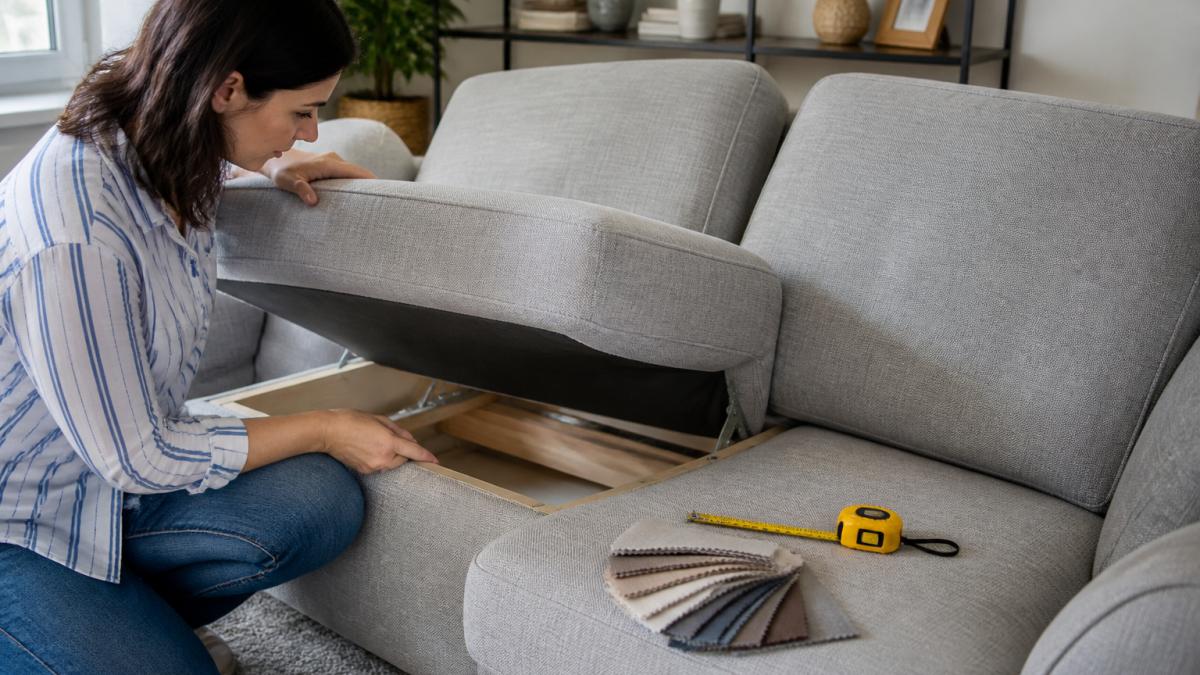
What to Check in a Showroom
- Lift one end. A heavy sofa usually means a solid frame. Particleboard feels light for its size.
- Press the seat cushion. It should spring back within a second or two, not stay flat. Ask for the foam density if the retailer knows it; higher density holds shape longer.
- Check the frame under the cushions. Look for staples, bare particleboard or gaps. You want screws, dowels or corner blocks.
- Rub the fabric. If fibres come away, it will pill at home. Ask what the fabric is rated for and whether it has been treated for stain resistance.
- Sit for five minutes. Comfort shows up after a few minutes, not a few seconds. Check the seat depth and back height against how you actually sit.
What to Look For When Buying Online
- Read the materials list, not the marketing copy. Look for "solid wood frame" or "hardwood frame" in the specs.
- Check the warranty length. Longer usually means better build, but read what it actually covers.
- Read reviews that mention wear after six months or more, not just delivery speed.
- Check the return policy before you order, including who pays return freight.
- Look for replacement parts: covers, cushions and legs. A sofa you can repair is a sofa you keep.
Price Bands by Category
Use these as a rough frame when you are comparing quotes. They move with retailer, style and material.
| Piece | Budget | Mid Range | Premium |
|---|---|---|---|
| Two-seat sofa | Under $600 | $1,200 to $3,000 | $4,000 and up |
| Bed frame | Under $400 | $800 to $2,000 | $2,500 and up |
| Dining table | Under $300 | $700 to $2,000 | $2,500 and up |
| Storage unit | Under $150 | $300 to $800 | $1,000 and up |
Repairability and Resale
A piece you can repair is a piece you keep. Check whether the retailer sells replacement covers, cushions and legs. A sofa with removable, washable covers will outlast one with fixed upholstery, because you can deal with spills before they set.
Resale is weaker than repairability. Most mid-range furniture loses value quickly once it leaves the showroom, and bulky items are hard to sell second-hand. Treat resale as a small bonus, not a reason to buy.
Which Furniture Pieces Are Worth Spending More On
Spend more on pieces you touch every day. Save on pieces that sit in the background.
Here is our order of priority:
- Sofa or couch. Used daily, takes heavy wear.
- Bed and mattress. Affects sleep and back health.
- Dining table. Used daily, takes scratches and spills.
- Office chair. Long hours mean comfort matters.
- Storage and shelving. Cheap units sag and wobble.
Pieces worth saving on:
- Side tables and occasional chairs
- Decor and accent pieces
- Guest room furniture
- Seasonal items
The rule is simple. The more you use it, the more mid range pays off.
When Mid Range Furniture Is Not Worth It
Mid range furniture is not always the right call. Skip it in these cases.
- You are renting short term. Cheap, light pieces are easier to move.
- The room is temporary. A nursery or spare room may not need a ten-year sofa.
- You change styles often. If you redecorate every two years, mid range will not pay back.
- The piece gets little use. A guest bed does not need premium foam.
- Space is tight. A cheap piece that fits beats a good piece that does not.
How to Plan a Furniture Budget That Balances Cost and Quality
Start with the pieces you use most, then work down.
A simple plan:
- List every piece you need.
- Mark each one as daily, weekly or rare use.
- Set a higher budget for daily-use pieces.
- Set a lower budget for rare-use pieces.
- Add a small buffer for delivery and assembly.
| Use Level | Examples | Where to Spend |
|---|---|---|
| Daily | Sofa, bed, dining table | Mid range or above |
| Weekly | Office chair, storage | Mid range |
| Rare | Guest bed, decor | Budget is fine |
A common mistake is spending evenly across every piece.
At The Family Nest, we focus on pieces that are easy to assemble and easy to move.
Choosing furniture is really a question of time. Cheap pieces cost less today and more later.
If you want furniture that is built to last without the high-end price, The Family Nest can help.
Frequently Asked Questions
Is mid range furniture worth the money?
For most households, yes. Mid range furniture typically uses solid wood or quality engineered wood frames, better joinery and denser cushioning than budget pieces, so it holds its shape through daily use and needs replacing less often. The value comes down to cost per year rather than purchase price alone. A mid range sofa that lasts ten years usually works out cheaper annually than a budget sofa replaced every three. Check the warranty, frame material and return policy before buying to confirm the quality matches the price.
How long should a mid range sofa last?
A well-made mid range sofa should last around seven to ten years with normal daily use, compared with roughly three to five years for a cheap sofa and fifteen or more for premium. The biggest factors are frame construction, cushion density and fabric durability. Rotating and plumping cushions, vacuuming upholstery regularly and keeping the sofa out of direct sunlight will push it toward the upper end of that range. If the frame is solid wood with corner blocks and the cushions keep their shape after a year, you are on track.
Is it better to buy cheap furniture or invest in quality?
It depends on the piece and how long you plan to keep it. For items you use daily, such as a sofa, bed or dining table, mid range furniture is usually the better investment because it survives moving, wear and tear, and everyday use without sagging or wobbling. For temporary or low-use items, a cheaper option can make sense. Compare the cost per year and the replacement frequency rather than the sticker price, and lean toward quality on anything you sit, sleep or eat on.
Which furniture pieces are worth spending more on?
Prioritise the pieces you touch every day: the sofa, mattress and bed frame, dining table and chairs, and your main storage. These take the most wear, so better materials and joinery pay off fastest. A quality sofa or bed frame also holds resale value better than budget equivalents. For decorative or occasional pieces, mid range or budget options are fine. A simple rule is to spend more where you spend time, and less on items that are mostly visual.