

Table of Contents
- What Makes West Elm Style Small Dining Tables Different
- Sizing Your Small Dining Table: Dimensions That Actually Work
- Table Shape: Round, Square, or Rectangular for Compact Spaces
- Small Apartment Dining Table Ideas: Design and Material Choices
- How to Style a Small Dining Area: Lighting and Layout Tips
- Extendable vs. Fixed Tables: Flexibility Without Clutter
- Assembly, Returns, and Real-World Durability
- Frequently Asked Questions
Last Updated: September 30, 2026
What Makes West Elm Style Small Dining Tables Different
West Elm style small dining tables blend minimalist aesthetics with functional design, prioritising clean lines and sustainable materials. The Family Nest offers a curated selection of stylish and practical home essentials for compact living spaces, proving smaller doesn't mean compromising on style or quality.
The defining characteristic is restraint. West Elm style tables embrace sculptural simplicity, a pedestal base or sleek four-leg frame becomes the statement. FSC-certified wood, marble tops, and sustainable finishes signal that aesthetic minimalism pairs with environmental responsibility.
These aren't scaled-down versions of full-size tables, they're designed from the ground up for small spaces, so every dimension serves a purpose: height, depth, and width work together to maximise usable floor space whilst maintaining ergonomic comfort.
For renters and young professionals moving frequently, pieces built to last move across multiple apartments without falling apart. The Family Nest offers free returns and easy installation with provided guides, removing the friction of buying furniture online.
Sizing Your Small Dining Table: Dimensions That Actually Work
Getting dimensions right is critical in compact spaces. A table that's too large dominates the room and blocks traffic flow; one too small feels cramped and defeats the purpose of having a dining area.
The sweet spot for a small dining table typically falls between 90-120 centimetres in length and 60-75 centimetres in depth. These dimensions comfortably seat two to four people whilst leaving enough clearance around the table for chairs to pull out and people to move past without squeezing.
The Traffic Flow Formula
Here's the practical rule most interior designers use: measure your space first, then subtract 120 centimetres from the length and 90 centimetres from the width. That remaining space is your buffer for movement and circulation. If you're left with less than 60 centimetres on any side, go smaller.
When a chair is pulled out, it extends roughly 45-50 centimetres from the table edge. Add the person's depth (roughly 30 centimetres), and you need a minimum of 75-80 centimetres of clear space behind each seat. For walkways adjacent to the table, maintain at least 90 centimetres of passage width so two people can pass without turning sideways.
Example: If your dining nook is 2.4 metres long and 2 metres wide, and you place a 120-centimetre table along the long wall, you have roughly 1.2 metres of depth remaining. Subtract 80 centimetres for chair push-back, and you're left with 40 centimetres, too tight. A 90-centimetre table leaves 1.5 metres, which gives you 70 centimetres of walking space after seating, still marginal. A 75-centimetre table is more realistic for this space, or position it away from the wall to allow circulation on both sides.
Height and Ergonomic Comfort
Standard dining tables sit at 75-76 centimetres, paired with chairs roughly 40-45 centimetres high. This 30-centimetre gap is where comfort happens; mismatched height throws off the entire experience.
For tables that double as workspace, prioritise the standard dining height of 75-76 centimetres; you can always add a desk pad or laptop stand for occasional work.
Shape and Visual Footprint
A round table 90 centimetres in diameter occupies less floor space than a rectangular 120-centimetre option and improves sightlines, making the space feel larger. If your space is narrower than 2.5 metres, a square 75-90 centimetre table or narrow rectangular 100 × 60 centimetre option works better, since you can't walk all the way around a round table.
Table Shape: Round, Square, or Rectangular for Compact Spaces
Round Tables and Visual Clearance
A round dining table is the most efficient shape for small spaces, no protruding corners to navigate, and the circular form creates an illusion of openness.
Round tables work best where you can walk all the way around them. The ideal footprint is 90 centimetres in diameter, seating four comfortably in roughly 0.64 square metres.
The trade-off: round tables offer less surface area than rectangular ones. If you regularly entertain or need workspace, this limitation becomes apparent quickly.
Square and Rectangular Options
A 75-90 centimetre square seats four and feels less cramped than a round equivalent, with linear surface along the edges. They're also easier to position against walls when needed.
A 120-centimetre by 60-centimetre rectangular table seats four to six and fits neatly along one wall, but corners become obstacles and the table can feel like it's dividing the room.
For small apartments, choose the shape based on how you actually use the space. If dining is your primary activity, rectangular works. If the table also functions as a desk, workspace, or informal gathering spot, round or square feels less intrusive.
Small Apartment Dining Table Ideas: Design and Material Choices
Pedestal Base vs. Four-Leg Designs
A pedestal base creates the illusion of more floor space, your legs aren't blocked by table legs, and the footprint visually shrinks. This matters in tight quarters where every centimetre of open floor impacts how the room feels.
Four-leg tables offer better stability and durability for daily wear, but the trade-off is visual weight, four legs divide the space, making a small room feel busier.
For renters, pedestal bases are easier to move because the base is self-contained; four-leg tables often require frame disassembly.
Surface Materials: Wood, Marble, and Sustainable Options
FSC-certified wood is the most versatile choice, warm, durable, and pairs with any aesthetic. Solid wood holds up to regular use, with scratches developing character. Lighter finishes (oak, ash, pine) feel less heavy than dark stains.
Marble tops signal luxury but stain easily, require sealing, and scratch under normal use. In a small apartment where the table serves as daily workspace and dining surface, marble demands more care than most people want to invest.
Sustainable alternatives, reclaimed wood, bamboo, or engineered surfaces from certified sources, align with the West Elm aesthetic and are typically lighter than solid hardwoods, making the table easier to move.
For durability in high-traffic small spaces, consider a sealed wood surface or a composite top. These handle spills, heat, and daily wear without requiring special maintenance.
How to Style a Small Dining Area: Lighting and Layout Tips
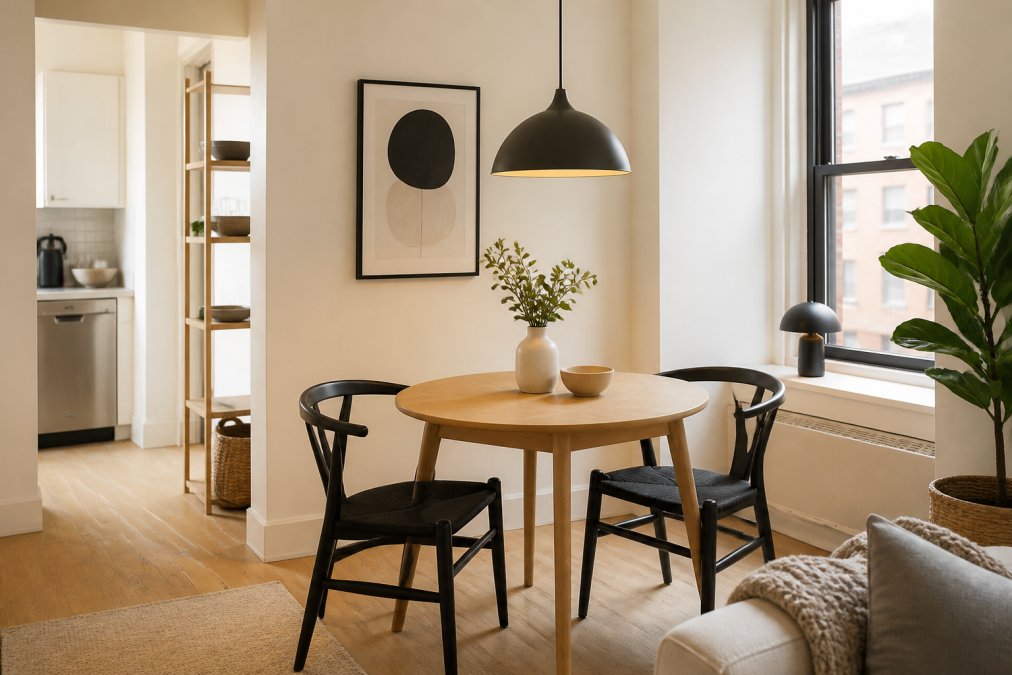
A single pendant light suspended 60-75 centimetres above the table creates focus and warmth, pooling light on the surface and making the space feel intimate rather than squeezed.
Extendable vs. Fixed Tables: Flexibility Without Clutter
An extendable small dining table offers practical flexibility, many West Elm style options expand from 90 centimetres to 120-150 centimetres when needed. The advantage is accommodating guests without a permanently oversized table. The disadvantage is mechanical complexity: leaves can warp, slides can jam, and moving parts wear out over time.
Assembly, Returns, and Real-World Durability
Online furniture shopping carries real risks. Pieces arrive damaged, assembly instructions confuse, or the table doesn't fit your space the way you imagined. The Family Nest addresses these concerns directly: free shipping, free returns within 30 days, and easy installation with provided guides.
Assembly Complexity and Time Investment
Assembly complexity varies by design. A pedestal table with a single central support typically requires 30-45 minutes and basic tools (screwdriver, wrench). Four-leg designs with aprons and stretchers can take 60-90 minutes. Before purchasing, check the assembly guide; if it requires more than basic skills or specialised tools, factor in the cost of professional assembly.
Real-World Durability: What Actually Lasts
Solid wood tables (oak, ash, walnut): With regular use (daily dining, occasional desk work), expect 7-10 years before the finish shows significant wear. Scratches and marks develop character. The wood itself remains structurally sound much longer, 15+ years is common. Refinishing costs £150-400 depending on size and finish complexity.
Multi-Functional Durability: Dining Plus Workspace
Small-space tables that double as desks face additional stress. A laptop, papers, and daily use create more wear than dining alone. The surface gets more scratches from pens, mugs, and keyboard edges. The base experiences more vibration from typing and movement.
If your table will serve both functions, prioritise:
- Sealed or composite surfaces over raw wood (easier to clean and more forgiving of spills from coffee and water bottles)
- Sturdy four-leg bases over pedestals (pedestals can develop wobble from the side-to-side movement of typing; four legs distribute this stress better)
- Thicker tabletops (at least 2.5 centimetres solid wood or equivalent engineered thickness) to resist sagging under the concentrated weight of a laptop and monitor arm
Testing and the Return Window
The Family Nest's 30-day return policy gives you time to test fit, usability, and durability concerns. If the table doesn't work spatially, functionally, or if assembly reveals quality issues (loose joints, warped top, missing hardware), you can return it without penalty. This removes the risk that usually comes with buying furniture without seeing it in person.
Frequently Asked Questions
What dimensions should a small dining table have to fit a compact apartment?
For studio and one-bedroom apartments, aim for tables no wider than 900-1000 mm. A rectangular table measuring 1200 mm long by 750 mm wide seats 4 comfortably without dominating the room. Round tables 900 mm in diameter work well for 2-3 people and create better sightlines in tight spaces. Measure your dining area's length and width, then subtract 600 mm on each side for walking clearance and chair pullout space.
Are round or square small dining tables better for small spaces?
Round tables maximise perceived space because they eliminate sharp corners and improve traffic flow. Square tables are more efficient for seating capacity relative to footprint. Both work well in small apartments; choose round if visual openness matters more, and square if you need to seat more people occasionally. A 900 mm round table and a 900 mm square table occupy similar floor space but create different atmospheres.
What makes West Elm style small dining tables work in compact apartments?
Minimalist aesthetics, clean lines, and functional design are key for compact apartments. Designs that prioritise proportions and offer visual lightness can make small dining tables feel like deliberate choices, not compromises.
Should I choose an extendable or fixed small dining table for a rental apartment?
Extendable tables offer flexibility for occasional entertaining without permanently consuming space. Fixed tables are simpler to assemble and move when you relocate. Consider how often you host guests: if rarely, a fixed table keeps things minimal. If regularly, an extendable option gives you breathing room. For renters, prioritise tables with straightforward assembly and no permanent installation requirements, making future moves painless.