

Table of Contents
- Start With a Layout Audit, Not a Shopping Spree
- Space-Saving Furniture for Small Apartments That Earns Its Footprint
- Vertical Storage Solutions: The Space You Already Own
- Small Apartment Storage Hacks That Cost Almost Nothing
- Declutter First: What Actually Frees Up Floor Space
- Lighting and Layout Tricks That Make a Small Room Feel Bigger
- Renter-Friendly Ways to Maximize Floor Space in Small Apartments
- Frequently Asked Questions
Last Updated: September 16, 2026
Start With a Layout Audit, Not a Shopping Spree
Before buying a single shelf, measure what you already have. Learning how to maximize floor space in small apartments starts with a walkthrough, not a wishlist, because most apartments have more usable room than their occupants realise.
The audit takes about 20 minutes. Grab a tape measure and note four things per room: clear floor area, wall height, door swing zones, and awkward corners wider than 40 centimetres, where vertical storage and slimline units earn their keep.
A common mistake is measuring furniture against the longest wall and ignoring circulation. Keep at least 60 centimetres of walking clearance between pieces; below that, a room feels cramped.
Space-Saving Furniture for Small Apartments That Earns Its Footprint
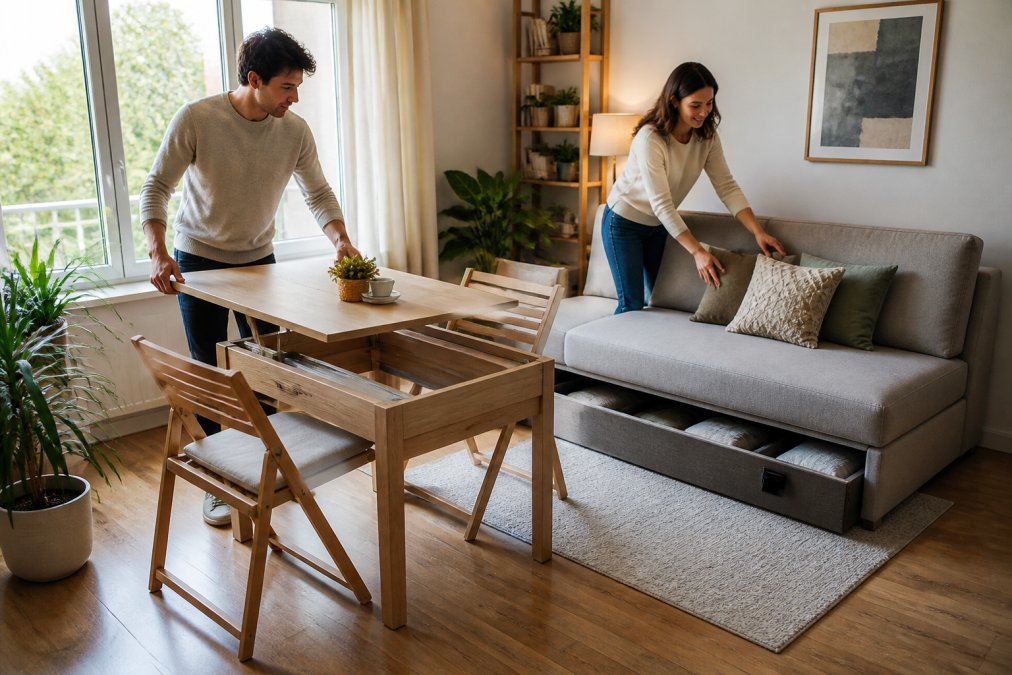
Space-saving furniture for small apartments is any piece that performs two or more jobs, or that folds, nests or stacks when not in use. A single-purpose piece occupying permanent floor space has to justify itself.
Multi-Functional Pieces That Do Two Jobs
An ottoman that opens into bedding. A coffee table with a lift-up lid. A dining table that seats two but extends to six. Each replaces two separate items: fewer objects, more floor space.
Prioritise pieces you'll actually use daily. A fold-out guest bed sounds clever until it lives permanently unfolded.
Modular and Slimline Options for Awkward Rooms
Modular furniture lets you rearrange rather than replace. Slimline sofas, narrow console tables and stackable stools fit corridors and studio nooks where standard sizes won't. Measure depth, not just width, depth steals your walking room.
Vertical Storage Solutions: The Space You Already Own
Vertical storage solutions use wall height instead of floor area, the single biggest lever in a small apartment. A wall 2.4 metres high holds roughly three times the storage of the floor strip beneath it.
Start with the tallest items you own: brooms, ironing boards, vacuum cleaners. Mounting these frees the floor entirely. Then work downward with shelves, hooks and stackable boxes.
Wall-Mounted Shelving and Units Without Losing Your Bond
Renter-friendly wall storage avoids permanent damage. Tension poles, over-door hooks, adhesive strips rated for the weight, and freestanding ladder shelves all add capacity without drilling.
Small Apartment Storage Hacks That Cost Almost Nothing
Small apartment storage hacks work because they exploit gaps you already have. Under a bed, behind a door, on top of a wardrobe and inside a suitcase all count as wasted storage capacity.
Try these first, before spending anything:
- Slide shallow lidded boxes under the bed for out-of-season clothing
- Hang a shoe organiser over the inside of a cupboard door
- Use the top of wardrobes for suitcases and spare bedding
- Add stackable crates inside deep cupboards to create two levels
- Store cleaning supplies in a slim caddy behind the bathroom door
Under-Bed Storage and Hidden Storage Ideas
Under-bed storage is the highest-value hidden zone in most apartments. A typical bed frame offers 20 to 30 centimetres of clearance, enough for flat boxes, spare linen and off-season gear. Vacuum-sealed bags cut bulky items down further. If your bed sits low, bed risers add height cheaply; just check the frame's stability first.
Declutter First: What Actually Frees Up Floor Space
Decluttering frees more floor space than any purchase, because every object you remove stops consuming room permanently. Storage containers don't create space; they only reorganise what's already there.
The Behavioural Side of Clutter in Small Spaces
A common pattern among renters is what organisers call the "deferral pile": items with no assigned home get stacked on a bench, chair or corner until they become part of the furniture. In a 45-square-metre apartment it eats a measurable share of your clear floor area. Every object needs a designated home; without one it defaults to the nearest horizontal surface, benches, dining tables, the top of a microwave, exactly the surfaces you need clear to make a room feel open.
A practical response is the "one-in, one-out" rule applied at the point of purchase, not disposal. If a new mug, cable or cushion comes in, something comparable leaves the same day.
Room-by-Room Decluttering Order That Actually Sticks
Working in categories rather than rooms often stalls in a small apartment because you can't lay everything out. A room-by-room order holds better:
- Entry and hallway first. These zones set the tone and are usually the smallest, so progress is visible within 20 minutes.
- Kitchen benches and the drawer closest to the bin. Duplicate utensils, expired spices and single-use gadgets are the most common offenders.
- Bathroom cabinet. Expired products and hotel toiletries accumulate faster than any other category.
- Bedroom surfaces and wardrobe floor. This is where the deferral pile usually lives.
- Living room last. By this point you've built the habit and have somewhere to put things.
Ask one question per item: would I replace this if it disappeared tomorrow? If not, it goes. For anything you're unsure about, a dated "maybe" box works better, if you haven't opened it in three months, the answer is decided.
Going Paperless and Digital Decluttering
Paper is the quiet space thief. Manuals, receipts, statements and old documents fill drawers that could hold things you actually use. Scanning documents and switching to digital statements typically clears an entire drawer per household.
Most banks and utilities now deliver statements electronically, and official records can be kept digitally. Check the Australian Taxation Office guidance on record keeping for how long to retain financial documents before shredding the paper originals. As a general rule, keep tax records for the period the ATO specifies, keep warranties for the life of the product, and shred everything else once it's scanned.
Digital clutter matters too.
What to Do With the Things You Remove
Decluttering only frees floor space if the items actually leave.
Lighting and Layout Tricks That Make a Small Room Feel Bigger
Lighting changes how large a room feels, even when the floor plan doesn't.
The Three Lighting Moves That Do Most of the Work
- Wash light up walls with a floor lamp or uplighter. Aim the beam at the wall-ceiling junction rather than into the room.
Layout Rules That Actually Change How Big a Room Feels
Three layout moves deliver most of the effect:
- Group furniture into zones rather than spreading it evenly. A sofa, rug and coffee table arranged as one cluster reads as a single object; the same pieces spread around the room read as three obstacles.
- Use a low, open bookshelf or a slim console as a room divider instead of a solid screen. Open shelving lets sightlines pass through, so the room reads as one larger space rather than two small ones. A solid divider does the opposite.
- Keep at least 60 centimetres of walking clearance between furniture pieces. Below that, a room stops feeling compact and starts feeling cramped, regardless of how well lit it is.
Renter-Friendly Lighting That Doesn't Need an Electrician
Renter-Friendly Ways to Maximize Floor Space in Small Apartments
| Approach | Effort | Cost | Moves With You |
|---|---|---|---|
| Tension poles and over-door racks | Low | Low | Yes |
| Freestanding modular shelving | Low | Medium | Yes |
| Adhesive hooks and strips | Low | Low | Partly |
| Drilled wall shelves | Medium | Medium | No |
| Built-in cabinetry | High | High | No |
Frequently Asked Questions
What are the best space-saving furniture pieces for small apartments?
Look for pieces that do more than one job: an ottoman bed with under-bed storage, a coffee table that lifts into a desk, a slim sofa with a hidden compartment, or a wall-mounted drop-leaf table. Measure your floor plan first so each item fits without blocking walkways. Modular and multi-functional furniture works best because it adapts as your needs change, and it is easier to move when you relocate.
How can I create more storage in a rental without drilling holes?
Use tension rods inside cupboards, over-the-door hooks, freestanding shelving units, stackable boxes and adhesive strips rated for the weight you need. Vertical storage solutions such as tall bookcases and over-fridge racks use height instead of floor space. Always check your lease and choose removable products so you can restore the walls when you leave and keep your bond intact.
What are the best ways to make a small room feel bigger?
Keep the floor visible, choose furniture with legs so light passes underneath, use a consistent colour palette, and add mirrors to bounce light around. Layer lighting with floor lamps and wall lights instead of relying on one ceiling fixture. Reducing visual clutter does more for a small room than any single purchase, because every surface you clear reads as extra space.
How do I organise a studio apartment effectively?
Divide the room into functional zones: a sleeping area, a work corner, a dining spot and a lounge. Use a room divider, a rug or a shelving unit to mark each zone without building walls. Choose furniture that doubles up, keep daily items within arm's reach, and store everything else in labelled boxes. A clear floor plan makes a studio feel calmer and larger.