

Table of Contents
- Space-Saving Dining Tables vs Folding Tables: Quick Comparison
- Space-Saving Dining Tables: What They Are and How They Work
- Folding Tables: Maximising Floor Space in Compact Living
- Space Saving Furniture Pros and Cons: Which Type Wins
- Best Dining Tables for Small Apartments: Choosing Your Table Shape
- Compact Dining Table Dimensions: How to Measure Your Space
- Assembly, Installation and Long-Term Durability
- Making Your Choice: Which Table Suits Your Kitchen Layout
Last Updated: August 16, 2026
Space-Saving Dining Tables vs Folding Tables: Quick Comparison
When your kitchen barely fits a single person, the furniture you choose determines whether you eat comfortably or squeeze past the table to reach the fridge. Space-saving dining tables compress through mechanisms like drop-leaves and pulleys, staying in place as permanent fixtures that expand when needed. Folding tables collapse entirely, disappearing against walls or into storage. The distinction matters because it shapes your daily workflow, your room's visual footprint, and how much flexibility you genuinely get.
Space-Saving Dining Tables: What They Are and How They Work
A space-saving dining table is a permanent fixture that adjusts its footprint through built-in mechanisms, typically drop-leaves, gatelegs, or pulleys. The real advantage is psychological: you don't have to plan ahead. Your table is always there. When someone texts that they're coming for dinner, you simply pull a leaf or adjust the mechanism.
Drop-Leaf and Gateleg Mechanisms
Drop-leaf tables have hinged leaves on the sides that fold down when not in use, reducing the table's width. Gateleg tables use swing-out supports (the "gates") that hold extended leaves in place, creating a more stable expanded surface.
The IKEA NORDEN Gateleg table exemplifies this design. It seats 2-4 people depending on whether the leaves are raised or lowered. When folded, it occupies roughly the footprint of a small console table. What makes gateleg tables particularly useful for compact living is the integrated storage, the NORDEN includes six drawers for cutlery, napkins, and kitchen linens, eliminating a separate storage piece you'd otherwise need.
Drop-leaf tables work best when you're willing to leave leaves down most of the time. Gateleg tables suit homes where you regularly need full capacity but also need the compact footprint for daily life.
Extendable Tables with Pulleys
Extendable tables use a pulley or slider system to stretch the tabletop, adding length without adding leaves. The Leona Collapsible Wooden Dining Table with Pulleys expands from 37 centimetres to 157 centimetres, a dramatic range that transforms it from a narrow console into a proper dining table.
The advantage over drop-leaf tables is that there are no loose leaves to store or manage. The disadvantage is weight: solid wood frames required for stability make these tables heavier and harder to move if you relocate. Pulley systems also tend to cost more than simple drop-leaf mechanisms, reflecting a premium product aimed at people prioritising flexibility over affordability.
Folding Tables: Maximising Floor Space in Compact Living
Folding tables reclaim your entire dining footprint when not in use. They're the nuclear option for space optimisation, your kitchen floor becomes uncluttered and visually larger the moment you fold the table away. This approach suits studio apartments, very small kitchens, and homes where dining happens only occasionally.
Wall-Mounted Folding Tables
Wall-mounted folding tables attach permanently to the wall and fold flat when not in use. The VIKUS Kitchen Wall-Mounted Folding Table is a 60-by-40-centimetre wooden surface that supports up to 20 kilograms and folds to just 1.4 centimetres thick.
When folded, it's invisible. When you need to eat or work, you unfold it and have a functional dining surface. Installation requires wall anchors and a stud finder if your walls are drywall. The real limitation is that wall-mounted tables work only for very small spaces. A 60-by-40-centimetre surface is intimate for two people and cramped for three.
Collapsible and Stowable Options
Collapsible tables that aren't wall-mounted offer portability. You set them up when needed and store them flat in a closet or under a bed. True collapsible tables tend to be lighter and cheaper than wall-mounted versions and are ideal for renters because they leave no permanent marks. The downside is that retrieving and storing them frequently gets tedious if you eat at home most evenings.
Space Saving Furniture Pros and Cons: Which Type Wins
The choice between space-saving and folding tables hinges on three factors: how often you dine at home, how much you entertain, and whether you can tolerate setup overhead.
Space-saving tables win when:
- You eat at home regularly and want a permanent dining setup
- You entertain guests weekly or monthly
- You're willing to sacrifice some floor space for convenience
- You want a table that's always ready without effort
Folding tables win when:
- You live in a studio or very small apartment
- You rarely entertain or eat at home
- Maximising open floor space is your priority
- You're willing to set up the table each time you use it
- You're renting and want to leave no permanent marks
Common mistake: assuming a folding table will work for daily dining. Most people who choose folding tables for everyday use find themselves eating at the kitchen counter instead, because retrieving and setting up the table becomes too much friction.
Best Dining Tables for Small Apartments: Choosing Your Table Shape
The shape of your table determines how efficiently it fits your floor plan and how many people it can seat comfortably. Rectangle, round, and semi-circle tables each have different spatial footprints and social dynamics.
Rectangle vs Round: Floor Plan Impact
Rectangular tables seat more people per square metre of floor space. A 120-by-60-centimetre rectangle seats 4-6 people efficiently and fits snugly against a wall, leaving the rest of your kitchen open. Round tables create a more intimate gathering but waste floor space because you can't push them against walls.
For small apartments, rectangle tables are almost always the better choice. The Ronaly Natural Rectangular Extendable Dining Table extends from 75 to 110 centimetres, fitting neatly into a compact kitchen whilst still accommodating guests.
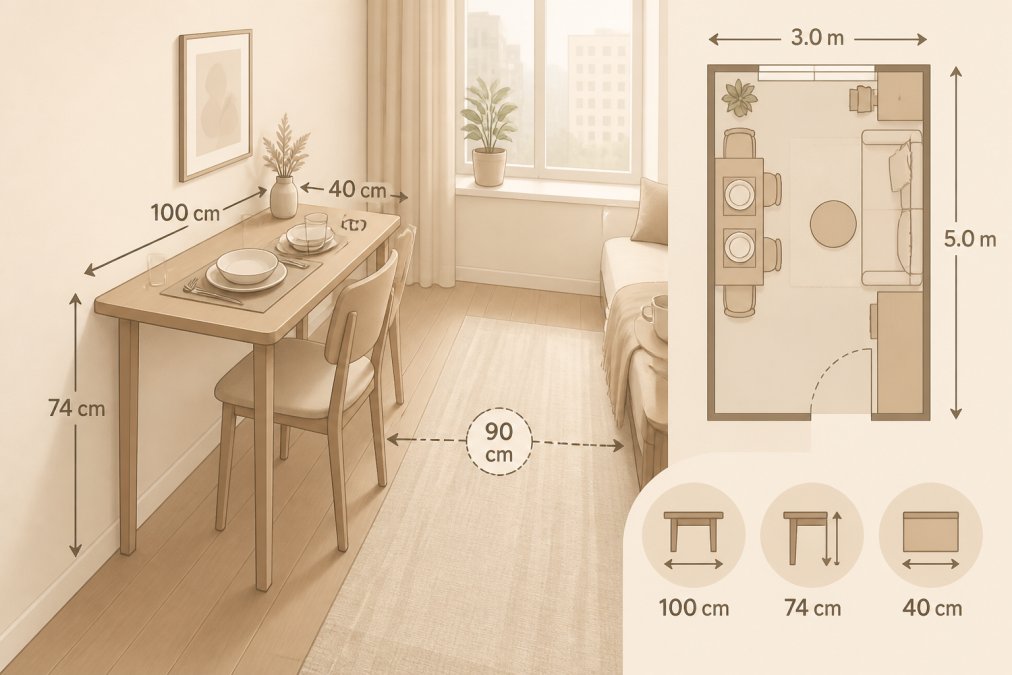
Semi-circular tables offer a compromise, providing the seating efficiency of rectangles with slightly softer lines. For couples or small households, semi-circles work well because they provide adequate seating without the full length of a rectangle.
Stability and Weight Capacity Considerations
A table that wobbles or feels unstable ruins the experience. In small apartments, instability is particularly frustrating because you can't push the table against a wall to stabilise it.
Weight capacity matters more than most people realise. The Ronaly supports 50-90 kilograms depending on how the table is configured, sufficient for everyday dining but not for hosting a dinner party where people lean on the table or place heavy serving dishes. The IKEA NORDEN provides solid performance for its price point, with the gateleg mechanism distributing weight evenly when properly engaged.
Wall-mounted tables like the VIKUS are inherently less stable because they rely entirely on wall anchors. The 20-kilogram limit reflects this constraint.
Compact Dining Table Dimensions: How to Measure Your Space
Before purchasing any table, measure your kitchen accurately. Most people underestimate how much space a table actually requires, not just the table itself, but the space around it for chairs and movement.
Start by measuring the available floor space in your dining area. Subtract 60 centimetres on each side for chair depth and movement. If your kitchen is 200 centimetres wide, subtract 120 centimetres for chairs and circulation, leaving 80 centimetres for the table itself.
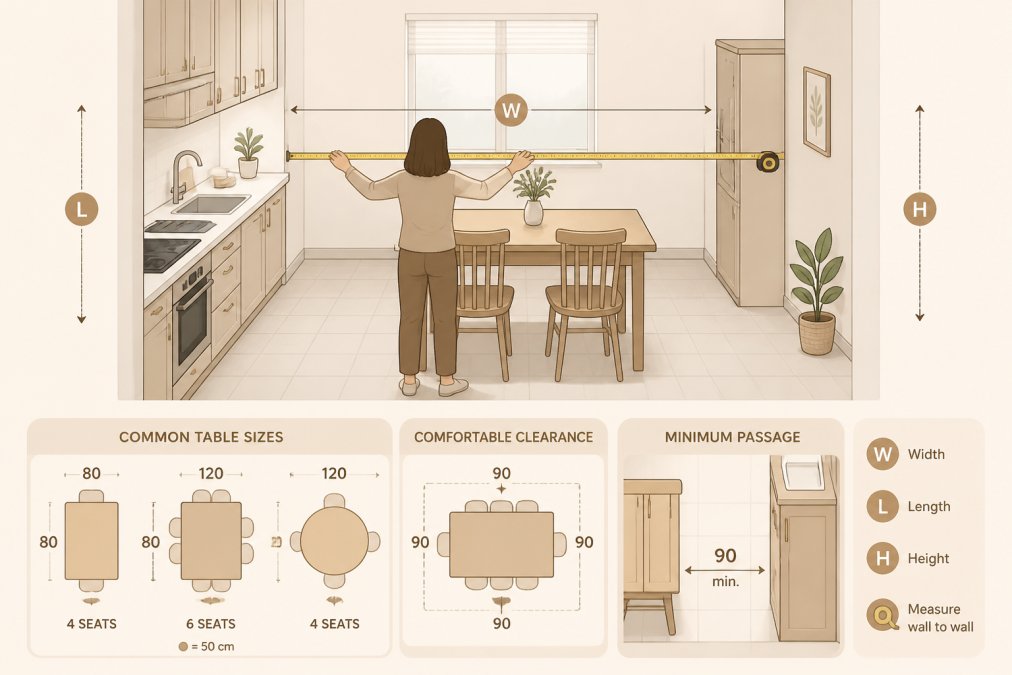
Next, measure the length of your available space. A 120-centimetre table is standard for 4 people. For 2 people, 75-90 centimetres is adequate. For 3 people, aim for 100 centimetres minimum.
Consider sightlines and movement paths. If your table blocks the route from the kitchen to the living room, you'll resent it within weeks. Test the measurement by marking the proposed table footprint on your floor with tape and living with it for a day.
Assembly, Installation and Long-Term Durability
How a table is assembled and how well it holds up over years determines whether it's truly space-saving or just space-consuming frustration.
The IKEA NORDEN requires assembly but includes clear instructions. Most people complete it in 45-60 minutes with basic tools. After three years of daily use, hinges may need occasional tightening, but the table remains solid.
The Ronaly also requires assembly. The particle board construction is lighter than solid wood, making it easier to move but potentially less durable long-term. After 5 years, particle board tables sometimes develop squeaks or slight warping, particularly in humid climates.
Wall-mounted tables like the VIKUS depend entirely on installation quality. If wall anchors are placed in studs, the table lasts indefinitely. If anchored only to drywall, they can sag or fail within 2-3 years.
The Leona Collapsible Wooden Dining Table with Pulleys, constructed from solid wood and plywood, is built for longevity. The trade-off is weight and cost. Buying a table for A$199 that fails after two years costs more per year than investing A$400 in a table that lasts eight years.
Making Your Choice: Which Table Suits Your Kitchen Layout
Your decision comes down to three concrete questions: How often do you eat at home? How frequently do you entertain? How much floor space can you spare?
If you eat at home 5+ nights per week and entertain monthly, a space-saving table like the IKEA NORDEN or Ronaly is worth the floor space it occupies. The convenience of a permanent, always-ready setup outweighs the cost of reduced open space.
If you eat out most nights and entertain rarely, a wall-mounted folding table maximises your usable floor space. Accept that setup takes 30 seconds each time and that the table's weight capacity limits how many people you can host.
If you're between these extremes, eating at home 2-3 nights per week with occasional guests, an extendable table like the Ronaly offers flexibility without requiring wall installation.
Measure your space honestly. Don't optimise for the dinner party you might host once a year. Optimise for the way you actually live. A table that doesn't fit your real habits becomes clutter, and in a small apartment, clutter is the enemy of comfort.
Choosing between space-saving dining tables and folding tables depends on how you actually use your kitchen. Space-saving tables keep dining as a permanent, effortless part of your daily routine. Folding tables reclaim maximum floor space but require setup overhead. The Family Nest curates both types, offering easy installation guides and a 30-day return policy so you can test your choice in your actual space. Browse The Family Nest's compact dining options and find the table that transforms your small kitchen into a functional, welcoming space.
Frequently Asked Questions
What type of table is best for a small kitchen?
The best choice depends on how often you dine and entertain. Space-saving dining tables with drop-leaf or extendable mechanisms work well if you need flexibility for occasional guests. Wall-mounted folding tables maximise floor space if you rarely dine formally. Measure your kitchen first, aim for at least 90 centimetres of clearance around the table for comfortable movement and chair pull-out.
What are the disadvantages of using a foldable dining table?
Folding tables typically have lower weight capacity (often 20 kilograms) and may feel less stable during daily use. Wall-mounted options require permanent installation, which is problematic for renters. Collapsible designs can be heavier and harder to manage alone. They also work best as auxiliary surfaces rather than primary dining furniture for regular family meals. Assembly and storage space for the folded table also matter.
How do I choose a dining table that fits a tight kitchen layout?
Measure your available floor space, accounting for at least 90 centimetres of clearance on all sides for comfortable movement. Consider your table shape: round tables need less floor space than rectangles, but rectangles fit snugly against walls. Assess your actual dining frequency, daily family meals suit space-saving tables with better stability, while occasional entertaining suits folding options. Check weight capacity if you plan to use the table for work or crafting beyond dining.
Are wall-mounted tables better than folding tables for small kitchens?
Wall-mounted tables excel at maximising floor space and work brilliantly in studio apartments or very tight kitchens. However, they require wall installation (problematic for renters), have strict weight limits, and suit auxiliary dining rather than regular family meals. Folding tables offer more flexibility if you move frequently. Space-saving tables with drop-leaf mechanisms provide better stability and weight capacity for daily use, though they occupy more floor space when folded. Your choice depends on permanence, frequency of use, and available wall space.
This article was written using GrandRanker